Basic Information
Scientific classification
- Chinese name: Jadeite
- Scientific name: Actenoides bougainvillei, Moustached kingfisher
- Classification: Climbing birds
- Genus and family: Order Coraciiformes, Family Aldehydeidae, Genus Aldehyde
Vital signs data
- Body length: Approximately 27 centimeters
- Weight: No verification information available.
- Lifespan: No verification data available.
Significant features
It has blue eye markings and whiskers.
Distribution and Habitat
The Solomon Islands (including Bougainville in the north and Guadalcanal in the south) are distributed among islands in the Pacific Ocean.
The bearded kingfisher inhabits the closed forests of Guadalcanal, at altitudes between 900 and 1,100 meters.
Appearance
The Kingfisher is 27 cm long. It is a beautiful and very elusive forest kingfisher. Its body is primarily composed of reddish-brown plumage and deep blue wings, with blue eye stripes and whiskers, a red beak, a white throat, and a pale yellow belly and collar. The rump and tail are deep blue. It is smaller than the dwarf kingfisher. Its beak is thick and long, like a chisel, wider at the base, with a straight apex and a rounded ridge, lacking nasal grooves on either side; the wings are rounded, with the first and seventh primary flight feathers being equal in length or slightly shorter, and the second, third, and fourth feathers nearly equal in length; the primary flight feathers have white spots at the base; the tail is rounded; and the beak is red.
Detailed introduction
The scientific name of the kingfisher is Actenoides bougainvillei, and its foreign name is Moustached kingfisher. It has two subspecies.
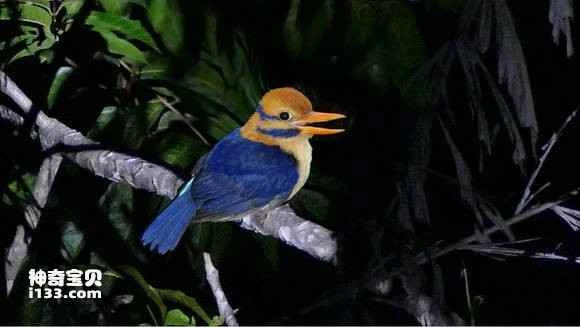
The bearded kingfisher, which lives on Guadalcanal, calls before dawn and after dusk, producing a series of loud, bell-like sounds. Bearded kingfishers in other locations have relatively simpler calls. They nest in burrows in the ground or along riverbanks, and also in forests using hollowed-out tree trunks eroded by whiteflies. Their diet includes insects and small vertebrates, crabs, mollusks, small fish, frogs, worms, and small reptiles.
Listed as Endangered in the IUCN Red List of Threatened Species (ver 3.1, 2008).
Protect wild animals and ban the consumption of wild game.
Maintaining ecological balance is everyone's responsibility!