
Basic Information
Scientific classification
- Chinese name: Brown frog-mouthed owl
- Scientific name: Tawny frogmouth, Tawny frogmouth, Tawny nightingale, Podargus strigoides, Tawny frogmouth
- Classification: Climbing birds
- Family and genus: Order Gaura, Family Gauraidae, Genus Gaura
Vital signs data
- Body length: Approximately 50 centimeters
- Weight: No verification information available.
- Lifespan: No verification data available.
Significant features
Often mistaken for an owl
Distribution and Habitat
It is distributed in Southeast Asia and Oceania.
The brown frogmouth prefers to inhabit open woodlands.
Appearance
The brown frogmouth has a peculiar and distinctive appearance. Its body is yellowish-brown, with yellowish eyes, a large head, a large mouth, and whiskers at the corners of its mouth, resembling a toad's beak, hence its name. The brown frogmouth is about 50 centimeters long, making it relatively large for its family. It has a huge head, large and broad wings with a crest, long legs, broad wings, and long toes. It preys on fish, frogs, and snakes, and lays four eggs. Both males and females are symbiotic, and their plumage is similar.
Detailed introduction
The tawny frogmouth, scientifically known as Podargus strigoides, is often mistaken for an owl due to its appearance and its usual presence in low-light conditions.
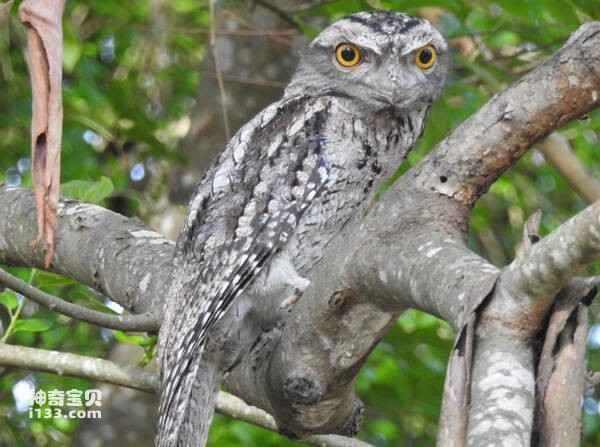
The tawny frogmouth is both solitary and found in groups. During the day, they usually remain motionless in the trees, looking just like pieces of bark, making them difficult to spot. They are most active at dawn and dusk. Their camouflage is so perfect that they might be right in front of us, while we mistake them for part of the tree.

The tawny frogmouth not only lives at night like an owl, but its posture while perched on a branch also closely resembles that of an owl, except this owl has a toad's beak, making it clearly an imposter. The tawny frogmouth has a loud call, and when provoked, it spreads its wings and large beak, adopting an aggressive posture to intimidate its opponent.
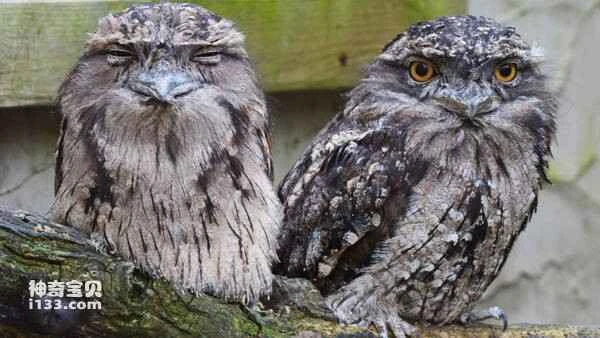
The breeding season for the Tawny Frogmouth is from August to December. They typically nest in trees, creating loose and haphazard nests that require annual maintenance. Females lay 1-5 eggs per clutch, with an incubation period of 28-32 days. Both parents take turns incubating the eggs. During incubation, the male frequently releases "stink bombs," earning them the nickname "aerial skunks." After 25 days of parental care, the chicks leave the nest to begin their independent lives.
Protect wild animals and ban the consumption of wild game.
Maintaining ecological balance is everyone's responsibility!


