Basic Information
Scientific classification
- Chinese name: Common swallow
- Scientific names: Common Swift, European Swift, Brown Swift, Wild Swift, Apus apus, Common Swift, European Swift, Swift, Martinet noir
- Classification: Climbing birds
- Family and Genus: Apotheales, Apodidae, Apothecium
Vital signs data
- Body length: 16-18 cm
- Weight: 29-41g
- Lifespan: No verification data available.
Significant features
The white throat and chest are separated by a dark brown horizontal band.
Distribution and Habitat
Breeding grounds: Afghanistan, Albania, Andorra, Armenia, Austria, Azerbaijan, Belarus, Belgium, Bosnia and Herzegovina, Bulgaria, China, Croatia, Cyprus, Czech Republic, Estonia, Georgia, Gibraltar, Hungary, India, Ireland, Israel, Kazakhstan, Kyrgyzstan, Latvia, Liechtenstein, Lithuania, Luxembourg, Malta, Moldova, Mongolia, Montenegro, Nepal, Netherlands, North Macedonia, Norway, Pakistan, Poland, Portugal, Romania, Russia, Serbia, Slovakia, Slovenia, Spain, Sweden, Switzerland, Tajikistan, Turkey, Turkmenistan, United Kingdom, and Uzbekistan.
Migratory birds: Bahrain, Jordan, Kuwait, Oman, Palestine, Qatar, Saudi Arabia, South Sudan, UAE and Yemen.
Resident birds: Algeria, Angola, Benin, Botswana, Burkina Faso, Burundi, Cameroon, Central African Republic, Chad, Democratic Republic of Congo, Republic of Congo, Honduras, Denmark, Djibouti, Egypt, Equatorial Guinea, Eritrea, Swatini, Ethiopia, Faroe Islands, Finland, France, Gabon, Gambia, Germany, Ghana, Greece, Guinea, Guinea-Bissau, Iran, Iraq, Italy, Kenya, Lebanon, Lesotho, Liberia, Libya, Malawi, Maldives, Mali, Mauritania, Morocco, Mozambique, Namibia, Niger, Nigeria, Rwanda, Senegal, Sierra Leone, South Africa, Sudan, Syria, Tanzania, Togo, Tunisia, Uganda, Ukraine, Western Sahara, Zambia, and Zimbabwe.
Wandering (non-breeding grounds): St. Peter and Miquelon.
Wandering: Cape Verde, Comoros, Hong Kong, Iceland, Saint Helena, Ascension and Tristan da Cunha, Seychelles, Somalia, Svalbard and Jan Mayen, United States.
It inhabits mountainous areas. It mainly inhabits various habitats including forests, plains, deserts, coastlines, and towns. It often dwells in tall ancient buildings, pagodas, temples, rock walls, and crevices in city walls. Its altitude reaches up to 3300 meters.
Appearance
The common swift has a dark brown head and upperparts, with a darker crown and back feathers that are slightly glossy. Its wings are narrow and sickle-shaped, with a slight coppery-green sheen on the outer edges of the primary flight feathers and the surface of the tail. The tail is forked. The chin and throat are greyish-white with fine, pale brown shaft streaks. The breast, belly, and undertail coverts are dark brown, with a narrow greyish-white edge on the belly. The iris is dark brown, the bill is short, broad, and flat, and pure black, while the legs are dark brown.
The juvenile bird has a dirty greyish-white forehead, and its entire body is smoky brown with no luster and narrow greyish-white feather edges. The greyish-white chin and throat extend to the upper chest.
Size measurements: Weight: ♂ 29-40 g, ♀ 31-41 g; Body length: ♂ 168-184 mm, ♀ 169-176 mm; Bill length: ♂ 6-7 mm, ♀ 6-8 mm; Wing length: ♂ 154-177 mm, ♀ 155-175 mm; Tail length: ♂ 73-87 mm, ♀ 76-90 mm; Tarsus length: ♂ 8-11 mm, ♀ 10-12 mm. (Note: ♂ male; ♀ female)
Detailed introduction
The Common Swift (scientific name: *Apus apus*), also known as the European Swift, Swift, or Martinet noir, has two subspecies. It is one of many species described by the Swedish naturalist Carl Linnaeus in 1758 in the tenth edition of his *Systema Naturae*. He introduced the binomial name "Hirundo apus". The current genus "Apus" was established in 1777 by the Italian naturalist Giovanni Antonio Scopoli based on a synonym. The word "apus" means "swift" in Latin. It derives from the Ancient Greek α, a, meaning "without," and πούς, pous, meaning "foot," based on the idea that these birds are a type of swallow without feet. The Central European subspecies that lived during the last Ice Age was described as "Apus apus palapus".
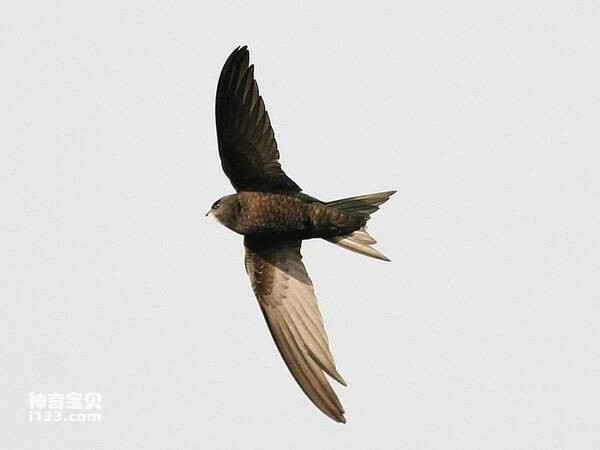
The Common Swift is a seasonal summer visitor. Its wintering grounds are in tropical Africa and northern India. They arrive in spring (April-May) and leave in autumn (September-October). Their wingbeats are relatively slow. During the day, they often fly in flocks, hunting for food, especially at dawn and dusk, on cloudy days, and before rain. They fly rapidly, reaching speeds of up to 110 km/h. They often call while flying, their calls being clear and loud. They primarily feed on insects, especially flying insects, and often hunt for food while in flight.
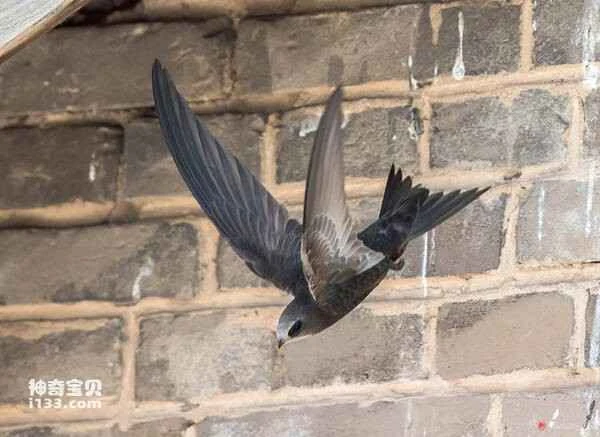
The breeding season for common swifts is from June to July. They often nest and breed in groups. They typically nest in the ceilings, beams, and wall cavities of tall ancient buildings, pagodas, temples, and palaces, as well as in caves in rock walls and city walls, usually at a height of 10-30 meters. The nest is made of a mixture of dry grass stems, leaves, hemp, rags, fibers, paper scraps, and mud, lined with soft materials such as down, feathers, and down feathers. The nest is saucer-shaped, with an outer diameter of 10-13 cm, an inner diameter of 8-9 cm, and a height of 3-6 cm. It can be used for many years. Each clutch contains 2-4 eggs, mostly 3. The eggs are white without spots, measuring 24-26 × 15-17 mm, and are oval in shape. Both parents take turns incubating the eggs, with an incubation period of 21-23 days. The chicks are altricial, and can fly after being fed by their parents for about 30 days.

In 2015, the total population of the Common Swift in Europe was estimated at 19,100,000–32,500,000 pairs, equivalent to 38,200,000–65,000,000 mature individuals. Europe accounts for an average of 40% of the global population, therefore a preliminary estimate of the global population size is 95,500,000–162,500,000 mature individuals, although this estimate requires further verification. Therefore, the total population of this species is placed between 95,000,000 and 164,999,999 mature individuals. The population trend in Europe was estimated to be stable between 1980 and 2013 (EBCC 2015). In China, the population is generally small, only prevalent in localized areas, and requires strict protection.
Listed as Least Concern (LC) in the IUCN Red List of Threatened Species 2016 ver3.1.
It is listed in the "List of Terrestrial Wild Animals of Beneficial or Important Economic and Scientific Research Value under State Protection" issued by the State Forestry Administration of China on August 1, 2000.
Protect wild animals and ban the consumption of wild game.
Maintaining ecological balance is everyone's responsibility!