Basic Information
Scientific classification
- Chinese name: Tooth-billed pigeon
- Scientific name: Didunculus strigirostris, Tooth-billed Pigeon
- Classification: Landfowl
- Family: Columbiformes, Columbidae, Dove family
Vital signs data
- Body length: 32-35 cm
- Weight: About 400g
- Lifespan: No verification data available.
Significant features
The mandible gets its name from the two "teeth" it has.
Distribution and Habitat
It is found only on three small birds in the western Samoan archipelago: Savai'i, Upolu, and Nuutaire.
These unusual pigeons exhibit a strong preference for living in undisturbed primeval forests. They inhabit oak trees (scientific name: Dysoxylum excelsum, a species of tree in the family Meliaceae, genus Dysoxylum), whose seeds may be their only food source.
Appearance
The Toothbill Dove is 32–35 cm long and weighs 400 grams. Its beak is large and strong, with a strongly curved, hooked upper mandible; the lower jaw is protruding with three tooth-shaped notches on either side. The lores and the small area around the eyes are reddish. The forehead and neck have a pale blue or blue-green sheen, and the overall plumage is a beautiful silvery-black. The lower part of the wattles and flight feathers are glossy brown; the greater coverts are greyish-brown; the primary and secondary flight feathers are chestnut; the back and upper tail coverts are blackish-brown. The tail gradually darkens, turning reddish-chestnut. The throat, neck, breast, and ear coverts are black, with a dark green reflection of the grey shading. The abdomen has a slight blackish-green sheen; the sides, thighs, and vent are dark greyish-brown. The tarsi are bare. The iris is dark brown; the beak is yellow or orange with a waxy red base; the legs are dark red.
Males and females are similar. Juveniles do not have a green sheen on their heads, necks and chests. They have black body feathers with brown or brownish-red stripes. The top of the head is colored, the wings are slightly darker, the abdomen is black, and each feather has a rolled edge.
Detailed introduction
Tooth-billed Pigeon (scientific name: Didunculus strigirostris), also known as Tooth-billed Pigeon, has no subspecies.
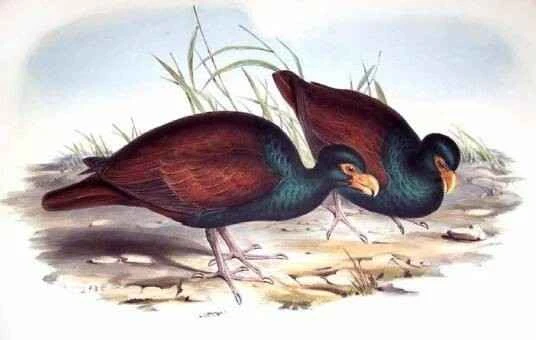
The Toothbill Pigeon lives at altitudes ranging from 300 to 1400 meters. It is shy and difficult to approach. Its call is similar to that of a common pigeon, often emitting a "coo-coo-coo" sound. It is a gregarious bird, typically living in small flocks of 20 or 30 individuals. Due to environmental destruction, its population is endangered, and only smaller flocks, pairs, or even single Toothbill Pigeons can be seen. This is a very cautious pigeon, almost entirely arboreal, spending most of its time hidden in the foliage of tall trees. When it takes flight, its wings generate powerful force, allowing for agile and rapid flight. It will stand at a certain height and call out, slightly lowering its head, seemingly in a gesture of praise.
Much of the breeding habits of the Toothbill Dove is unknown. It was once thought to nest on the ground. In reality, due to fear of predators, the Toothbill Dove nests in trees, sometimes up to 15 meters above the ground. They typically lay two eggs per clutch, with both parents incubating them and taking turns entering the nest in a very regular pattern. The incubation period for the chicks and the duration of the nest are unknown.
In the mid-1980s, the number of Toothbills ranged between 4,800 and 7,200. Following hurricanes in the early 1990s, the population had declined to approximately 2,500. Increased agricultural use and deforestation are the greatest threats to this species, and hunting has also exacerbated the pressure on its endangered status. By 1985, nearly 400 birds were being killed annually. Fortunately, the species has received timely protection, and human photography and disturbance are prohibited. Furthermore, in Samoa, this bird has been chosen as the emblem of the organization "Developing the Conservation of Natural Heritage."
Listed as Endangered (EN) on the IUCN Red List of Threatened Species 2012 ver 3.1.
Protect wild animals and ban the consumption of wild game.
Maintaining ecological balance is everyone's responsibility!