
Basic Information
Scientific classification
- Chinese name: Red-breasted Woodpecker
- Scientific name: Red-breasted Barbet, Megalaima haemacephala, Coppersmith Barbet, Crimson-breasted barbet, Coppersmith
- Classification: Climbing birds
- Family and genus: Entomomorpha, Pterygomorphaceae, Pterygomorpha
Vital signs data
- Body length: 15-16 cm
- Weight: 38-49g
- Lifespan: No verification data available.
Significant features
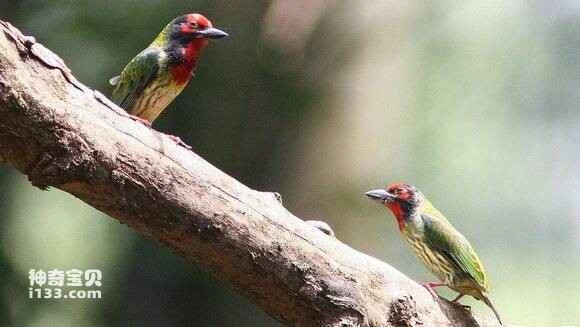
Bright orange-yellow spots are visible above and below the eyes, standing out starkly against the dark head.
Distribution and Habitat
The Red-breasted Barbet is distributed in Yingjiang, Luxi, Shuangjiang, Yongde, Gengma, Lancang, Jinggu, Jingdong, Simao, Xishuangbanna, Yuanjiang and other areas in Yunnan Province within China.
The Red-breasted Barbet is found outside of China in Bangladesh, Bhutan, Cambodia, India, Indonesia, Laos, Malaysia, Myanmar, Nepal, Pakistan, the Philippines, Singapore, and Sri Lanka.
The Red-breasted Barbet mainly inhabits broad-leaved forests and forest edges and farmland areas in low mountains and foothill plains, up to open lowland forests at an altitude of 1,000 meters. It also appears in woodlands, gardens, orchards and urban areas near dwellings.
Appearance
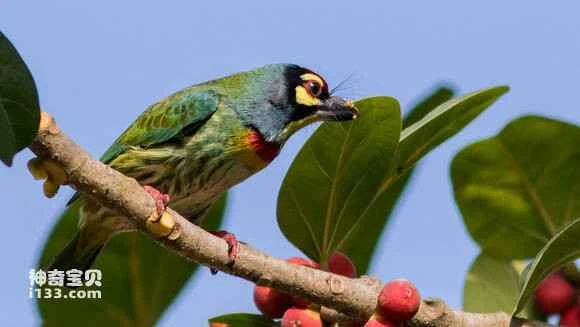
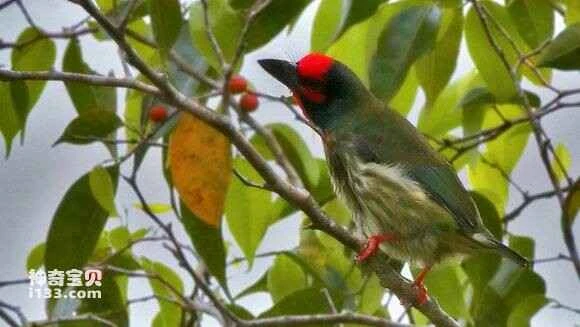
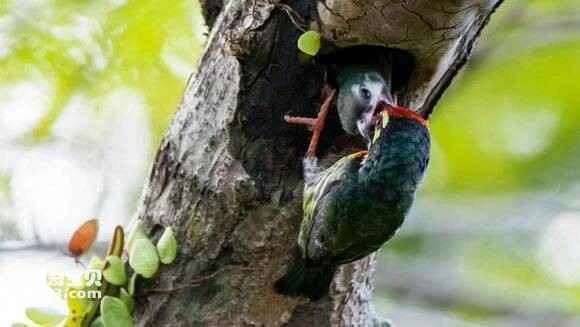
The Red-breasted Woodpecker has a vermilion forehead and front of the barbels, followed by a black horizontal band that connects with the black on the chin and behind the eye; the cheek stripes are also black; there is a bright yellow patch above and below the eye; the back of the head, nape, hindneck, and sides of the neck are dark green or slate green; the back, shoulders, rump, and upper tail coverts are olive green with yellow streaks, especially the rump and upper tail coverts where the yellow is brighter. The wing coverts are the same color as the back, slightly tinged with greyish-blue; the wings are blackish-brown, with a greenish-blue outer surface; the tail is dark green. The chin and throat are bright yellow; the breast has a vermilion crescent-shaped patch, behind which is an orange-yellow crescent-shaped patch. The rest of the underparts are pale yellowish-white with dark green or greyish-green longitudinal stripes. The iris is dark brown; the bare skin around the eyes is vermilion; the bill is black; the tarsi and toes are coral red; and the claws are black.
Size measurements: Weight: ♂ 40-48 g, ♀ 38-49 g; Body length: ♂ 156-168 mm, ♀ 149-164 mm; Bill length: ♂ 17-20 mm, ♀ 17-20 mm; Wing length: ♂ 80-90 mm, ♀ 82-88 mm; Tail length: ♂ 37-40 mm, ♀ 37-41 mm; Tarsus length: ♂ 19-21 mm, ♀ 19-21 mm. (Note: ♂ male; ♀ female)
Detailed introduction
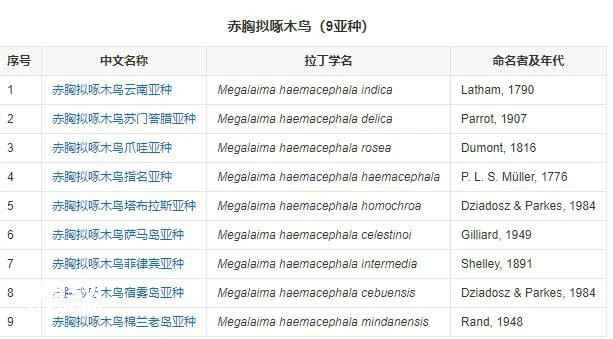
The Red-breasted Barbet, scientifically known as Megalaima haemacephala, also called Coppersmith Barbet, Crimson-breasted barbet, or Coppersmith, has nine subspecies.
The Red-breasted Barbet is a resident bird. Except during the breeding season, it is usually solitary, but sometimes gathers in small flocks in trees with abundant food. It mostly lives and inhabits the canopy. Its flight is powerful and fast. It primarily feeds on plant fruits and seeds, but also eats insects and insect larvae.
Like other barnyard woodpeckers, the Red-breasted Barnyard Woodpecker gathers in groups on bare branches at dawn, calling a resonant, monotonous, metallic "tuk" or "tonk" sound that lasts for several minutes, with a stable frequency of about 110 beats per minute. With each "tonk," the tail flicks forward. Another call is slower and more irregular, involving head nodding but without tail movement.
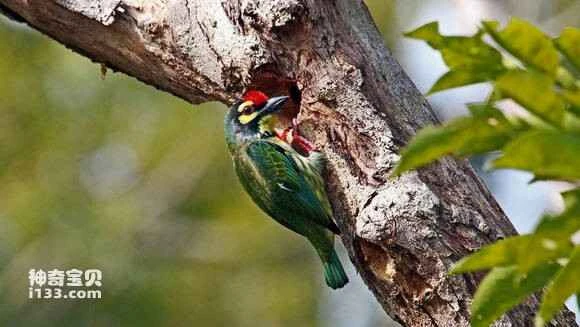
The breeding season for the Red-breasted Barbet is from March to May. They nest in tree cavities. Suitable trees can be chosen for nesting in forests, forest edges, field borders, orchards, towns, and around houses. The parent birds dig the nest cavities themselves, usually with the entrance about 1.5 to 5 meters above the ground. Each clutch contains 2 to 4 eggs. The eggs are white, measuring 23-29 × 17-19 mm, and both parents take turns incubating. The incubation period is 14-16 days; the chicks are altricial.
The Red-breasted Woodpecker has a wide distribution range and does not approach the vulnerable or endangered threshold criteria for species survival (distribution area or fluctuation range less than 20,000 square kilometers, habitat quality, population size, fragmentation of distribution area), and its population trend is stable. Therefore, it is assessed as a species of least concern.
Listed as Least Concern (LC) on the IUCN Red List of Threatened Species 2012 ver 3.1.
Protect wild animals and ban the consumption of wild game.
Maintaining ecological balance is everyone's responsibility!


