
Basic Information
Scientific classification
- Chinese name: White-collar Emerald
- Scientific name: *Todirhamphus chloris*, *Halcyon chloris chloris*, *Collared Kingfisher*
- Classification: Climbing birds
- Genus and species: Order Coraciiformes, Family Kingfisher, Genus Aldebaran
Vital signs data
- Body length: Approximately 24 centimeters
- Weight: No verification information available.
- Lifespan: No verification data available.
Significant features
Distribution and Habitat
Country of origin: American Samoa, Australia, Bangladesh, Brunei Darussalam, Cambodia, Eritrea, Fiji, India, Indonesia, Lao People's Democratic Republic, Malaysia, Federated States of Micronesia, Myanmar, Northern Mariana Islands, Oman, Palau, Papua New Guinea, Philippines, Saudi Arabia, Singapore, Solomon Islands, Thailand, East Timor, Tonga, United Arab Emirates, Vanuatu, and Vietnam.
Wandering: Mainland China, Christmas Island, Hong Kong, Japan, Somalia.
Uncertain: Sudan.
They mainly inhabit coastal or near-water open areas, as well as freshwater channels, reed beds, mangroves, intertidal forests, thickets, seashores, and orchards, and occasionally venture into inland areas.
Appearance
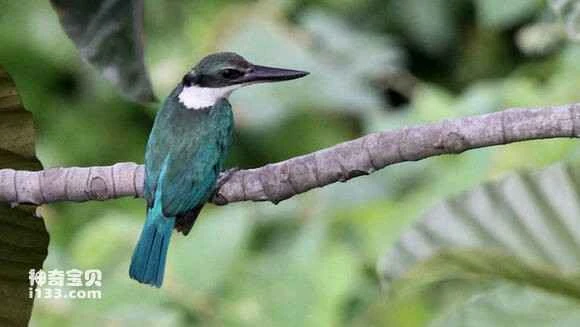
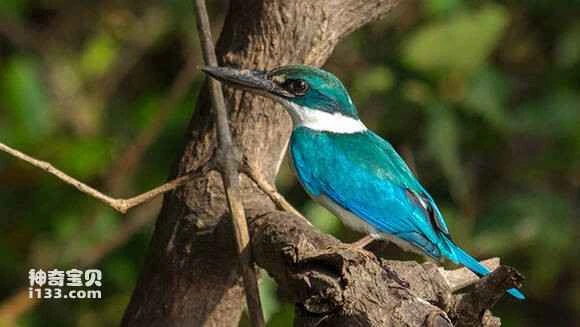
The white-collared emerald has a bluish-green forehead, crown, nape, sides, and wattles; a white stripe runs from the nostrils to the eyes, above the lores; a few black feathers are present on the lores and above the eyes; the ear coverts are dark bluish-green, with a few black feathers on the upper part of the ear coverts; the nape is white, extending to the sides of the neck and connecting with the white underparts to form a complete white neck ring. The back, rump, upper tail coverts, tail, and upper surface of the wings are blue. The tips and calyxes of the primary flight feathers are greyish-black, the rest blue. The chin, throat, cheeks, and entire underparts are white, as are the underwing coverts and axillary feathers.
When paired, the male appears bluer, while the female appears greener. The upper jaw is black, and the lower jaw is off-white. Juveniles have duller plumage. The black edge of the collar is wider, with small black spots adorning the breast.
It has short legs, weak feet, and syndactylous toes, with the base of the first three toes of the feet fused to varying degrees; short, rounded wings; a cordate-palatine skull; and a long, broad beak.
The iris is dark brown, the mouth is black, the base of the lower mouth and the edge of the upper mouth are white, and the feet and toes are dark gray.
The body length is 240 mm, the bill is 46 mm, the wing is 105 mm, the tail is 66 mm, and the tarsus is 16 mm.
Detailed introduction
Collared Kingfisher, scientifically known as *Todirhamphus chloris* or *Halcyon chloris chloris*, has 50 subspecies.

The white-collared kingfisher is a solitary bird, often found alone, and usually perches on dead branches at the top of trees. It primarily feeds on fish, crustaceans, and aquatic insects, but also eats reptiles, amphibians, and young birds. Its call is noisy and harsh, sounding like "krerk, krerk, krerk, krerk."
The White-collared Kingfisher's nesting method and behavior are very similar to that of the common kingfisher, nesting in tree cavities or earthen burrows. Both parents take turns digging tunnel-like nests with their beaks, 6-7 cm high and 60-90 cm in diameter, with the tunnels being straight and slightly sloping. These nests are generally unlined. Eggs are laid directly on the ground inside the nest. The egg-laying period varies by region: in Tanzania from January to May and October; in Zimbabwe from July to March and September to October; in Zambia from February to March; and in South Africa from June and August to October. Each clutch contains 3-5 eggs, measuring 28-32 mm × 23-26 mm. Both parents take turns incubating the eggs. The chicks are altricial.
Listed as Least Concern (LC) in the IUCN Red List of Threatened Species 2016 ver 3.1.

Protect wild animals and ban the consumption of wild game.
Maintaining ecological balance is everyone's responsibility!


