
Basic Information
Scientific classification
- Chinese name: Big Mouth Jade
- Scientific name: Pelargopsis melanorhyncha, Black-billed Kingfisher, Great-billed Kingfisher
- Classification: Climbing birds
- Classification and Genus: Order Coraciiformes, Family Kingfisher, Genus Kingfisher
Vital signs data
- Body length: Approximately 35 centimeters
- Weight: 184-203g
- Lifespan: No verification data available.
Significant features
Distribution and Habitat
The large-mouthed jadeite is found in the islands of the Pacific Ocean and the Wallace region.
The large-mouthed jadeite is highly dependent on aquatic environments, typically inhabiting water-close locations such as rivers, estuaries, bays, mangroves, coastal cliffs, and dense thickets.
Appearance
The Great-billed Kingfisher is 35 cm in length and weighs 184-203 g. Adults have a cream-white head, neck, wattles, tail, and underparts. The underbelly and tail are pale yellow or yellow. The lores are black. The feathers on the forehead, cheeks, and face have black spots. The back, shoulders, wings, and tail have some dark green and dark brown. The tail and sides show a shady green. The dark brown edge of the tail has white stripes. The bill is black with a small red spot at the base. The iris is dark brown, and the legs are reddish-brown.
The beak is thick and long, resembling a chisel, with a relatively wide base, a straight beak peak, a rounded ridge, and no nasal grooves on either side; the wings are rounded, with the first primary flight feather being the same length as or slightly shorter than the seventh primary flight feather, and the second, third, and fourth primary flight feathers being nearly the same length; the base of the primary flight feathers has white spots; the tail is rounded.
Detailed introduction
The scientific name for the large-mouthed kingfisher is Pelargopsis melanorhyncha, and its foreign names are Black-billed Kingfisher and Great-billed Kingfisher. It has three subspecies.
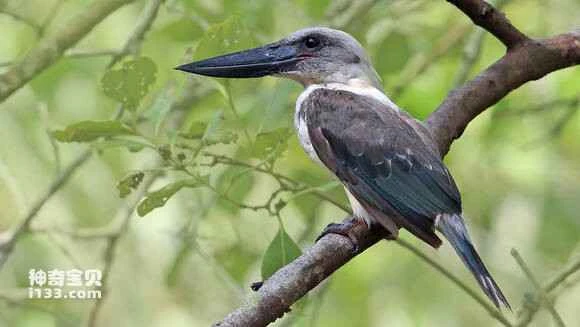
Large-mouthed kingfishers typically hunt alone or in pairs. They primarily feed on aquatic environments, both on land and in freshwater. Their main diet consists of crabs, as well as crayfish.
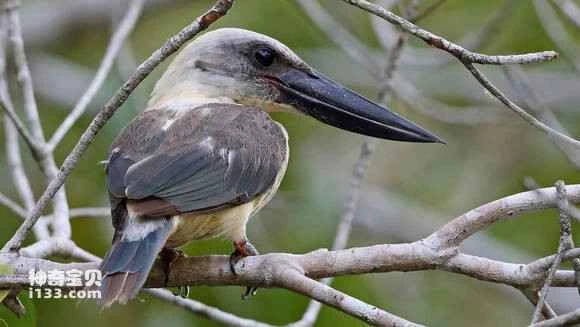
Nesting occurred in September. Other information is unavailable.
Listed as Least Concern (LC) in the IUCN Red List of Threatened Species 2016 ver 3.1.
Protect wild animals and ban the consumption of wild game.
Maintaining ecological balance is everyone's responsibility!


