Basic Information
Scientific classification
- Chinese name: Brown-winged Kingfisher
- Scientific name: Brown-winged Kingfisher (Pelargopsis amauropterus)
- Classification: Climbing birds
- Classification and Genus: Order Coraciiformes, Family Kingfisher, Genus Kingfisher
Vital signs data
- Body length: Approximately 35 centimeters
- Weight: No verification information available.
- Lifespan: No verification data available.
Significant features
Distribution and Habitat
Distributed in the Indian subcontinent and southwestern China (including India, Bangladesh, Bhutan, Sikkim, Nepal, Pakistan, Sri Lanka, Maldives, and southeastern Tibet, China), the Indochina Peninsula, and southeastern coastal China (including Myanmar, Vietnam, Laos, Cambodia, Thailand, Hong Kong, and Hainan Island), and Pacific islands (including Taiwan, the Dongsha Islands, Xisha Islands, Zhongsha Islands, Nansha Islands, the Philippines, Brunei, Malaysia, Singapore, Sumatra and Java in Indonesia, and Papua New Guinea).
Appearance
The Brown-winged Kingfisher, measuring 35 cm in length, is a relatively large kingfisher. Its head, neck, upper tail, and underparts (including the wing base) are orange, though the feathers in the center of its forehead are slightly darker, and its lores are dark orange. The lower tail, shoulders, wings, tail, and upperparts are dark brown. The back and tail are a beautiful bright blue. Its powerful beak is dark red. The iris is dark brown. It has bright red legs with black-tipped claws.
The beak is thick and long, resembling a chisel, with a relatively wide base, a straight beak peak, a rounded ridge, and no nasal grooves on either side; the wings are rounded, with the first primary flight feather being the same length as or slightly shorter than the seventh primary flight feather, and the second, third, and fourth primary flight feathers being nearly the same length; the base of the primary flight feathers has white spots; the tail is rounded.
Detailed introduction
The brown-winged kingfisher, scientifically known as Pelargopsis amauropterus, has no subspecies.
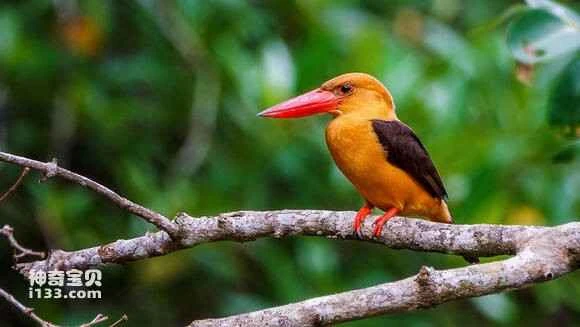
Brown-winged kingfishers are almost entirely coastal, inhabiting mangroves, mudflats, estuaries, and saltwater bays. Sometimes they venture inland for several kilometers along riverbanks. They catch crabs in low-lying mudflats. They can also dive into the water to catch bass, holding them in their mouths and shaking them back and forth. They hunt alone or in pairs. Most of the time, their movements are calm, as if immersed in their own surfing, slowing down and seemingly lacking energy. In reality, at low water levels, their flight is powerful, with a steady wingbeat. When they begin to rise and pass through mangroves, their wingbeats become faster, doubling their speed. They typically inhabit riverbanks near water, usually hunting alone or in pairs. They are entirely carnivorous, their main diet consisting of crabs and fish.
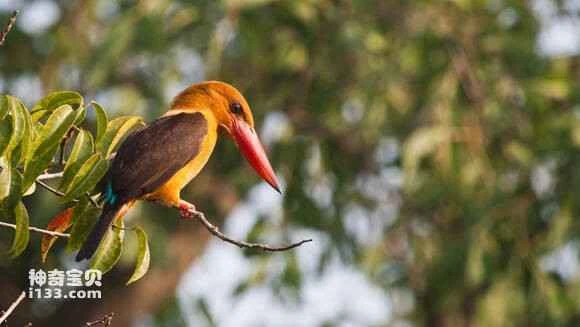
In India, the brown-winged kingfisher's breeding season occurs in March and April. It nests on earthen cliffs or riverbanks, using its beak to dig tunnel-like burrows. The nest is 20 to 60 cm deep and long, with an entrance about 10 cm high and 20 cm wide. The female lays 3 or 4 eggs. Incubation time is unknown.
Listed as Near Threatened (NT) in the IUCN Red List of Threatened Species (ver 3.1: 2008).
Protect wild animals and ban the consumption of wild game.
Maintaining ecological balance is everyone's responsibility!