
Basic Information
Scientific classification
- Chinese name: Red Jade
- Scientific name: Halcyon coromanda, Ruddy Kingfisher
- Classification: Climbing birds
- Family and Genus: Order Coraciiformes, Family Kingfisher, Genus Kingfisher
Vital signs data
- Body length: 26.8-27.4 cm
- Weight: 98-107g
- Lifespan: No verification data available.
Significant features
Distribution and Habitat
The red jadeite is the northernmost member of the jadeite subfamily. Although its main distribution area is in Southeast Asia, its northernmost distribution area extends across Japan to Sakhalin Island, and in China it can be found in the Changbai Mountain area.
Origin: Bhutan, Brunei Darussalam, China, India, Indonesia, Japan, South Korea, Lao People's Democratic Republic, Malaysia, Myanmar, Nepal, Philippines, Singapore, Thailand, Vietnam.
Possibly extinct: Bangladesh; migratory bird: Cambodia, Russian Federation.
The red-crowned kingfisher primarily inhabits riverbanks in broad-leaved and mixed forests in low mountains and foothills. It occupies a fairly wide range of habitats. In the Himalayas, Northeast China, and Japan, its main habitat is mountainous terrain, at high altitudes along the edges of rushing rivers, in dense evergreen forests up to 1800 meters above sea level. In tropical regions, it lives in forest coastlines, coconut groves, flood forests, and especially mangroves. In temperate regions, such as the Tokyo area, it lives in humid plains and can be found in cedar forests.
Appearance
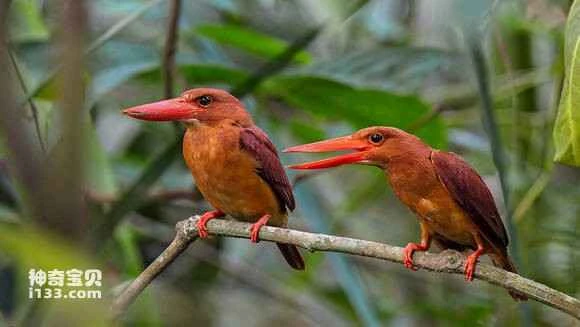
The head, neck, back, rump, upper tail coverts, and tail feathers are brownish-red, while the center of the rump and the central base of the upper tail coverts are turquoise-blue. The wings are also brownish-red, the same as the back. The chin and throat are white; a thick yellowish-white stripe extends from below the bill to both sides of the nape; the foreneck, breast, belly, and undertail coverts are reddish-yellow, darker on the foreneck and breast, and lighter on the belly. The iris is brown; the bill is bright red with a bright pale white tip; the tarsi and toes are bright buff.
Size measurements: Weight: ♂ 98-107 g, ♀ 104 g; Body length: ♂ 268-274 mm, ♀ 274 mm; Bill length: ♂ 53.5-61 mm, ♀ 59.5 mm; Wing length: ♂ 121-124 mm, ♀ 125.5 mm; Tail length: ♂ 73-81 mm, ♀ 83 mm; Tarsus length: ♂ 20-22 mm, ♀ 22 mm. (Note: ♂ male; ♀ female)
Detailed introduction
The scientific name for the red kingfisher is Halcyon coromanda, Ruddy Kingfisher, and it has 10 subspecies.
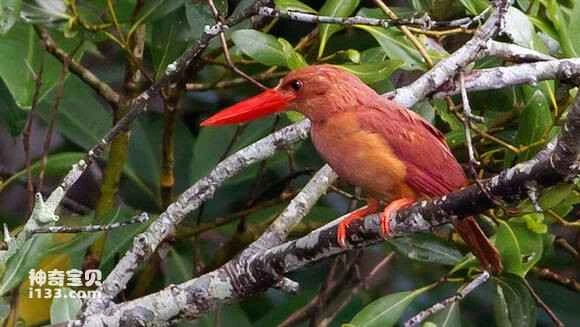
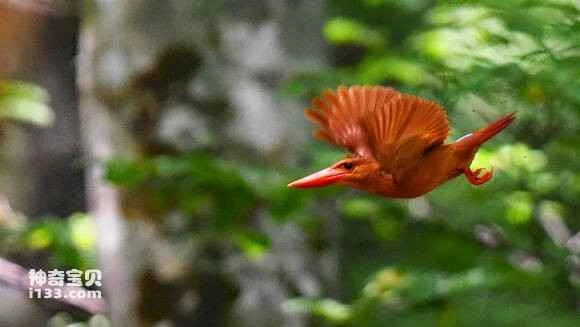
The red kingfisher is solitary or mates, and is typically found perched on tree stumps and rocks along riverbanks, sometimes also on the low branches of small trees near the river. It often gazes motionless at the water's surface for extended periods, and upon spotting fish or shrimp, it dives in with lightning speed and ferocity to catch them with its beak. Sometimes it hovers in the air, flapping its wings and watching the water's surface, diving in immediately to capture any prey it finds. It is very noisy when territorial disputes arise, its call a rapid, melodious two- or three-syllable utterance that gradually subsides. It will remain in the same location for at least six years. It hunts for perch in the same pond and surrounding area. Like other kingfishers, it uses its wings to knock fish to death from trees before consuming them. It is entirely carnivorous. Inland subspecies primarily feed on insects (beetles, locusts, grasshoppers, larvae), other small arthropods, small snails, and lizards. Not only do they prey on freshwater creatures, but in coastal areas, red kingfishers also eat crayfish, fish, frogs, tadpoles, and crabs.
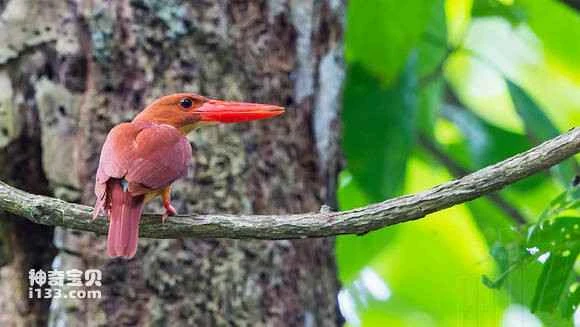
The Red-crowned Kingfisher breeds from May to July. They nest in burrows on the ground or riverbanks, and also in hollowed-out tree cavities more than 3 meters above the ground in forests. Some subspecies nest in termite mounds. Ground-level nests are usually covered with vegetation. The nest entrance is 5 cm wide, and the nest is 45 to 100 cm deep. The female typically lays 4 to 6 eggs, which measure 26-29 mm × 22-24 mm, with an average of 27 × 23 mm. Both parents take turns incubating the eggs and caring for the chicks, who are altricial.
Listed as Least Concern (LC) on the IUCN Red List of Threatened Species 2013 ver 3.1.
Protect wild animals and ban the consumption of wild game.
Maintaining ecological balance is everyone's responsibility!


