Basic Information
Scientific classification
- Chinese name: Leopard Seal
- Scientific name: Hydrurga leptonyx
- Order: Carnivora
- Family and genus: Phocidae, Seal leopard
Vital signs data
- Body length: Adult males are mostly about 2.8–3.3 meters long, and females are mostly about 2.9–3.8 meters long; large females can exceed 3.5 meters.
- Weight: Males typically weigh about 300–320 kg; females mostly weigh about 370 kg, with some exceeding 500 kg.
- Lifespan: Lifespan is estimated to be over 26 years; some records show it can be close to 30 years in the wild.
Significant features
One of the top predators in the Antarctic Ocean, with an extremely broad diet, it can prey on penguins and seals as well as krill and fish.
Distribution and Habitat
They are distributed around Antarctic and sub-Antarctic waters and are closely related to sea ice belts; they are commonly found on sea ice edges, near-shore continental shelves and penguin breeding grounds, and occasionally individuals migrate to lower latitude waters.
Appearance
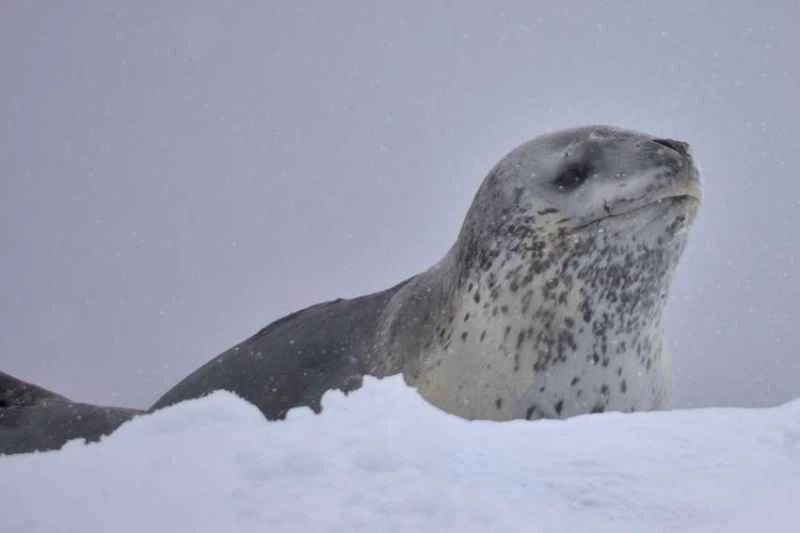
Its body is grayish-silver with dark spots scattered on its sides; it has a large head, strong lower jaw, large mouth, and long canines, with a tooth structure that can both tear and filter small prey.
Detailed introduction
Leopard seals (scientific name: Hydrurga leptonyx ) are among the most representative apex predators in the Antarctic waters, named for their "spotted leopard" flank markings and powerful hunting abilities. They have a close relationship with sea ice, often resting, molting, and breeding on floating sea ice, and ambushing prey at the edges of sea ice or near penguin colonies.
Leopard seals are mostly solitary animals with a range that covers a wide area of the ocean. They are known for preying on krill and fish, as well as larger prey such as penguins and young seals, making them a highly influential species in the Antarctic food web.
Classification and nomenclature
Leopard seals belong to the family Phoccidae, genus Hydrurga . Their English name, "Leopard seal," comes from the spots on their bodies.
Appearance features
It has a streamlined body, a large head, and a strong lower jaw. Its body color is typically dark gray to silver-gray, lighter on the underside, with irregular dark spots scattered along its sides and back. It has a large mouth with long canines and complex-shaped molars, enabling it to grasp large prey as well as filter out smaller prey such as krill. Adult females are generally larger than males.
Distribution range and habitat
They are distributed in a ring around the Antarctic and sub-Antarctic waters, closely associated with the Southern Ocean sea ice belt. They are commonly found in ice-rich areas such as the Antarctic Peninsula, the Weddell Sea, and the Ross Sea, and can extend northward to the sub-Antarctic archipelago; some stray individuals occasionally reach lower latitudes such as New Zealand, southern Australia, or the coast of South America. Typical habitats include sea ice edges, nearshore shelf waters, and waters adjacent to penguin breeding grounds.
Lifestyle Habits and Behaviors
Most are solitary or loosely distributed, often resting on sea ice. They are fast and highly maneuverable swimmers, able to patrol, lie in ambush, and launch sudden attacks along the ice edge. During the breeding season, males will make underwater calls, which are related to courtship; female seals usually give birth and nurse their pups on sea ice or near-shore ice edges.
feeding habits
Their diet is broad: juveniles and some individuals feed more on krill, fish, squid, etc.; adults can prey on penguins and other seal larvae, and even whale carcasses.
Reproduction and life cycle
Typically, each litter produces one offspring. At birth, the offspring are approximately 1.0–1.6 meters long and weigh about 30–35 kilograms. Sexual maturity is generally reached around 4 years old (females slightly earlier). Lifespan is estimated to be over 26 years, with some records indicating that wild individuals can live close to 30 years.
Relationship with humans
Leopard seals are star predators in Antarctic scientific research and ecotourism. Field observations should adhere to safe distances and management regulations.
Protecting the status quo and threats
The IUCN Red List assesses the leopard seal as Least Concern (LC, 2015 assessment). Potential threats include sea ice loss and habitat change, indirect impacts of fisheries on food webs, fishing gear entanglement and marine debris, pollutant accumulation, and disturbances from local tourism and shipping activities.
Frequently Asked Questions
Q1: Why is the leopard seal called "leopard"?
Because they often have dark spots on their sides and back, their appearance is similar to leopard spots.
Q2: What do leopard seals mainly eat?
They may prey on everything from krill, fish, and squid to penguins and other seal pups.
Q3: Where do leopard seals mainly live?
They mainly inhabit the Antarctic and sub-Antarctic waters, are closely associated with sea ice, and often frequent the edges of sea ice and near penguin breeding grounds.
Q4: Are leopard seals endangered animals?
No. It is currently listed as Least Concern (LC) by the IUCN.


