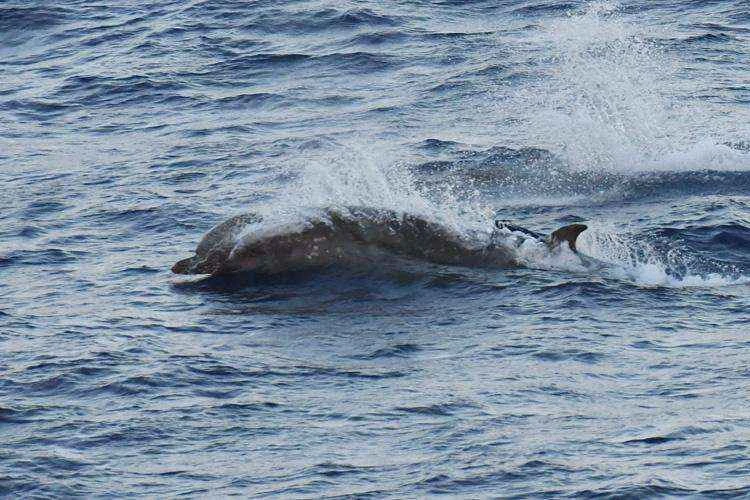
Basic Information
Scientific classification
- Chinese name: Langevin's beaked whale
- Scientific name: Indopacetus pacificus
- Order: Cetacea
- Family and genus: Beaked whale family, Indo-Pacific beaked whale
Vital signs data
- Body length: Adults can reach about 6.5 meters (about 21.3 feet) in length; newborn calves are about 2.3–2.9 meters in length.
- Weight: There is currently a lack of reliable public estimates of weight, and authoritative species data usually label it as "unknown".
- Lifespan: Lifespan data is scarce, and there is currently no authoritative and consistent public estimate. It is often marked as "unknown".
Significant features
The beaked whale is a rare deep-sea whale, and is relatively large for a beaked whale. It usually appears in close groups (about 10-20 individuals) and mainly lives in the deep waters of the tropical Indo-Pacific.
Distribution and Habitat
It is mainly distributed in the tropical-subtropical outer ocean deep waters of the Indian and Pacific Oceans; it has been recorded in the waters off Hawaii, parts of the coast of Africa, northern Australia, the Maldives, Sri Lanka, the Philippines, and southern Japan.
Appearance
It has a robust body, a prominent forehead, and a long, tubular beak; a large dorsal fin positioned towards the back; and a body color that is mostly grayish-brown/olive-gray, often with dark bands and scars. Adult males have two small teeth at the front of their lower jaw.
Detailed introduction
The Langstroth's beaked whale (scientific name: *Indopacetus pacificus* ), also known as the "tropical bottlenose whale" or "Indo-Pacific beaked whale," is one of the most mysterious and historically poorly documented deep-sea whales in the beaked whale family. They typically inhabit the deep waters of the open ocean from tropical to subtropical regions, and their appearances at the surface are often brief. Therefore, for a long time, the scientific community could only rely on a few stranded specimens to understand this species.
Over the past two decades, with the increase in oceanographic surveys and maritime sightings, people have gained a clearer description of the appearance and behavior of Langevin's beaked whales: they are relatively large among beaked whales, with a prominent forehead ("forehead/melon head"), a long and slender snout, and a large dorsal fin positioned towards the rear; they usually appear in groups and have a high degree of group cohesion.
Classification and nomenclature
Longman's beaked whale belongs to the genus * Indopacetus * of the family Ziphiidae in the order Cetacea. This genus currently contains only one species. The species was first described in 1926 by H.A. Longman based on a skull discovered in Australia, hence the name "Longman's beaked whale".
Appearance features
The Langstroth's beaked whale has a robust body and a distinctively triangular/sickle-shaped dorsal fin located behind the midpoint of its back. Its forehead (melon head) is prominent and is often described as transitioning almost vertically to a slender beak; the upper jaw is usually darker, and two conical teeth are visible near the front of the lower jaw (more prominent in adult males, but not easily seen in the wild). Its body color is mostly grayish-brown, bronze, or olive-gray, with darker bands often appearing on the head and back, along with abrasions and circular scars (such as biscuit shark bite marks).
Distribution range and habitat
It is known to be mainly distributed in the tropical to subtropical deep-sea areas of the Indian and Pacific Oceans, preferring warm, deep open ocean environments. In US waters, it is mostly recorded off the coast of the Hawaiian Islands; groundings and sightings have also been recorded off parts of the African coast, northern Australia, the Maldives, Sri Lanka, the Philippines, and southern Japan. Its overall distribution is not yet fully understood, but it is believed to span the tropical Indo-Pacific region.
Lifestyle Habits and Behaviors
Unlike many beaked whales, Langevin's beaked whales typically appear in large, close-knit groups, usually 10–20 individuals, with larger groups occasionally observed. They are strong divers and can perform prolonged dives to medium to deep depths; when at the surface, they are seen spouting low, "shrub-like" streams of water. They may be sensitive to disturbance by boats and have been observed rapidly moving away from research vessels at the surface.
feeding habits
Its feeding ecology remains unclear, but similar to other beaked whales, it is generally believed to primarily feed on cephalopods in deep water. Analysis of the stomach contents of stranded individuals suggests that cephalopods such as squid and octopus may be important food sources.
Reproduction and life cycle
Due to the low encounter rate at sea, basic biological data such as reproduction and lifespan are still very scarce. Newborn calves have been recorded to be approximately 2.3–2.9 meters in length, and it is estimated that they typically give birth to one calf per litter. Reliable public estimates of weight and lifespan are currently lacking.
Relationship with humans
While not a traditional prey species, the Langstroth's beaked whale may be affected by incidental fishing or entanglement in deep-sea fishing operations. Strandings, suspected to be related to loud noise activity, have also occurred in some areas. Due to their potential sensitivity to underwater sound, human noise such as military sonar and seismic exploration is considered a potential risk factor.
Protecting the status quo and threats
The IUCN Red List classifies the Langstroth's beaked whale as Least Concern (LC, 2020 assessment). However, researchers also emphasize that this species remains a relatively scarce deep-sea cetacean, and its global population and trends are not easily assessed. Known or potential threats include entanglement in fishing gear and bycatch, marine noise, marine debris, and pollutant accumulation.
Frequently Asked Questions
Q1: Is Langstroth's beaked whale a "bottlenose whale"?
It belongs to the family Ziphiidae. In the past, it was mistaken for a species due to its appearance and was long known as the "tropical bottlenose whale," but it has now been identified as an independent genus and species: Indopacetus pacificus .
Q2: In which sea areas do Langstroth's beaked whales mainly live?
It is mainly associated with the deep waters of the outer Indian and Pacific Oceans in the tropical and subtropical regions, and is frequently recorded in places such as the waters off Hawaii, but its overall distribution is still not fully clear.
Q3: What do they eat?
Data is limited, but similar to other beaked whales, it is speculated that they mainly feed on cephalopods such as squid and octopus, and analysis of stomach contents also supports this.
Q4: Is Langevin's beaked whale an endangered animal?
The IUCN currently assesses it as Least Concern (LC). However, due to insufficient research on this species and scarce marine records, continued monitoring and efforts to reduce risks such as fishing gear entanglement and marine noise are still needed.