Basic Information
Scientific classification
- Chinese name: Long-nosed kangaroo
- Scientific name: Potorous tridactylus
- Classification: Rodentia
- Family and genus: Kangaroosidae (common kangaroo)
Vital signs data
- Body length: Adults have a head and body length of about 34–36 cm and a tail length of about 20–26 cm; body size varies slightly depending on the region and habitat.
- Weight: Adults typically weigh between 0.66 and 1.6 kg; males are usually slightly larger and heavier.
- Lifespan: Several years in the wild, up to about 7 years under good conditions; even longer in captivity.
Significant features
Nocturnal marsupials that hunt truffles feed on underground fungi and spread spores are important for forest regeneration and soil health.
Distribution and Habitat
It is distributed in southeastern Australia and Tasmania (including parts of the Bass Strait Islands); it inhabits moist eucalyptus forests, coastal heather thickets, shrublands and rainforest edges, and depends on thick litter and dense understory vegetation.
Appearance
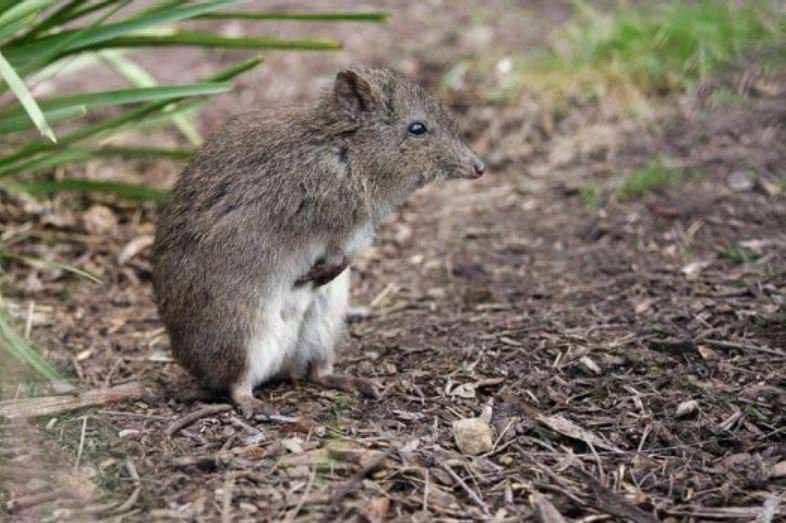
The back is reddish-brown to grayish-brown, and the belly is lighter; the snout is slender, the ears are erect, and the eyes are large; the forepaws are strong and good at digging, the hind limbs are relatively long for jumping, and the tail is relatively long to help carry nesting material.
Detailed introduction
The long-nosed kangaroo (scientific name: *Potorous tridactylus *) is a small marsupial endemic to southeastern Australia and Tasmania. Resembling a "mini kangaroo," it has a long, slender snout and is adept at digging for food. Primarily nocturnal, they use their forepaws to search for underground fungi (commonly known as "truffles"), roots, and insects in the leaf litter of forests, earning them the nickname "aboriginal truffle hunters" of the Australian forests.
Long-nosed wallabies are highly dependent on ground cover and understory: they typically hide in dense vegetation during the day and forage in more open forest edges or grasslands at night. Their digging behavior loosens the soil, disperses fungal spores, and promotes forest regeneration, giving them unique value in the ecosystem.
Classification and nomenclature
The long-nosed potoroo belongs to the genus * Potorous * of the family Potorroidae in the order Diprotodontia. Its English name, "Long-nosed Potoroo," is a direct translation of the name. In different states/territories of Australia, it is also managed according to subspecies or local population lists.
Appearance features
The body is "rabbit-sized but more slender," with fur ranging from reddish-brown to grayish-brown on the back and lighter on the belly. It has a long, slender snout, erect ears, and large eyes; its forelimbs have strong, curved claws for digging, while its hind limbs are longer and used for hopping. Its long tail helps in carrying nesting material. Females possess a pouch in which the young continue to develop.
Distribution range and habitat
It is mainly distributed in southeastern Australia (southeast Queensland to parts of New South Wales and Victoria) and Tasmania, and is also found in some Bass Strait islands. Typical habitats include moist eucalyptus forests, coastal heather thickets, shrublands, rainforest edges, and moist valleys. The core requirement is a thick layer of leaf litter and dense understory vegetation, which can provide both cover and facilitate burrowing for fungi and rhizomes in relatively loose soil.
Lifestyle Habits and Behaviors
Primarily nocturnal, they are mostly solitary or loosely distributed when their ranges overlap. They create trails ("runways") in the understory and leave many typical conical digging pits. During the day, they usually nest and rest in shrubs, ferns, or leaf litter; in the cold season, they may occasionally forage briefly during the day.
feeding habits
Omnivorous, but underground fungi (various underground fruiting fungi/"truffles") constitute a large proportion of their diet in many regions. They also feed on roots, tubers, seeds, fruits, insects and their larvae. By consuming fungi and spreading spores, they promote the mycorrhizal system and the health of forest plants.
Reproduction and life cycle
Breeding time varies with region and climate. Typically, one offspring is born per litter; gestation is short, and the young continue to develop in the pouch for several months after birth before gradually becoming independent. Lifespan in the wild is generally several years, reaching about 7 years under favorable conditions; captive individuals can live even longer.
Relationship with humans
In some protected areas and suburban woodlands, their tracks can be recorded using camera traps or nighttime surveys. Long-nosed wallabies are sensitive to invasive predators and habitat changes, and are therefore often used as "indicator species" of forest health and food web integrity.
Protecting the status quo and threats
Globally, the IUCN classifies the long-nosed wallaby as Near Threatened (NT). Within Australia, some subspecies/populations are listed as Vulnerable on federal or state lists and are subject to special management. Major threats include: habitat loss and fragmentation, invasive predators (foxes and feral cats), unfavorable fire regimes (large fires and frequent burning leading to thinning of understory vegetation), road traffic fatalities, and habitat and food resource fluctuations caused by localized drought and climate change.
Frequently Asked Questions
Q1: What is the difference between a long-nosed kangaroo and a bandicoot?
They are all small in size and have relatively long snouts, but the long-nosed kangaroo belongs to the family Coccinellidae, has longer hind limbs, and mainly jumps; the bandicoot belongs to the order Bandicoothrix, and its running and jumping methods and skull and teeth structure are also different.
Q2: Why do they always dig holes in the ground?
They primarily burrow to feed on underground fungi (truffles), rhizomes, and insect larvae. The marks left by their burrows are often clues to their presence.
Q3: Where are long-nosed kangaroos mainly distributed?
Southeastern Australia and Tasmania prefer forests, scrublands, and coastal heather with thick leaf litter and dense understory vegetation.
Q4: Is it an endangered animal?
The IUCN Global Assessment classifies it as Near Threatened (NT). Within Australia, some subspecies or endemic populations may be listed as Vulnerable and managed on federal or state lists.