Basic Information
Scientific classification
- Chinese name: Liyu Hummingbird
- Scientific name: Costa's Hummingbird (Calypte costae)
- Classification: Climbing birds
- Family and genus: Apodiformes, Hummingbird family, Lisbeak genus
Vital signs data
- Body length: 7-9 cm
- Weight: Approximately 3g
- Lifespan: 3-5 years
Significant features
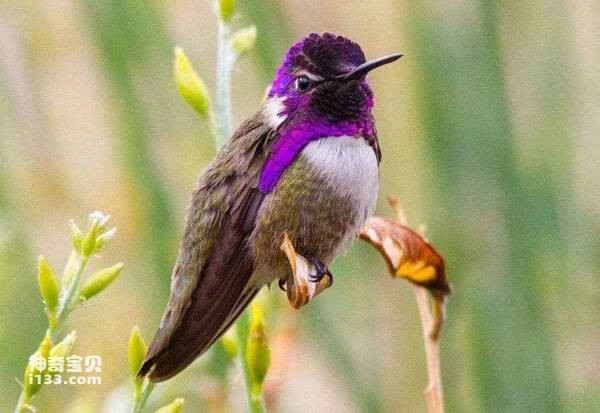
Adult males have a striking purple hue, with bright purple scaly feathers on their head and throat.
Distribution and Habitat
The Common Hummingbird is mainly distributed along the Pacific coast of southwestern North America, often inhabiting the bushes and cacti of the Mojave and Sonoran deserts, and also appearing in areas with human activity. Every winter, they migrate to southern Mexico to overwinter, and return to their usual habitat during the breeding season. Of course, they only make short migrations, and are always among the first migratory birds to arrive at their breeding grounds.
Appearance
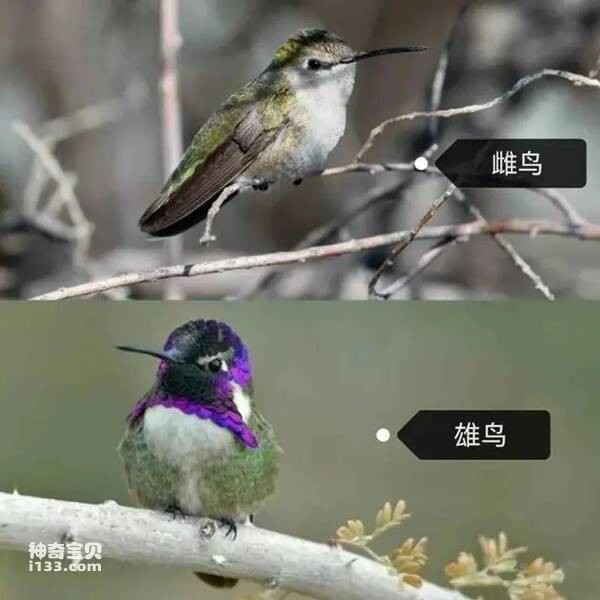
Like most birds, they exhibit sexual dimorphism. The Common Hummingbird is typically green, while adult males have a striking purple hue, with bright purple scaly feathers on their head and throat that gleam like jewels in the sunlight. Adult females have a predominantly greyish-green back and wings, with a white belly. They are very small, generally 7-9 cm in length, with males averaging 3 grams and females slightly larger at 3.2 grams.
Detailed introduction
The Costa's Hummingbird (scientific name Calypte costae) is a bird native to the Americas. Ornithologists consider it to be the most drought-adapted hummingbird. It was officially introduced to the public by a French ornithologist in 1839 and named Costa in honor of the French nobleman Louis Marie Pataleon Costa, Marquis de Beauregard.
Hummingbirds are small in size but have a high metabolism. The heart rate of a beautiful hummingbird is usually 500 to 900 beats per minute. When the temperature drops, they enter a state similar to hibernation (this state reduces their ability to cope with risks, and tropical hummingbirds are more likely to enter this state than temperate hummingbirds). Their heart rate drops sharply to 50 beats per minute and their body temperature drops drastically. This often happens during migration to reduce energy consumption.
The Common Hummingbird is a nonsocial bird, and males often fight over territory, mates, and food during the breeding season. Hummingbird habitats overlap, leading to more interspecific mating, but offspring of the Scarlet Hummingbird and the Common Hummingbird still resemble their parents. Females begin nest building before mating, and males often engage in highly energetic courtship displays, such as swooping, singing, and feather displays. They are polygynous; after mating, the male immediately seeks another mate, while the female raises the chicks alone.
The incubation period for the Common Hummingbird varies from 12 to 22 days, depending on external factors. During incubation, the female spends most of her time in the nest, leaving only time for foraging, preening, and reinforcing the nest. This brief absence often exposes her to attacks from predators (birds of prey, squirrels, lizards, etc.). Although the female will fight back, only a portion of the chicks successfully hatch.
Both the female bird and the chicks during the egg-laying and chick-rearing periods require a large amount of protein, minerals, and other nutrients. The female parent bird will spend more time hunting insects and then regurgitating the digested insect juices into the chicks' mouths. Under this high-protein diet, the chicks will emerge from their plumage in about 9 to 12 days and begin to fly for the first time after a week. At this time, the nest becomes crowded, and the chicks will roost near the nest. After another week, the chicks leave the nest, and the old nest can no longer be used due to fecal contamination. The female parent bird will then choose to build a new nest nearby.
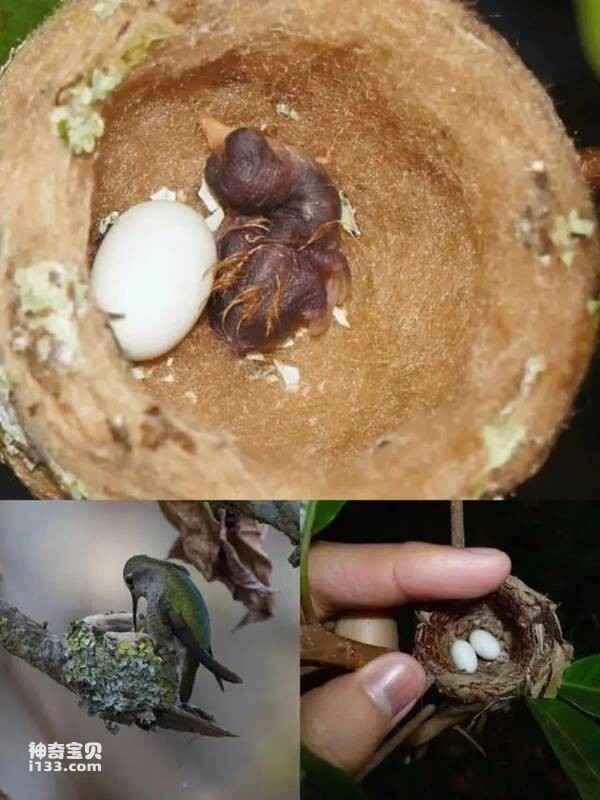
Young birds will learn basic survival skills from their mothers for 1-4 weeks: hunting insects, locating nectar sources, etc. They undergo two molts before becoming independent. Female parents build 2-3 nests during a breeding season, sometimes using material from the old nest to build new ones. Hummingbirds are truly skilled craftsmen, able to weave exquisite nests using various materials such as spider silk, cotton, animal hair, and lichen.
Male hummingbirds face particularly difficult circumstances. They must defend their territory and mate, and their smaller size and vibrant plumage are essential for survival. During their first migration, independent chicks already exhibit sexual maturity, but finding mating opportunities is challenging. The first winter is the most difficult, with the vast majority perishing at the hands of predators, suffering from frost on early spring nights, or dying in summer hailstorms; only a small percentage survive. Their average lifespan is 3-5 years.
Protect wild animals and ban the consumption of wild game.
Maintaining ecological balance is everyone's responsibility!