Basic Information
Scientific classification
- Chinese name: Blue-black jade
- Scientific name: Todirhamphus nigrocyaneus, Blue-black Kingfisher
- Classification: Climbing birds
- Genus and species: Order Coraciiformes, Family Kingfisher, Genus Aldebaran
Vital signs data
- Body length: Approximately 22 centimeters
- Weight: 51-57g
- Lifespan: No verification data available.
Significant features
Adult males have a bluish-purple forehead and crown.
Distribution and Habitat
Blue-black jadeite is distributed in islands in the Pacific Ocean, including Taiwan Province of China, the Dongsha Islands, Xisha Islands, Zhongsha Islands, Nansha Islands, as well as the Philippines, Brunei, Malaysia, Singapore, Sumatra and Java in Indonesia, and Papua New Guinea.
The blue-black kingfisher typically inhabits dense forests and riverbanks near water. In the wooded central mountains of Papua New Guinea, it is frequently found in lowland forests, near rivers, as well as eucalyptus forests, swamps, scrublands, and nearby streams. It can also be seen in gardens and woodlands of coastal villages. Once quite common, the blue-black kingfisher is now becoming increasingly rare and is very uncommon in its native habitat of much of Papua New Guinea.
Appearance
The Blue-Black Kingfisher is 22 cm in length, with females weighing 51-54g and males 55-57g. Adult males have a bluish-purple forehead and crown. The eyebrows extend to the neck in a clearer, slightly lighter blue. The lores, cheekbones, cheeks, neck, and sides of the chest are black. The scapula and cloak feathers are black with a slight bluish-purple tinge. The tail is black. The chin and throat are white. A large section of the chest is blue. A white stripe runs between the chest and abdomen, with a blue belly. The wings, thighs, vent area, and tail are black. The beak and eyes are black, the iris is dark brown, and the legs are greyish-black. In females, the belly is white extending to the chest.
The beak is thick and long, resembling a chisel, with a relatively wide base, a straight beak peak, a rounded ridge, and no nasal grooves on either side; the wings are rounded, with the first primary flight feather being the same length as or slightly shorter than the seventh primary flight feather, and the second, third, and fourth primary flight feathers being nearly the same length; the base of the primary flight feathers has white spots; the tail is rounded.
Detailed introduction
The scientific name for the blue-black kingfisher is *Todirhamphus nigrocyaneus*, also known as Blue-black Kingfisher. It has three subspecies: (1. *Todirhamphus nigrocyaneus nigrocyaneus*, distributed in western Papua (Batanta, Salawati), extending east to the north of Helfink Bay and the south of the Marian Strait; (2. *Todirhamphus nigrocyaneus quadricolor*, distributed in Apen Island and Astroleb Bay, Indonesia; and (3. *Todirhamphus nigrocyaneus stictolaemus*, distributed in the western part of the Owen Stanley Range in Papua).
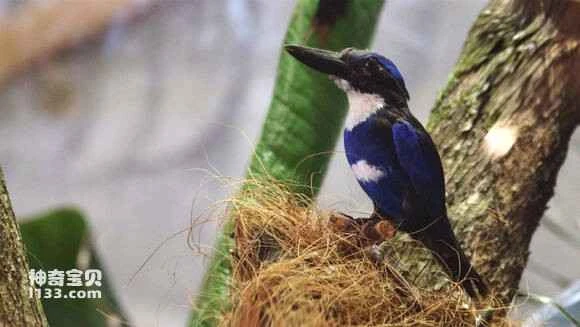
The blue-black kingfisher typically hunts alone or in pairs. Like most forest kingfishers, it is entirely carnivorous, often searching for prey in leaves or soil. Its main diet consists of invertebrates such as crickets, spiders, scorpions, and snails. It also eats small vertebrates such as small fish, snakes, and lizards.
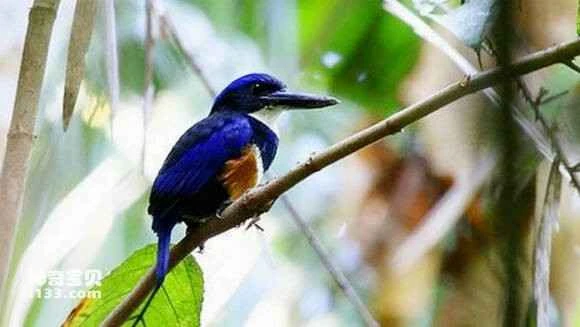
There are no records of the breeding and social behavior of the Blue-Black Emerald, and its nests and eggs have never been described to date (2008). Its territoriality and vocalizations are very similar to those of the Woodland Emerald, and its call consists of three sharp, short rhythmic notes followed by a long, powerful trill lasting about three seconds.
Listed in the IUCN Red List of Birds, ver 3.1: 2008.
Protect wild animals and ban the consumption of wild game.
Maintaining ecological balance is everyone's responsibility!