
Basic Information
Scientific classification
- Chinese name: Ring-necked Pochard
- Scientific name: Aythya collaris, Ring-necked Duck
- Classification: Waterfowl
- Family and genus: Anseriformes, Anatidae, Duck (Duck)
Vital signs data
- Body length: 39-46 cm
- Weight: 490-910g
- Lifespan: No verification data available.
Significant features
It has a large head with a shiny black, high-set top.
Distribution and Habitat
Origin: Anguilla, Antigua and Barbuda, Aruba, Bahamas, Barbados, Belize, Bermuda, Canada, Cayman Islands, Colombia, Costa Rica, Cuba, Dominican Republic, Dominican Republic, Grenada, Guatemala, Haiti, Honduras, Martinique, Mexico, Montserrat, Nicaragua, Panama, Puerto Rico, Saint Barthélemy, Saint Kitts and Nevis, Saint Lucia, Saint Pierre and Miquelon, Saint Vincent and the Grenadines, Trinidad and Tobago, Turks and Caicos Islands, United States, Bolivarian Republic of Venezuela, British Virgin Islands, U.S. Virgin Islands.
Migratory birds: Algeria, Austria, Belgium, Cape Verde, Denmark, Faroe Islands, Finland, France, Germany, Guadeloupe, Iceland, Ireland, Jamaica, Japan, Morocco, Netherlands, Norway, Poland, Portugal, Spain (Canary Islands), Sweden, Switzerland, United Kingdom.
The habitat of the Ring-necked Pochard varies seasonally. During the breeding and post-breeding season, the species prefers freshwater wetlands, typically marshes, all of which are shallow and generally near-neutral in pH, as these ducks feed on aquatic invertebrates, especially the females during the breeding season, who would not thrive in highly acidic conditions. Their usual habitats contain high levels of organic matter and are typically rich in vegetation, whether floating or submerged, throughout the open water.
During winter, this species inhabits large areas of wetlands, but is rarely found in areas with high salinity or depths greater than 1.5 meters. Common habitats include river floodplains, freshwater and brackish sections of estuaries, and shallow inland lakes and marshes. These shallow water areas are also rich in moist soil vegetation. The Ring-necked Pochard has also been found in flooded farmland, aquaculture ponds, and managed freshwater reservoirs.
Appearance
The Ring-necked Pochard is a small to medium-sized wild duck, with males slightly larger than females. Males are 40-46 cm long, and females are 39-43 cm long. Males weigh 542-910 grams, and females weigh 490-894 grams. Seasonal weight fluctuations are common, leading to sex overlap. The wingspan is 63.5 cm. It has a glossy black, high-set head, and the chestnut-red metallic rings on the neck are almost invisible. The male is entirely glossy black except for a white belly, flanks, and speculum, and a distinct white wedge-shaped band extending upwards from the shoulder. The female has a shorter crest, grayish-brown plumage, and a darkest crown. The head, chin, and front of the throat are pale, and there are white eye rings around the eyes, making it appear duller overall than the male. Its white wings are very similar to those of the Tufted Pochard.
Both males and females display grey streaks on their flight feathers during flight. Adults have distinctive white rings on their blue bills. Males have bright yellow eyes, while females have darker irises, usually edged with white. The feet and legs are two shades of grey-blue. The species' silhouette is similar to other diving ducks, but its tail is slightly longer, and its head has a short crest, giving it a distinctive pointed or angular appearance. Immature Ring-necked Pochards look similar to adults but are darker in coloration.
During the winter, the physical condition of both adult ducks and ducklings changes. Both will gain weight, but adult ducks will become much larger than before.
Detailed introduction
The Ring-necked Duck (scientific name: Aythya collaris) has no subspecies.
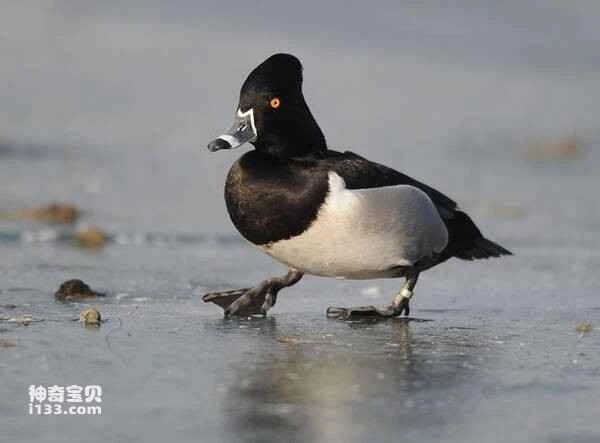
The Ring-necked Pochard is a migratory bird. It begins its migration in early September through eastern North Dakota and western Minnesota, peaking in mid-October, with the entire migration completed by mid-November. It reaches the Atlantic coast of the Middle East in early October, peaking again in late November, and declines in December. From October to December, it winters in Arkansas, Louisiana, the southeastern Atlantic coast, and Florida.
When migrating, the Ring-necked Pochard migrates in flocks, usually in small groups of ten to several dozen individuals, rarely in large flocks of over a hundred. During the breeding season, they mainly inhabit open areas with abundant aquatic plants, such as freshwater lakes, ponds, and marshes. In winter, they mainly inhabit large lakes, slow-flowing rivers, estuaries, bays, and river deltas.
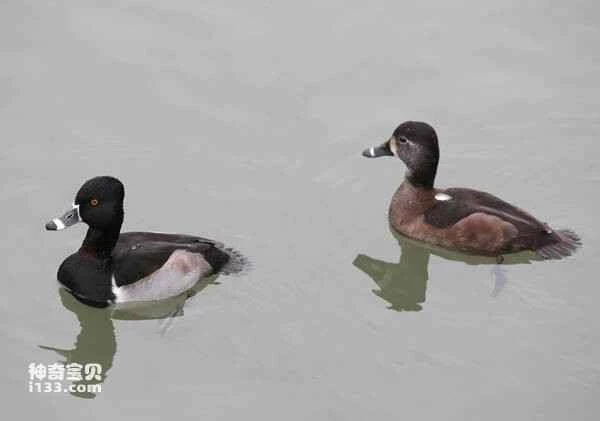
The Ring-necked Pochard is an omnivorous animal, primarily feeding on plant matter, mainly tubers, seeds, leaves, and moist soil and aquatic plants (such as black sedge, grass, and wild rice). It also eats aquatic insects, snails, and clams. It typically forages in shallow, lush vegetation near the water's edge. Foraging activity is mainly at dawn and dusk; during the day, it rests on the shore or floats on open water to sleep. It primarily forages by diving, generally in shallow water, sometimes dipping its head or tail into the water near the edge to feed.
The breeding season for ring-necked ducks occurs between May and early August, peaking from mid-May to mid-July. Pairings form during the spring migration and continue until late June or early July. When choosing a nesting site, they swim along open waters in wetlands. The female swims to submerged vegetation to find a suitable spot, while the male observes nearby. They seek dry or semi-arid locations near water, usually with dense vegetation. The female builds the nest; after 3-4 days, the nest resembles a bowl, and by the 6th day, it is well-built and clearly shaped. Occasionally, nest building may stop before the 3rd or 4th egg is laid. The nest is lined with curved grass and soft feathers.
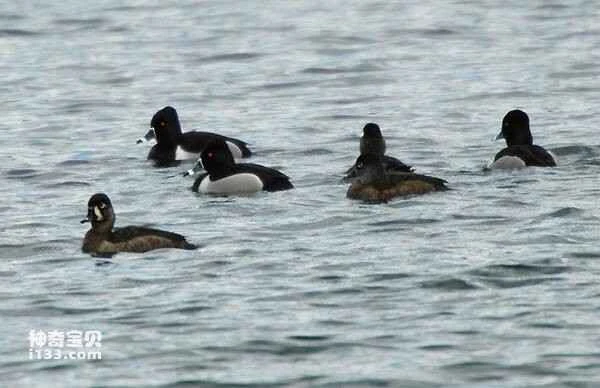
Female ring-necked ducks lay 6-14 eggs per season, averaging 8-10. The eggs are oval, ranging in color from olive-grey to olive-brown, with a smooth surface texture. Incubation begins after nesting is complete, coinciding with the first day the female spends the night in the nest. The incubation period typically lasts 26-27 days. Hatched chicks weigh between 28-31 grams. The ducklings are covered in soft feathers, are able to track their parents, and begin feeding themselves soon after hatching. Ducklings can move independently after 49-56 days and reach independence 21-56 days after hatching. Reproductive maturity is achieved quickly in both sexes, and breeding can begin in the first year, although young ducks may avoid breeding for several years due to lower availability of nesting areas.
Listed as Least Concern (LC) on the IUCN Red List of Threatened Species 2020 ver 3.1.
Protect wild animals and ban the consumption of wild game.
Maintaining ecological balance is everyone's responsibility!


