Basic Information
Scientific classification
- Chinese name: Australian diving duck
- Scientific name: Australian White-eyed Duck, Hardhead Duck, White-eyed Duck
- Classification: Waterfowl
- Family and genus: Anseriformes, Anatidae, Duck (Duck)
Vital signs data
- Body length: 42-60 cm
- Weight: 840-900g
- Lifespan: No verification data available.
Significant features
With a round body and a large head, it rarely makes a sound; it is a deep-water bird and is adept at diving with its wings folded.
Distribution and Habitat
Distributed across the islands of the Pacific Ocean, including Taiwan, the Dongsha Islands, Xisha Islands, Zhongsha Islands, and Nansha Islands of China, as well as the Philippines, Brunei, Malaysia, Singapore, Sumatra and Java in Indonesia, and Papua New Guinea. Also found in Australia and New Zealand, including Tasmania and its surrounding islands.
During the breeding season, they mainly inhabit open areas with abundant aquatic plants, such as freshwater lakes, ponds, and marshes. In winter, they mainly inhabit large lakes, slow-flowing rivers, estuaries, bays, and river deltas.
Appearance
The Australian Pochard measures 42-60 cm in length and weighs 840-900 g. It is a medium-sized duck, generally chocolate brown when swimming, with its underparts visible in flight. The inner side of the primary wing is white with a brown edge. Distinct white markings are visible on the chest when flying or swimming in shallow water. The bill is blue with a white tip. Males have white eyes, while females have brown eyes.
Detailed introduction
The Australian White-eyed Duck (scientific name: Aythya australis), also known as the Hardhead or White-eyed Duck, is a bird belonging to the genus Aythya in the family Anatidae of the order Anseriformes.
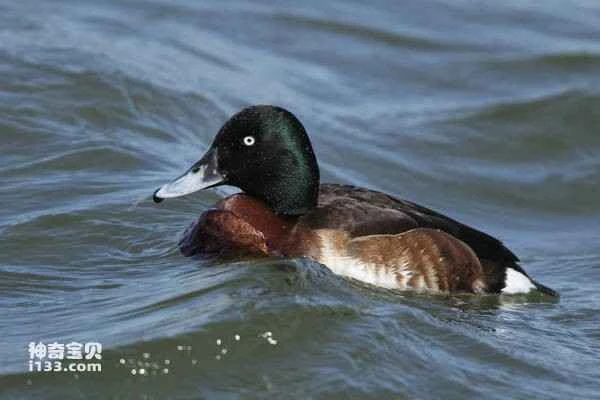
The Australian pochard is a migratory bird. When migrating, they form flocks, usually small groups of ten to several dozen individuals, and rarely large flocks of hundreds.
The Australian pochard is an omnivorous animal, feeding on aquatic plants and animals, especially mussels and freshwater shellfish. It typically forages in shallow, lush vegetation near the water's edge. Foraging activity is mainly at dawn and dusk; during the day, it rests on the shore or floats on open water to sleep. It primarily forages by diving, generally in shallow water, sometimes dipping its head or tail into the water near the edge to feed.
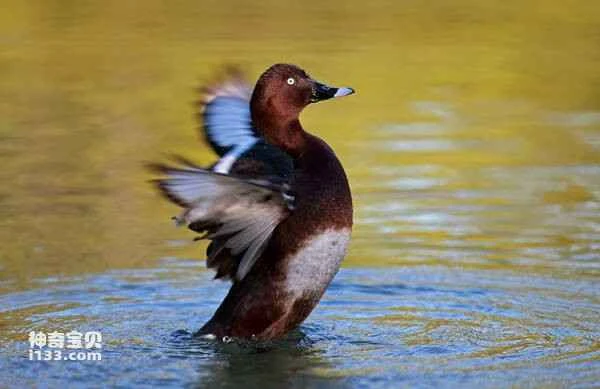
They inhabit areas with thick vegetation, near water, along rivers and canals, around stagnant pools, and near dams. Nests are built with reeds and grass stems within vegetation. The female duck builds the nest and incubates the eggs alone.
Listed as Least Concern (LC) in the IUCN Red List of Threatened Species 2016 ver 3.1.
Protect wild animals and ban the consumption of wild game.
Maintaining ecological balance is everyone's responsibility!