Basic Information
Scientific classification
- Chinese name: American diving duck
- Scientific name: Aythya americana, Redhead
- Classification: Waterfowl
- Family and genus: Anseriformes, Anatidae, Duck (Duck)
Vital signs data
- Body length: 46-55 cm
- Weight: 680-1450g
- Lifespan: No verification data available.
Significant features
The male duck has a copper-red head and neck, a blue bill, a black breast, orange-yellow eyes, and a grey back and sides.
Distribution and Habitat
It is distributed in the Bahamas, Bermuda, Canada, the Cayman Islands, Cuba, Guatemala, Haiti, Mexico, the Turks and Caicos Islands, and the United States.
Migratory birds: Barbados, Greenland, Guam, Jamaica, Japan, Saint Pierre and Miquelon, United Kingdom.
The American Pochard inhabits mountainous areas, grasslands, large basins, and depressions. Its range extends from sea level to mountainous regions up to 2000 meters. Nests are built in high density near the Great Salt Lake swamps. It breeds in central and northwestern North America. During winter, it migrates to the southern and central United States and Central America, with southern Texas and Madreli, Mexico being important wintering grounds. During migration, it often forms a V-shaped flight pattern.
Habitats include freshwater lakes, ponds, and marshes. The water needs to be at least 70 centimeters deep so the ducks can dive. Grassland depressions provide a perfect breeding ground, as the depressions are filled with melted snow and rainwater, providing temporary, seasonal freshwater deposits. Marshes also offer areas with abundant aquatic plants and vegetation cover for protection. American pochards are also found in saltwater and coastal bays and lakes.
During the breeding season, they mainly inhabit open areas with abundant aquatic plants, such as freshwater lakes, ponds, and marshes. In winter, they mainly inhabit large lakes, slow-flowing rivers, estuaries, bays, and river deltas.
Appearance
The American Pochard weighs 680-1450 grams, is 46-55 cm long, and has a wingspan of 23 cm. It is relatively small for a pochard and has a darker coloration. The male has a copper-red head and neck, a blue bill, a black breast, orange-yellow eyes, and a grey back and sides. The belly is greyish-white; the wings are grey with slight white spots; and the feet are bluish-grey. When the male molts in June, the black becomes more brownish, while the red head becomes less vibrant. By November, the dark winter plumage has grown in.
The female pochard has a mottled head and body, a dark blue bill, and a black crown. Adult males are easily confused with the sail-backed pochard, but the difference lies in the pochard's steep forehead, grey back, and blue bill. The female's colors are not as vibrant as the male's; her head is yellowish-brown with a somewhat darker comb, and she has a slight pale eye ring around her brown eyes. Her body and tail are mostly dark greyish-brown, with a whitish belly that fades to greyish-brown. Her wings are also greyish-brown. Her feet are blue, slightly darker than the male's.
Both males and females of this species have pale blue beaks with black tips and white rings around them, which are about 1.3 cm long.
The first feathers of a young duck resemble those of a mottled female. As the ducklings mature, the males become darker than the females and begin to exhibit duck colors.
Detailed introduction
The American pochard (scientific name: Aythya americana), also known as the Redhead, has no subspecies.
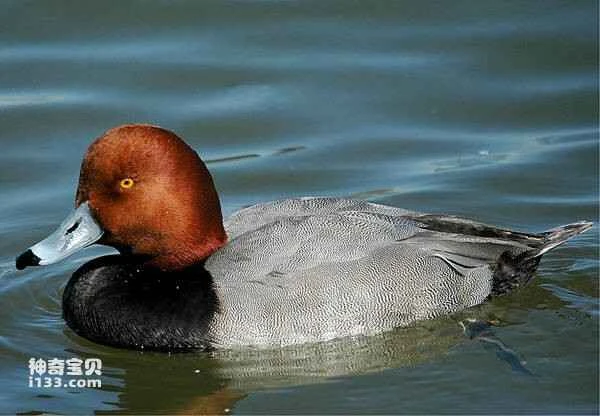
The American Pochard is a migratory bird. During migration, they migrate in flocks, usually in groups of 5-15. However, in winter, they can gather in groups of thousands. Their breeding range extends from southern Canada to the northern United States (Washington to Maine). Many American Pochards breed in the prairie-hoarded areas of the northern Great Plains of North America. There are also some breeding populations in central Alaska. In September, these ducks migrate through northern and central Mexico to winter, migrating from California to the Gulf Coast and the Atlantic coast. Most winter in Florida and Mexico.
The American pochard primarily forages at dawn and dusk, spending most of its day resting on land or floating on open water to sleep. It mainly forages by diving, generally in shallow water, but sometimes also dipping its head or tail into shallow water near the shore to feed.
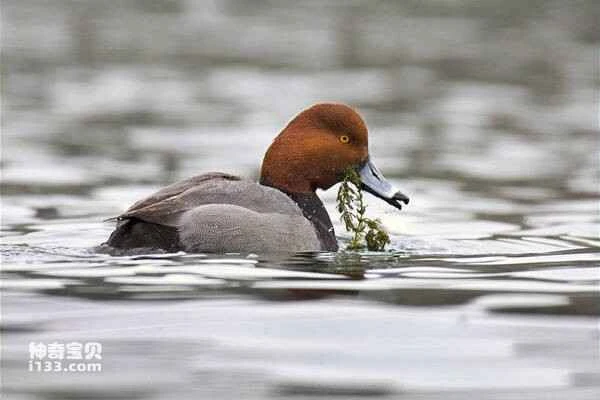
The diet of the American Pochard consists primarily of plant matter. They dive to the bottom of water bodies to feed on aquatic plants and mollusks, and wade on the surface of shallow marshes to locate insects. Before the spawning season, the females increase their protein intake. At this time, about 77% of their diet is animal-based. Approximately half of the ducklings' diet consists of animal matter to provide the nutrients needed for growth. Typical foods include: grasses, pond grasses, thyme, sedges, wild celery, duckweed, water lilies, grasshoppers, goji berries, water fleas, and snails.
Studies of the American Pochard have revealed that while they build their own nests and reproduce, they often lay their eggs in the nests of other ducks, allowing those other ducks to incubate and raise their young. This phenomenon is known as incomplete brood parasitism. Female American Pochards frequently target the nests of Sailfin Pochards. However, Sailfin Pochard eggs are pale green, while American Pochard eggs are white. The female American Pochard lays her egg in the middle of a Sailfin Pochard nest, attempting to deceive the other ducks. When the female Sailfin Pochard leaves to forage, the presence of a white egg in the nest indicates that more than one American Pochard has been using the nest. The pair of American Pochards then swim away to build their own nest. This is akin to taking out insurance, as danger lurks throughout the lake region. They must act as cautiously as possible to ensure the continuation of their lineage.
Listed as Least Concern (LC) in the IUCN Red List of Threatened Species 2016 ver 3.1.
Protect wild animals and ban the consumption of wild game.
Maintaining ecological balance is everyone's responsibility!