Basic Information
Scientific classification
- Chinese name: Magpie Goose
- Scientific name: Magpie Goose (Anseranas semipalmata)
- Classification: Waterfowl
- Family and genus: Anseriformes, Anatidae, Apiaceae
Vital signs data
- Body length: 75-85 cm
- Weight: Approximately 2.07 kg
- Lifespan: No verification data available.
Significant features
It is a "living fossil" of birds, having appeared 25 million years ago.
Distribution and Habitat
It is distributed in Australia, Indonesia and Papua New Guinea.
Magpie geese live in various tropical rivers, swamps, or wet meadows along the coastline during both dry and wet seasons.
Appearance
The Magpie-Goose is 75-85 cm long and weighs 2070 grams. It is a large waterfowl native to Australia and Papua New Guinea. It differs greatly from its close relatives and has a unique appearance. Sexes are similar, with humps on their heads and black and white plumage resembling a magpie, hence its name. It has a long neck and legs. Its toes are not webbed. It has a long, hooked beak and a bare face, similar to a bald eagle. Unlike other waterfowl, it gradually molts its flight feathers, thus having no period of flightlessness.
During the dry season, the plumage sometimes takes on a reddish-brown tinge. Adults have a high-set head, neck, and chest; most of their wings and tail are black, contrasting sharply with the white underparts, wattles, nostrils, and inner tail. Adult geese have long, straight bills, primarily yellow with pink and rose-red markings. The bare face is pink or red during the breeding season. The tips of the magpie goose's claws show a very slight yellow tinge.
Detailed introduction
The Magpie Goose (scientific name: Anseranas semipalmata) has no subspecies.
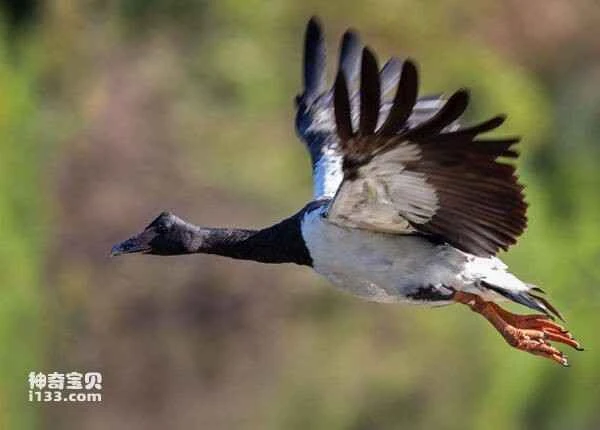
After the breeding season, magpie geese migrate in large family flocks to areas favorable for survival, gathering in groups of several hundred to forage. They are primarily herbivorous, feeding mainly on green plants, rushes, reeds, and wild rice. On land, they also eat plant tubers and roots. To do this, they will dig a wide pit and bury their entire head and neck in it while foraging.
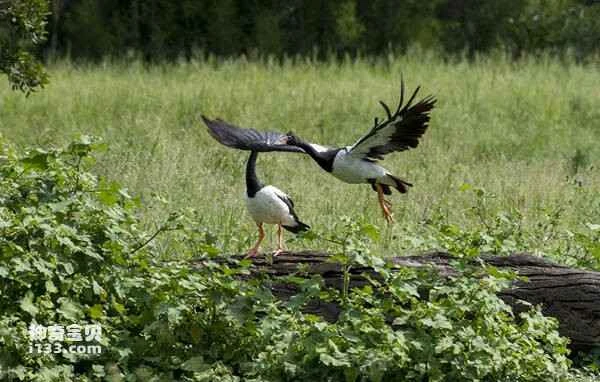
Nesting density for magpie geese varies depending on location and year. Mating can occur year-round, with breeding beginning during the rainy season, typically October to November. Nesting takes place in two phases. Adult geese first construct a folded, prototype nest using vegetation, then place it inside a cup-shaped nest. Male geese have two female mates, and the three often live together, generally remaining united. In nature, female geese typically lay 7-9 eggs per nest. However, if two females share a nest, this number can rise to 8 or 10. Incubation lasts 24 to 26 days, with adult geese taking turns incubating regularly.
Listed as Least Concern (LC) on the IUCN Red List of Threatened Species 2012 ver 3.1.
Protect wild animals and ban the consumption of wild game.
Maintaining ecological balance is everyone's responsibility!