Basic Information
Scientific classification
- Chinese name: Slender-billed Goose
- Scientific name: Ross's Goose, Anser rossii, Chen rossii, Ross's Goose
- Classification: Waterfowl
- Family: Anseriformes, family Anatidae, genus Ansalis
Vital signs data
- Body length: 57-64 cm
- Weight: 860-2040g
- Lifespan: No verification data available.
Significant features
The Slender-billed Goose is somewhat similar to the Snow Goose, but it is much smaller. Like the Emperor Goose, it lacks a black stripe at the base of its beak.
Distribution and Habitat
It is distributed in North America, including the United States, Canada, Greenland, Bermuda, Saint Pierre and Miquelon, and the transitional zone between North and Central America in Mexico.
Depending on the season and environment, Slender-billed Geese inhabit tundra, coastal plains, and the Big Island. They winter in meadow areas. During the fall migration, they are distributed across plains, rice paddies, and harvested fields. They primarily nest in the Northwest Territories of Canada, or in other Arctic regions, particularly on Southampton Island and along the McConnell River and the bay at the mouth of the Hudson River. They winter almost entirely in the Sacramento Canyon in California, USA. Their winter range is wider, and their migration patterns have changed considerably due to changes in agriculture. Some Slender-billed Geese borrow a route through northwestern Oregon and Montana, then as far south as possible to New Mexico and northern Mexico. Some may still follow the route along the Mississippi River Valley, regularly passing through the Louisiana and Texas coasts to reach their meeting point with Snow Geese. Slender-billed Geese in other parts of the United States occasionally migrate eastward to the west coast.
Appearance
The Slender-billed Goose measures 57-64 cm in length, has a wingspan of 114 cm, and weighs 860-2040 grams. It belongs to the Snow Goose family. The Slender-billed Goose is somewhat similar to the Snow Goose, but is much smaller. Like the Emperor Goose, it lacks a black line at the base of its beak. Its head is smaller and rounder, and its neck is strong and thick. The Slender-billed Goose's wingspan is higher than that of the Snow Goose. Like the Snow Goose, its head is often stained a watery red. Its body feathers are pure white, with black wingtips. The beak is dark pink, a more pronounced characteristic. The blue warts at the base of the beak are more or less extensive, and the legs and feet are pink. The iris is dark brown. Young goslings differ from the Lesser Snow Goose in that their feathers are entirely white except for a small gray patch on the neck and shoulders. Their legs are greenish-gray, turning pink after the first winter.
Blue-billed geese are rare (only a very small percentage are blue, while snow geese have a maximum of 50%). Blue-billed geese are not significantly different from regular geese, but their bellies appear to be whiter.
Detailed introduction
The slender-billed goose (scientific name: Anser rossii) has no subspecies.
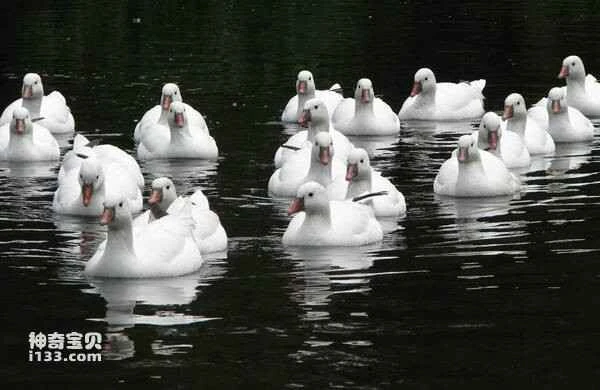
The Slender-billed Goose is entirely herbivorous, foraging for seeds and shoots in fields. Its diet consists mainly of tender leaves, shoots, stems, fruits, seeds, roots and tubers of aquatic plants, reed shoots, and grasses. In winter, it also frequently forages for grains, rice, and crop seedlings in farmland. Its strong beak is well-suited for digging up underground plant roots, hence its primarily herbivorous diet. In the Arctic, it mainly feeds on the roots and stems of various plants, corn seeds from cultivated land, weeds, and horsetails. In its wintering grounds, it primarily consumes grains and the tender shoots of crops.
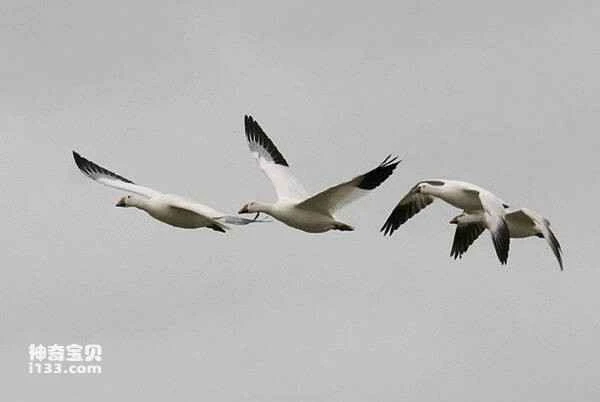
The nesting areas of the Slender-billed Goose and the Snow Goose overlap slightly. However, the two species typically do not interbreed. Mating begins shortly after their arrival in mid-May. Nesting commences shortly thereafter. Nests are generally built on islands or tundra, usually hidden behind small bushes or rocks. Female geese typically lay 4 to 6 eggs per nest.
Listed as Least Concern (LC) on the IUCN Red List of Threatened Species 2012 ver 3.1.
Protect wild animals and ban the consumption of wild game.
Maintaining ecological balance is everyone's responsibility!