
Basic Information
Scientific classification
- Chinese name: Imperial Goose
- Scientific name: Blue Goose, Snowy Blue Goose, Emperor Goose
- Classification: Waterfowl
- Family: Anseriformes, family Anatidae, genus Ansalis
Vital signs data
- Body length: Approximately 68.5 cm
- Weight: About 2.8kg
- Lifespan: No verification data available.
Significant features
It has a gray and plump body, with similar characteristics in both sexes. Adults have a white head and nape, a black throat, a pink beak and webbed legs, black cape feathers, and dark blue-gray plumage covered with white spots.
Distribution and Habitat
The distribution of the Emperor Goose is limited to the Bering Sea. It breeds in Alaska, at the far northeastern tip of the United States in the Arctic and sub-Arctic regions, and winters from the eastern coast to Russia, primarily along the ice floes to the Aleutian Islands coast. Its numbers are relatively small in Canada and the Alaskan Peninsula, with a very small number migrating south to California.
Origin: Russian Federation, USA. Migratory bird: Canada, Japan.
Emperor geese begin their massive spring migration each year, moving from their wintering grounds in the Aleutian Islands or Command Islands of Alaska, Russia, to spring pastures in early March. These geese arrive in the Yukon Territory and Bristol Bay, and the Kascoquim Delta in Canada, between mid-May and late May. They forage in these forage-rich areas during the spring, preparing for nesting in early summer. In late May and early June, they reach their breeding grounds in the Seward Peninsula, St. Lawrence Island, and Siberia. In autumn, they depart in late August and early September, embarking on their return migration, arriving back in the Aleutian Islands by the end of November.
Migration is highly dependent on weather conditions, with birds migrating to foraging grounds in the spring as ice melts. Harsh weather conditions may force Emperor Geese to move on to their next destination, while exceptionally good weather may allow them to make the most of good foraging grounds for an extended period. The distances traveled for wintering and nesting range from 650 to 2500 kilometers.
Appearance
The Emperor Goose averages about 68.5 cm in length, has a wingspan of 110 cm, and weighs 2.8 kg. It has a plump, greyish body. Sexes are similar; adults have white heads and napes, black throats, pink beaks and webbed legs, black cape feathers, and dark blue-grey undercoat covered with white spots. Juvenile Blue Snow Geese also resemble native geese in plumage, but are darker. Emperor Geese and White Snow Geese can interbreed. Their offspring are either pure Blue Snow Geese or pure White Snow Geese. This is very different from humans. The offspring of a white person and a black person will not be entirely white or entirely black.
Detailed introduction
The Emperor Goose (scientific name: Anser canagicus) is a large bird in the Anser genus.
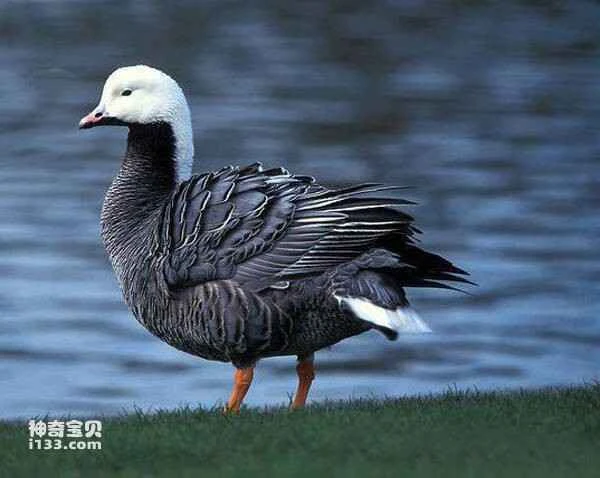
Outside of the breeding season, Emperor Geese move in flocks, typically consisting of dozens, hundreds, or even thousands of birds, especially during migration. They are agile and nimble on the ground, often standing on one leg when resting. They are good swimmers and divers, but cannot sustain diving for extended periods and rarely dive unless absolutely necessary. They are extremely cautious and vigilant, especially when foraging and resting in flocks. Often, one or more greylag geese act as guards, neither eating nor sleeping, alertly stretching their necks to observe their surroundings. Once an enemy is detected approaching, they take flight first, followed by the rest of the flock.
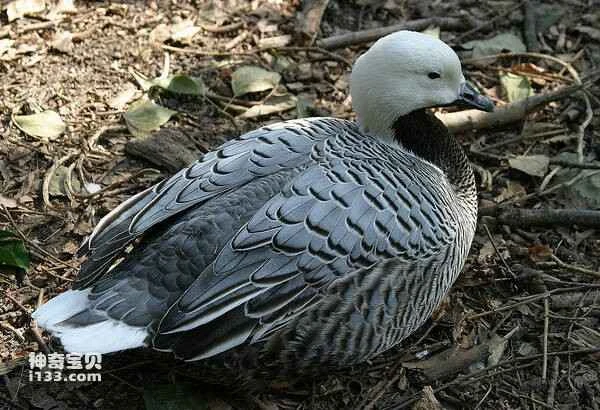
Every year in late May, Emperor Geese arrive at the Arctic coastal plains of Alaska to nest and breed. They typically choose higher ground in the tundra, lining the nesting area with weeds. In early June, they lay a clutch of 4-7 eggs, with an incubation period of 22-23 days. Once the chicks hatch, the mother goose leads her family to a river or stream. Because the newly hatched chicks are unable to fly, they need to find a secluded place to escape predators. During this period, some Emperor goose families will automatically unite with Snow Geese to form a flock of 150-250 birds. Under their mother's diligent care, the chicks thrive and are ready to take flight in just 35-45 days.
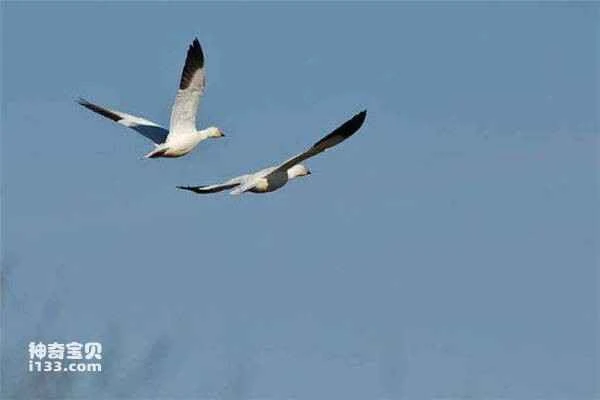
The Emperor Goose has a limited distribution range and is believed to be experiencing a moderate decline in numbers. Although the reasons for this decline are not yet clear, it has been listed as a near-threatened species due to habitat loss.
Listed as Near Threatened (NT) on the IUCN Red List of Threatened Species 2013 ver 3.1.
Protect wild animals and ban the consumption of wild game.
Maintaining ecological balance is everyone's responsibility!


