Basic Information
Scientific classification
- Chinese name: Southern Leaf-tailed Gecko
- Scientific name: Phyllurus platurus
- Classification: Squamata
- Family and genus: Southern paddock gecko family, genus *Leaf-tailed gecko*
Vital signs data
- Body length: Adults can reach a total length of about 15 cm from snout to tail tip, belonging to the medium-sized, flat-bodied leaf-tailed gecko.
- Weight: Weight varies from person to person, with most adult individuals weighing around several tens of grams.
- Lifespan: It is estimated that it can live for about 8–10 years or longer in the wild, and its lifespan may be even longer under suitable captive conditions.
Significant features
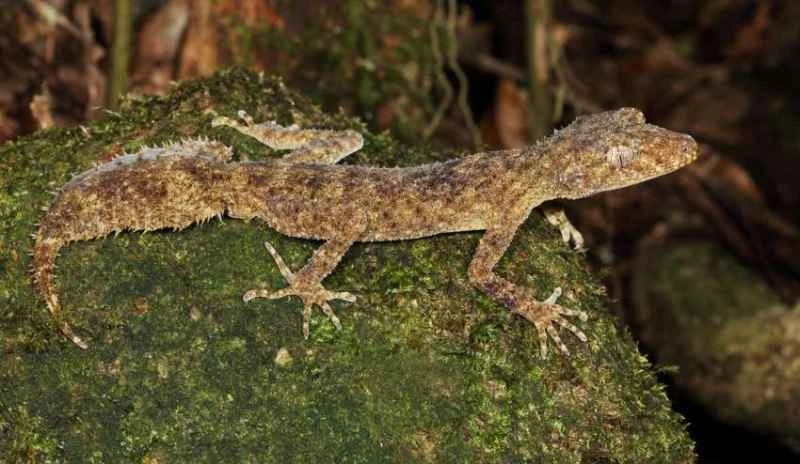
The leaf-tailed gecko, endemic to the Sydney Basin in Australia, has a flat body and a broad, leaf-like tail. Its rough, warty scales and mottled patterns closely resemble sandstone cliffs, making it an expert at camouflage on rock walls and tree trunks at night.
Distribution and Habitat
It is mainly distributed in the Sydney Basin and surrounding areas of New South Wales, Australia. Its typical habitat is the rock walls, boulder piles and rock crevices of coastal sandstone plateaus and valleys, while also utilizing the gaps and shelters provided by nearby woodlands and urban building structures (such as retaining walls, house foundations and garages).
Appearance
Medium-sized with a flattened body, its back is covered with rough, warty scales and small spines. Its body color is brown or gray with spots and cloud-like patterns of varying shades, closely resembling sandstone and tree bark. The tail is broad and flat with irregular edges like dried leaves. The toes have claws rather than well-developed suckers. The head is slightly broad, with large eyes that lack eyelids, and the pupils are vertical slits.
Detailed introduction
The Southern Leaf-tailed Gecko ( Phyllurus platurus ) is a medium-sized gecko with an extremely camouflaged appearance, belonging to the genus Phyllanthus in the family Phyllanthidae. Its body is flat, its tail is broad like a leaf, and its skin is covered with rough, warty scales. Its overall pattern closely resembles the sandstone walls and tree bark commonly found in the Sydney Basin of Australia, making it a master of camouflage against rocks and tree trunks at night.
Classification and nomenclature
The southern leaf-tailed gecko belongs to the class Reptilia, order Squamata, suborder Sauria, family Carphodactylidae, and genus Phyllurus . This genus includes several species of leaf-tailed geckos found in eastern Australia, known for their flattened body and leaf-like tail. Phyllurus platurus was also previously known as the broad-tailed gecko or Sydney leaf-tailed gecko, all names related to its broad, leaf-like tail and typical distribution in the Sydney Basin.
Appearance features
The Southern Leaf-tailed Gecko is a medium-sized animal, with adults reaching approximately 15 cm in length from snout to tail tip. Its body is flattened, with a back covered in rough, wart-like scales and small spines. The skin is brown or gray with varying shades of spots and cloud-like patterns, closely resembling sandstone surfaces, tree bark, and moss. The broad, flat tail resembles a dried leaf, often with irregular notches along the edges, helping to break the silhouette and further camouflage itself. Unlike many geckos, its toes have almost no prominent suckers, instead possessing well-developed claws and toes adapted for climbing rocks and rough bark. The head is slightly broad, with large, protruding eyes lacking eyelids and vertical slit-like pupils—a typical characteristic of nocturnal geckos.
Distribution range and habitat
The Southern Leaf-tailed Gecko is endemic to Australia, primarily distributed in the Sydney Basin and surrounding areas of New South Wales, extending south from Newcastle to the Illawarra region. Its most typical habitats are coastal sandstone plateaus and valleys, including sandstone walls, boulder mounds, rock crevices, and rock surfaces covered with moss and lichen. It is also found in nearby woodlands and rainforest edges. This species is well adapted to urban and suburban environments, often found inhabiting man-made structures such as house facades, retaining walls, fences, garages, and foundation crevices, utilizing the gaps and shelter provided by these artificial environments.
Lifestyle Habits and Behaviors
The southern leaf-tailed gecko is a typical nocturnal lizard. During the day, it usually lies still, close to rock walls or tree trunks, in dark crevices. It also hides in rock crevices, under rocks, in tree root holes, and in the foundations of houses. After nightfall, it emerges from its hiding place and moves slowly across rock surfaces, tree trunks, and building surfaces, ambushing or actively searching for prey such as insects. When threatened, the southern leaf-tailed gecko will remain still, pressed against the substrate, using its markings and body shape for camouflage. If the threat persists, it may open its mouth and hiss, or even raise its body in a threatening posture.
feeding habits
The Southern Leaf-tailed Gecko primarily feeds on invertebrates and is a typical nocturnal insect predator. Its prey includes spiders, moths, beetles, cockroaches, and other nocturnal insects, and occasionally small arthropods and other appropriately sized prey. In urban and suburban environments, they also prey on light-attracted flying insects on walls and near lights around residences, playing a positive role in controlling some pest populations.
Reproduction and life cycle
The Southern Leaf-tailed Gecko is an oviparous species, with its breeding season generally from late spring to summer. Females typically lay 1–2 soft-shelled eggs in moist, sheltered environments (such as rock crevices or under leaf litter), burying them in moist soil or fallen leaves to prevent dehydration. In the wild, the eggs incubate for about two to three months. The larvae are capable of independent living after hatching and can begin preying on small insects within a few days. It takes about two years for the larvae to fully develop into adults, and their lifespan in the wild can reach about ten years, and even longer under captive conditions.
Relationship with humans
Southern leaf-tailed geckos are commonly found around houses or in garages in the Sydney Basin and surrounding urban areas because they effectively utilize crevices in rocks and building structures. They are non-venomous and pose little direct threat to humans; in fact, they act as natural pest control agents by preying on cockroaches, moths, and other insects. However, if roughly handled, they may attempt to bite or struggle, resulting in minor bites or abrasions. In Australia, the collection and keeping of native reptiles are regulated; the general public should focus on observation and protection and avoid arbitrarily capturing or removing individuals.
Protecting the status quo and threats
The Southern Leaf-tailed Gecko is not currently individually evaluated on the IUCN Red List and remains a common species in the Sydney Basin and surrounding sandstone areas. However, urban sprawl, road construction, and habitat fragmentation can still stress local populations, especially when rocky habitats are destroyed or removed. Invasive predators such as domestic cats and foxes also threaten individuals active on the ground. Key measures for the conservation of the Southern Leaf-tailed Gecko include: preserving natural sandstone surfaces and native vegetation as much as possible; maintaining micro-habitat structures such as rocks and driftwood in urban green spaces and residential areas; limiting invasive predator populations; and raising public awareness of the ecological value of native geckos through public education.
Frequently Asked Questions
Q1: Are Southern Leaftail Geckos really only active at night?
Southern leaf-tailed geckos are primarily nocturnal, typically resting during the day close to rock faces or hiding in crevices, under rocks, or in gaps between buildings. They are only occasionally spotted during the day on cloudy days or when sunlight is weak.
Q2: Is the Southern Leaf Gecko poisonous? Will it hurt people?
Southern leaf-tailed geckos do not have venom glands and pose no toxic threat to humans. They are cautious and usually rely on camouflage to remain still or escape slowly. They may bite only when caught or severely frightened, and bites are mostly minor mechanical wounds.
Q3: What should I do if I find a Southern Leaftail Gecko in my home or garage?
In general, simply remain calm and let it leave on its own; there is no need to chase or capture it. If it is absolutely necessary to remove it from indoors, contact a local wildlife rescue or reptile rescue organization for professional handling to avoid accidentally injuring the gecko or being bitten.
Q4: What role does the Southern Leaftail Gecko play in the ecosystem?
The southern leaf-tailed gecko primarily preys on insects and other invertebrates, helping to control populations of spiders, cockroaches, and beetles. It is an important small predator in rocky and urban fringe ecosystems, while also providing a food source for birds of prey and large reptiles.