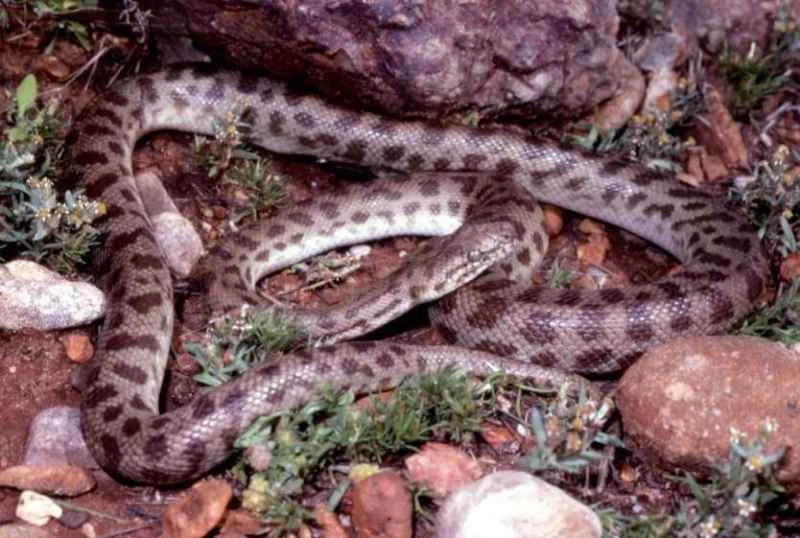
Basic Information
Scientific classification
- Chinese name: Scylla serrata
- Scientific name: Antaresia stimsoni
- Classification: Squamata
- Family and genus: Pythonidae, genus *Boracopteris*
Vital signs data
- Body length: Adults are generally about 90–120 cm in total length, which is a small python with a relatively small and sturdy body.
- Weight: Weight varies with individual and nutritional status, with most adult individuals weighing between several hundred grams and 1 kilogram.
- Lifespan: It is estimated that it can survive for more than ten years in the wild, and its lifespan is often longer under suitable breeding conditions.
Significant features
The small, non-venomous python, endemic to Australia, is generally less than 1.2 meters long. Its back is light brown or sandy with dark spots. It is adapted to arid and semi-arid environments and has a relatively docile temperament. It is a common and popular small python.
Distribution and Habitat
It is widely distributed in the arid and semi-arid regions of the Australian outback and north, including rocky slopes, gravel plains, dry scrubland, savanna, and around farms and pastures. It prefers micro-habitats with hiding places such as rock crevices, piles of stones, burrows, and tree root crevices.
Appearance
The body is slightly slender but muscular, with a light brown, yellowish-brown or sandy base color on the back, covered with dense dark brown to reddish-brown spots or irregular horizontal stripes, and a cream or pale yellowish-gray belly. The head is slightly broad and clearly distinguished from the neck, with medium-sized eyes and vertically slit pupils, giving it an overall appearance of being "small and finely patterned".
Detailed introduction
Stimson's Python (commonly known as * Antaresia stimsoni *) is a small, relatively docile native Australian python belonging to the genus *Antaresia* in the family Pythonidae. It is known for its dense, dark spots and its ability to adapt to arid and semi-arid environments, and is one of the most common and popular small, non-venomous pythons in Australia. In modern taxonomic research, some scholars consider it a regional type or allspecific variation of * Antaresia childreni *, but the name "Stimson's Python" remains widely used among amphibian and reptile enthusiasts and pet owners.
Classification and nomenclature
Antaresia, belonging to the class Reptilia, order Squamata, suborder Serpentes, family Pythonidae, and genus Antaresia , is a genus of small Australian pythons. This genus includes several small Australian pythons such as the juvenile python and the Angora python, generally characterized by their small size, non-venomous nature, and high adaptability. The traditional scientific name for Antaresia is *Antaresia stimsoni *, with the specific epithet "stimsoni" named in honor of the Australian zoologist A.J. Stimson. While some recent taxonomic studies have tended to classify it under the juvenile python category, it is still widely used as a distinct name in practice.
Appearance features
The Skavenboa is a small python, with adults typically measuring 90–120 cm in total length, though a few individuals may be slightly longer but still much smaller than larger pythons. Its body is somewhat slender but muscular, with a slightly broad head that is clearly distinguishable from the neck, but not excessively so. The back is typically light brown, yellowish-brown, or sandy, covered with dense dark brown to reddish-brown spots or irregular transverse bands, forming a very beautiful pattern, particularly suitable for camouflage among rocks, gravel, and dry grass. The underside is lighter in color, generally cream or pale yellowish-gray, with fewer spots. The eyes are medium-sized with vertically slit pupils, a typical characteristic of nocturnal snakes. Overall, its appearance gives the impression of being "small and delicate, with intricate patterns."
Distribution range and habitat
The Skaven's python is endemic to Australia (or regionally endemic), widely distributed in the interior and north, in arid and semi-arid regions, including Western Australia, the Northern Territory, the Queensland interior, and parts of South Australia. They are adapted to a variety of terrestrial habitats, such as rocky slopes, gravel plains, dry scrub, savanna, and areas surrounding farms and pastures. Skaven's pythons particularly prefer environments with rock crevices, piles of stones, burrows, and tree root crevices, where they spend the day hiding from the heat and predators, and are active on the ground or among low bushes at night.
Lifestyle Habits and Behaviors
Staffordshire pythons are primarily nocturnal or twilight-active snakes. During the day, they typically rest in rock crevices, caves, tree root gaps, or under man-made structures (such as farm buildings, sheet metal, or piles of planks) to avoid strong sunlight and high temperatures. At night, they slowly roam among the ground, rocks, and bushes, searching for small prey. In terms of temperament, Staffordshire pythons are generally docile, often choosing to hide or curl up defensively when threatened. However, if repeatedly provoked, roughly grasped, or cornered, they will hiss and attempt to bite in self-defense. Due to their non-venomous nature and small size, they pose a very low direct threat to humans.
feeding habits
The Skaven's python is a carnivorous predator, primarily feeding on small mammals (such as rodents), lizards, and occasionally birds or bird eggs. In the wild, it often hunts using a combination of ambush and short-range strikes: lurking near burrow entrances, rock crevices, or animal-traced paths, it swiftly lunges forward and constricts its prey with its characteristic python-like constriction technique, suffocating it before swallowing it whole. In farm and storage environments, the Skaven's python also actively preys on rodents, potentially contributing to rodent population control.
Reproduction and life cycle
The Skaven's python is an oviparous python. The breeding season typically occurs in the local spring and early summer. Males actively seek out females, and fighting between males may occur. After mating, the female lays several eggs in secluded locations such as burrows, under tree roots, or in rock crevices; a clutch size usually ranges from 5 to 20 eggs. The mother coils around the eggs, using muscle tremors to help regulate their temperature, exhibiting a degree of parental care behavior. Under suitable temperature and humidity, the eggs incubate for several weeks to months. The hatchlings, though small, are already capable of independent survival and can begin preying on small rodents and lizards. Skaven's pythons are estimated to live for over ten years in the wild, and often even longer in captivity.
Relationship with humans
Due to their non-venomous nature, moderate size, and beautiful markings, the Skaven's python is a popular small python species in Australia and overseas reptile enthusiast circles. In Australia, the collection and keeping of native reptiles in the wild is strictly regulated, requiring a license in most areas; in some countries and regions, legally bred individuals have entered the pet market. For farmers and rural residents, the Skaven's python is considered a relatively "friendly" snake because it helps in hunting small rodents such as mice. Even so, when encountering a Skaven's python in the wild, respect and distance should be maintained, and it should not be captured or disturbed.
Protecting the status quo and threats
In the IUCN Red List, the Southern Python population, which is associated with the Skowper's Python, is generally classified as "Least Concern," reflecting its wide distribution and continued presence in many areas. However, local populations remain threatened by habitat degradation, roadkilling, invasive predators such as domestic cats and foxes, and illegal collection for the pet trade. Key measures for protecting the Skowper's Python and its close relatives, the Southern Python, include: maintaining native vegetation and rocky habitats in arid and semi-arid regions; preserving a number of natural rock mounds and burrows in farm and ranch management; controlling invasive predator populations; and restricting illegal capture and trade through legislation and regulation.
Frequently Asked Questions
Q1: Are Skaven pythons venomous?
The Skaven (also known as the python) is a non-venomous snake belonging to the Pythonidae family. It lacks venom glands and poses no threat to humans through venom. Bites are primarily mechanical wounds, which generally only require cleaning, disinfection, and observation for infection.
Q2: What is the relationship between Strychnine python and baby python?
In traditional classification, the stimsoni python is considered a separate species, *Antaresia stimsoni *; however, some recent studies tend to view it as a regional type or allophane variant of the children's python (* Antaresia childreni* ). Regardless, both belong to the genus *Antaresia*, and are small, non-venomous pythons with very similar appearances and ecological habits.
Q3: Are Staghorn pythons suitable as pets?
Provided it is legal and the individuals are sourced legally, the Skaven's python is considered by many reptile enthusiasts as a suitable entry-level python for intermediate keepers due to its moderate size, relatively docile temperament, and less demanding environmental requirements compared to larger pythons. However, it is still a wild animal and requires appropriate temperature, humidity, shelter, and a reasonable feeding schedule.
Q4: What should you do if you encounter a Skaven in the wild?
The best approach is to keep your distance, avoid disturbing it, and let it leave on its own. If found in residential areas or farm buildings, contact your local wildlife rescue or reptile handling agency for safe removal by professionals. It is not recommended to capture or drive it away yourself.


