Basic Information
Scientific classification
- Chinese name: Pink-footed Goose
- Scientific name: Pink-footed Goose, Anser brachyrhynchus
- Classification: Waterfowl
- Family: Anseriformes, family Anatidae, genus Ansalis
Vital signs data
- Body length: 60-75 cm
- Weight: 2.2-2.7kg
- Lifespan: Approximately 22 years
Significant features
Its head and neck are dark, its beak is yellow with black patches, and its pink legs are its most distinctive feature.
Distribution and Habitat
Distributed in North America, including the United States, Canada, Greenland, Bermuda, Saint Pierre and Miquelon, and the transitional zone between North and Central America within Mexico. Also found in Eurasia and North Africa, including all of Europe, Africa north of the Tropic of Cancer, the Arabian Peninsula, and Asia north of the Himalayas-Hengduan Mountains-Minshan Mountains-Qinling Mountains-Huai River.
Appearance
The Pink-legged Goose measures 60-75cm in length, has a wingspan of 145-160cm, weighs 2200-2700g, and has a lifespan of 22 years. It has relatively small legs compared to other goslings, a short neck, and a compact head and beak, making it most closely related to the Greylag Goose. Its head and neck are dark, its beak is yellow with black patches, and its pink legs are its most distinctive feature. The main body color is relatively light, primarily light brown and grey with white feather edges. Most notably, the tail feathers are black in the center with broad white edges. The shoulder and primary flight feathers form almost a spectrum: silver-grey, pink, and grey.
In the phylogenetic relationships of geese in the genus *Aeschynanthus*, four evolutionary branches have been formed, with the pink-legged goose belonging to one of them.
Detailed introduction
The Pink-footed Goose (scientific name: Anser brachyrhynchus) is a large bird in the Anser genus.
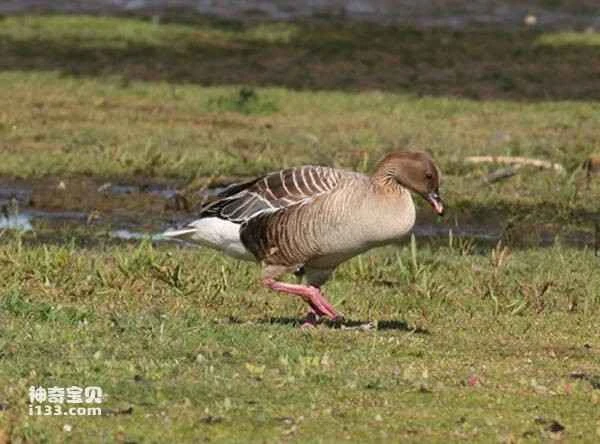
Pink-legged geese inhabit the Arctic tundra, marshes, and ponds in the summer, building their nests in a variety of environments, including flatlands, steep cliffs, and very dry ground. In winter, they frequent meadows, harvested potato fields, or grain fields. They rely on large lakes or estuaries for shelter. This is a migratory species. In late August, they leave Svalbard, Iceland, and eastern Greenland, flying to the British Isles, the Danish coast, and the North Sea. The westernmost species reach the southern coasts of Flanders and Calais, Ireland, and Calais.
Like all geese, the pink-legged goose has a powerful flight ability, stretching its neck to maintain the same distance as its companions. This allows it to successfully cross oceans and mountains during migration.
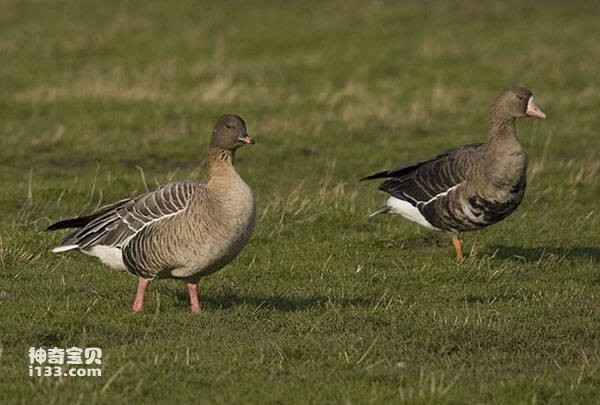
The pink-legged goose is a highly herbivorous bird. When staying in tundra, it feeds on the roots and seeds of terrestrial plants and aquatic herbs. In winter, they make full use of crops, causing damage to seedlings. Bird conservation experts believe that some winter grains should be selectively preserved for the pink-legged geese to eat. Practice has shown that potato tubers are more attractive to these geese, especially during their autumn migration.
Goose nests are lined with moss, lichen, and feathers. Each female goose lays 4 to 5 eggs per nest. Incubation lasts 25 to 28 days and is performed solely by the female. The goslings are able to fly after approximately 56 days.
Listed in the International Union for Conservation of Nature (IUCN) Red List of Birds, 2009 ver 3.1.
Protect wild animals and ban the consumption of wild game.
Maintaining ecological balance is everyone's responsibility!