
Basic Information
Scientific classification
- Chinese name: Hawaiian duck
- Scientific name: Hawaiian Duck, Anas wyvilliana, Hawaiian Duck, Koloa
- Classification: Waterfowl
- Family: Anseriformes, Anatidae, Anatidae
Vital signs data
- Body length: 40-50 cm
- Weight: 460-604g
- Lifespan: No verification data available.
Significant features
It is a timid and mysterious medium-sized duck.
Distribution and Habitat
They primarily inhabit the Hawaiian Islands, found only on Kauai, Niihau, and the largest U.S. National Wildlife Refuge on Kauai. Captive Hawaiian ducks have been reintroduced to Hawaii Island, Oahu, and Maui, but the proportion of Hawaiian ducks and mallards interbreeding is very high on all three islands.
Inhabits tall wetland grasslands and streams near Kola Superior on the main island of Hawaii. It lives in wetlands and the hottest coastal areas, with habitats ranging from sea level to 3,300 meters, encompassing suitable ponds and mountainous regions. These include lowland wetlands, river valleys, coastal ponds, lakes, swamps, submerged grasslands, mountain streams, and artificial waterholes, and occasionally, swamp forests.
Appearance
The Hawaiian duck weighs 460-604 grams, is 40-50 cm long, and has a wingspan of 81-98 cm. It was once thought to be an island subspecies of the mallard. It is a timid and mysterious medium-sized duck. Although it resembles the more common mallard in appearance, its behavior differs due to genetic differences. The Hawaiian duck is smaller, with both males and females having mottled brown plumage. Males are usually larger and slightly darker than females, with bluish-green feathers and green to blue speculum bordered by white on the sides. The tail is generally dark, while the neck is sometimes green and glossy. The feet and legs are orange to orange-yellow. The male's beak is bright olive green, while the female's beak is dark orange with dark markings. Adult males have a darker head and neck, sometimes also green. Females are usually lighter in color than males, with paler hind feathers. A one-year-old male Hawaiian duck looks like an enlarged mallard.
Detailed introduction
The Hawaiian Duck (scientific name: *Anas wyvilliana*), also known as the Hawaiian Duck or Koloa, is a waterfowl belonging to the family Anatidae and the genus *Anas*. The native Hawaiian name for this duck is "koloa maoli," meaning "native duck," often shortened to "koloa." Local Hawaiian tradition says that Hawaiian ducks can only get wet when the gods permit it. This means that Hawaiian ducks can only get wet with divine permission, as they appear to walk around water sources. This is solely because they are searching for prey. According to Hawaiian legend, Hawaiian ducks have been guides for the fierce, blind warrior king "Imaikalini." It is said that when the warrior king went to war, Hawaiian ducks would guide him to the enemy. They quacked to indicate their location.
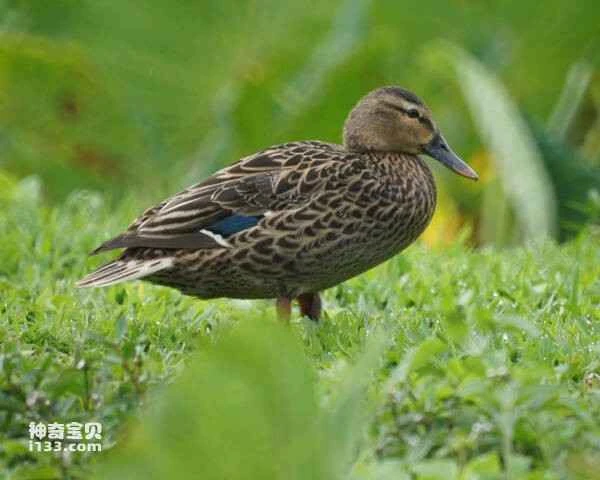
Hawaiian ducks are cautious, secretive, and vigilant birds, especially during breeding and molting seasons. They are diurnal, usually solitary or in pairs rather than flocks. This species does not migrate between islands due to changes in rainfall or food availability. They are strong and agile birds, primarily active between islands. They are generally not very vocal. Sometimes they quack like mallards, but their calls are usually softer and the quacking frequency is lower.
Hawaiian ducks are omnivorous, primarily foraging in shallow water, feeding on aquatic insects, mollusks, crustaceans, and more. Their diet includes freshwater vegetation, mollusks, insects, and other aquatic invertebrates. Specifically, they consume snails, insect larvae, crayfish, mosquito larvae, mosquito eggs, grass seeds, plant seeds, and green algae.
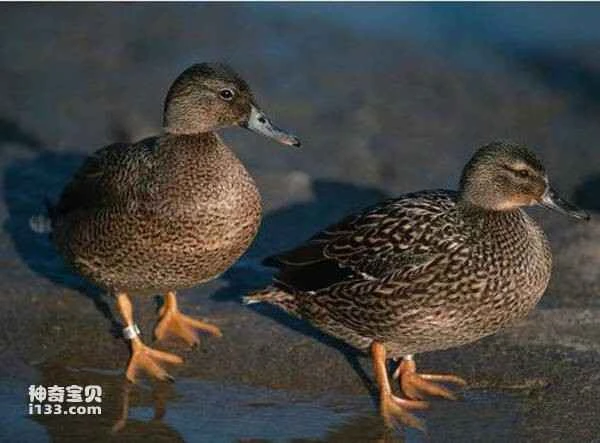
Hawaiian ducks are monogamous. This means they will remain together during the breeding season. Some pairs nest year-round, but the main breeding season is from December to May. During this time, pairs of Hawaiian ducks often participate in spectacular wedding flights. The female builds a concealed, bowl-shaped nest using plant stems, placed above nearby water and hidden among aquatic plants. Each clutch contains 2-10 eggs, which are lined with down and breast feathers. Incubation lasts about 4 weeks. The ducklings mature early and can enter the water soon after hatching, but they don't fly until about 9 weeks old, spending most of their time in the water with their mother until they become independent. They reach reproductive maturity enough to breed after one year.
The Hawaiian duck is classified as endangered because its distribution is presumably very small and scattered on a few islands where wetlands are disappearing and degrading, and hybridization is gradually reducing the number of purebred individuals. The total Hawaiian duck population is estimated at 2,200, including 1,500 adults. The species has been declining. In 2005, its total population was 2,525, but this was revised to 2,200 in 2007. The population on Kaua is estimated at 2,000. Other islands average 200 each. In 1997, 5–11 were seen on Maui. Additionally, there are approximately 300 on O'ahu and approximately 50 on Maui, all of which are purebred Hawaiian ducks (US Fish and Wildlife Service 2005). However, most of the ducks on these two islands are hybrids of mallards and Hawaiian ducks. Due to the difficulty in identifying and distinguishing hybrids, the distribution and abundance of this species in certain areas are unclear (US Fish and Wildlife Service, 2005).
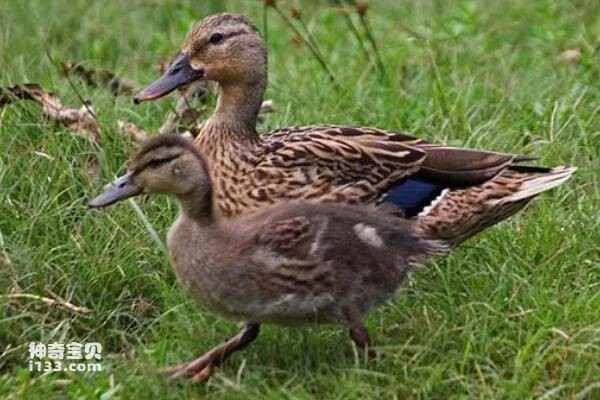
Hybridization is considered one of the most serious but neglected threats to Hawaiian ducks, particularly hybridization between Hawaiian ducks and wild ducks. Hawaiian duck populations are also affected by habitat loss, wetland habitat alteration for flood control, invasive non-native plants, diseases, environmental pollutants, hunting, and predation. Predatory threats to these birds include wildcats, rats, and Asiatic mongooses that eat duck eggs and ducklings. Hawaiian ducks are also threatened by dogs, introduced fish, and other birds introduced to their habitats. Hunting of waterfowl in these areas from the 1800s to the 1900s also played a significant role in the decline of this species. Urban development, due to land use for local agriculture and the loss of its natural habitat, plays a significant role in the decline of this endangered species. Among the threats of urban development, some issues have emerged, such as anthropogenic interference from the entertainment or tourism industries.
On Kauai, the Hanare National Wildlife Refuge is an important habitat for this species, especially during the winter. The species was reintroduced to Oahu by the release of 326 captive birds between 1958 and 1982. In 1989, fewer than 12 captive birds were released on Maui; the species was also re-established on the Big Island between 1976 and 1982 by the release of captive birds (US Fish and Wildlife Service, 2005). In the late 1980s, imports of Hawaiian ducks were restricted by the state, with exceptions for research and exhibition (Uyehara et al., 2007). In 2002, the Department of Agriculture imposed an embargo on all birds shipped to the Hawaiian Islands to protect the public from West Nile virus. Research is underway to develop techniques for identifying hybrids, which will require simultaneous genetic testing and morphological characterization.
Develop techniques for identifying cultural hybrids of Hawaiian ducks and mallards. Determine the range, behavior, and abundance of Hawaiian duck and mallard hybrids, and estimate the degree of hybridization. Control tiger prawns and hybrids aggressively and humanely. Restore wetlands and continue to enhance and create wetlands through the USDA's Wetland Conservation Program. Control predators where feasible. Raise awareness among policymakers and the public about threats to Hawaiian ducks and the need for control. Prevent the importation and release of Hawaiian ducks and related species. Protect and manage core and auxiliary wetlands and control invasive plants. Conduct environmental education programs for landowners and land managers. Identify reintroduction sites on Maui and Molokai and assess future uses for captive breeding and translocation. Reintroduce captive-bred or transferred birds to protected and managed sites on Maui and Molokai and monitor these new populations. Control wild mallards.
Listed as Endangered (EN) in the IUCN Red List of Threatened Species 2016 ver 3.1.
Protect wild animals and ban the consumption of wild game.
Maintaining ecological balance is everyone's responsibility!


