Basic Information
Scientific classification
- Chinese name: Silver Duck
- Scientific name: Silver Teal, Anas versicolor
- Classification: Waterfowl
- Family: Anseriformes, Anatidae, Anatidae
Vital signs data
- Body length: No verification information available.
- Weight: No verification information available.
- Lifespan: No verification data available.
Significant features
Distribution and Habitat
They are distributed in South America, including Colombia, Venezuela, Guyana, Suriname, Ecuador, Peru, Bolivia, Paraguay, Brazil, Chile, Argentina, Uruguay, and the Falkland Islands (also known as the Malvinas Islands).
They typically inhabit freshwater lakeshores, and also live in groups in rivers, lakes, reservoirs, bays, and coastal salt flats.
Appearance
The silver duck has a black cap that extends below its eyes. Its cheeks are white. Its bill is blue with a yellow base. The upper body feathers are predominantly brown and tan with pale edges. In flight, green speculum with white borders can be seen on its wings. The female's bill is slightly brownish.
Detailed introduction
The Silver Teal (scientific name: Anas versicolor) has three subspecies. It is a medium-sized waterfowl belonging to the genus Anas in the family Anatidae.
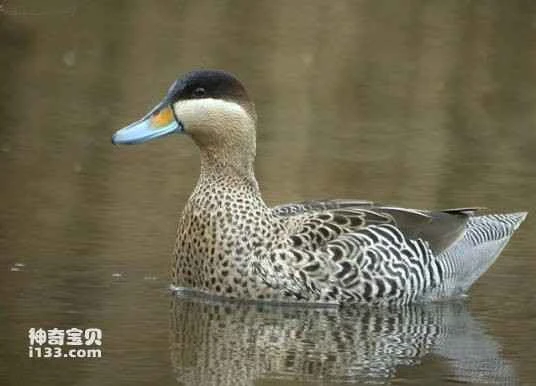
Silver ducks primarily float on the water's surface, foraging underwater. Their diet consists mainly of plants, but they sometimes consume animal matter. They have webbed toes but rarely dive, swimming with their tails above the water. They are adept at foraging, playing, and courting in the water. They are clean animals, frequently preening their feathers both in the water and on land. Their diet consists mainly of roots, seeds, leaves, cardamom, and rice from marshes and lakes, but they also eat invertebrates and arthropods.
The breeding season for silver ducks is from October to February. They build a bowl-shaped nest using plant stems, placing it above the nearby water and concealing it among aquatic plants. Each nest contains 4 to 12 eggs, which incubate for 30 days. The chicks leave the nest at 60 days old and are usually incubated solely by the female duck. After hatching, the female continues to care for the chicks, who follow her to forage.
Listed in the International Union for Conservation of Nature (IUCN) Red List of Birds, 2009 ver 3.1.
Protect wild animals and ban the consumption of wild game.
Maintaining ecological balance is everyone's responsibility!