Basic Information
Scientific classification
- Chinese name: African Yellow-billed Duck
- Scientific name: African Yellow-billed Duck, Anas undulata
- Classification: Waterfowl
- Family: Anseriformes, Anatidae, Anatidae
Vital signs data
- Body length: 51-58 cm
- Weight: No verification information available.
- Lifespan: No verification data available.
Significant features
It has green speculum with white frames on its wings, a bright yellow duckbill, and black eyes and legs.
Distribution and Habitat
It is distributed in south-central Africa, including the southern Arabian Peninsula and the entire African continent south of the Sahara Desert (Tropic of Cancer).
They typically inhabit freshwater lakeshores and also live in groups in rivers, lakes, reservoirs, and bays, avoiding coastal tidal flats and salt fields.
Appearance
The African Yellow-billed Duck is 51-58 cm long, with a grey body, darker head feathers edged with white. It has green speculum on its wings with white borders. It has a bright yellow bill, black eyes, and black legs. Males and females are very similar, with juveniles being slightly paler.
Detailed introduction
The African Yellow-billed Duck (scientific name: Anas undulata) has two subspecies and is a medium-sized waterfowl belonging to the genus Anas in the family Anatidae.
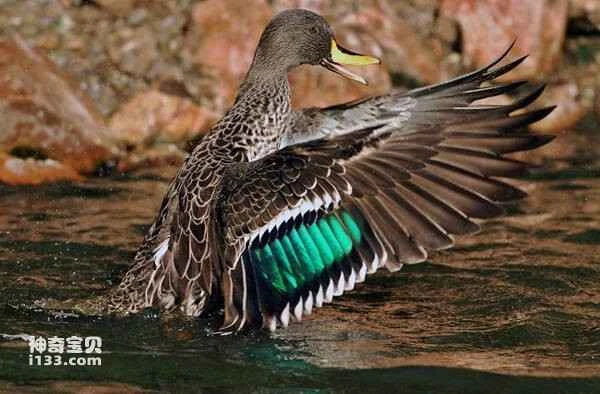
African yellow-billed ducks primarily float on the water's surface, foraging underwater. Their diet consists mainly of plants, but they sometimes consume animal matter. While their toes are webbed, they rarely dive, keeping their tails above water when swimming. They are adept at foraging, playing, and courting in the water. Their diet consists mainly of roots, seeds, leaves, cardamom, and rice from swamps and lakes, and they also eat invertebrates and arthropods.
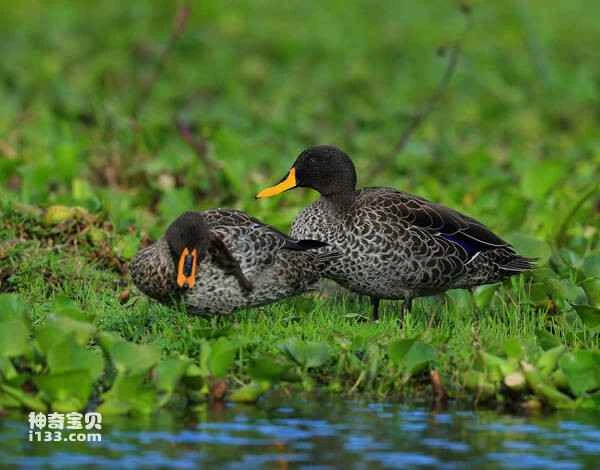
The African Yellow-billed Duck is mainly distributed in South Africa, where it is very common. They live in various types of wetlands and can lay eggs and breed year-round. The female builds the nest, laying 6-12 eggs at a time, one per day. The female incubates the eggs alone for 26-29 days. Afterward, the ducklings are cared for by the female, following her in foraging. They take their first flight after 68 days and become completely independent after 6 weeks.
Listed in the International Union for Conservation of Nature (IUCN) Red List of Birds, 2009 ver 3.1.
Protect wild animals and ban the consumption of wild game.
Maintaining ecological balance is everyone's responsibility!