Basic Information
Scientific classification
- Chinese name: Brown-headed jade
- Scientific name: Halcyon albiventris, Brown-hooded Kingfisher
- Classification: Climbing birds
- Family and Genus: Order Coraciiformes, Family Kingfisher, Genus Kingfisher
Vital signs data
- Body length: 23-24 cm
- Weight: No verification information available.
- Lifespan: No verification data available.
Significant features
Distribution and Habitat
It is distributed in south-central Africa (including the southern Arabian Peninsula and the entire African continent south of the Sahara Desert (Tropic of Cancer)).
They typically inhabit dense forests and riverbanks near water, and are active in scenic areas, gardens, coconut plantations, mango groves, or the edges of evergreen forests.
Appearance
The Brown-headed Kingfisher is 23-24 cm in length. Adult males have brown plumage with black stripes from the crown to the neck. The rump and cape are black, while the throat, underparts, and tail are white. The belly and sides have varying degrees of cream coloration, depending on the individual. The rump and tail are blue. The beak is red with a small black spot at the tip. Females are slightly larger than males, and their plumage differs slightly: the stripes on the crown are not black, while the tail and wings have a greenish tinge. Juveniles closely resemble females; their plumage is darker.
The beak is thick and long, resembling a chisel, with a relatively wide base, a straight beak peak, a rounded ridge, and no nasal grooves on either side; the wings are rounded, with the first primary flight feather being the same length as or slightly shorter than the seventh primary flight feather, and the second, third, and fourth primary flight feathers being nearly the same length; the base of the primary flight feathers has white spots; the tail is rounded.
Detailed introduction
The brown-headed kingfisher, scientifically known as Halcyon albiventris, has four subspecies.
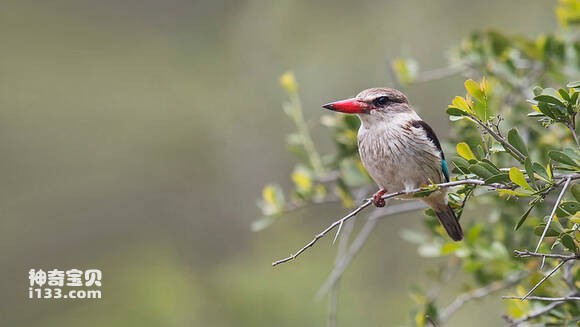
Brown-headed kingfishers typically hunt alone or in pairs. Like most forest kingfishers, they are entirely carnivorous, often searching for prey in leaves or soil. Their main diet consists of invertebrates such as crickets, spiders, scorpions, and snails. They also eat small vertebrates such as small fish, snakes, and lizards.
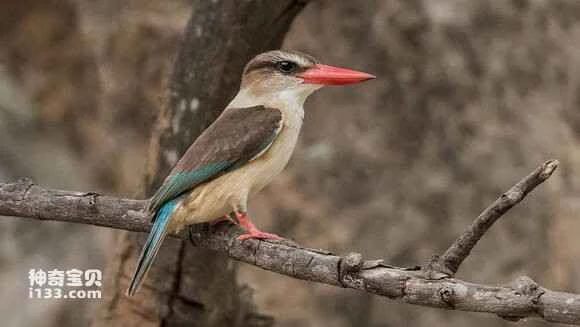
The Brown-headed Kingfisher lays its eggs from September to December. It nests in cliff faces or river embankments, using its beak to dig a one-meter-long sloping tunnel as its nest. These burrows are generally unlined. The eggs are laid directly on the ground inside the nest. The female lays 4 to 5 eggs, each about 27.5 mm in size. Incubation lasts 14 days.
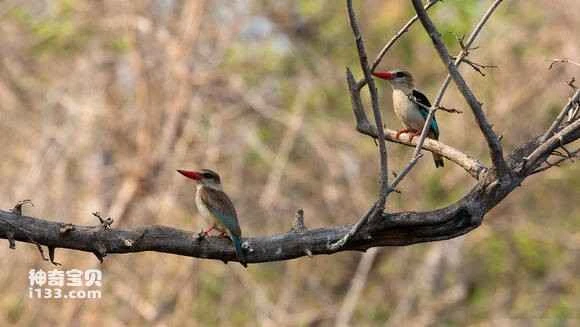
Listed as Least Concern (LC) on the IUCN Red List.
Protect wild animals and ban the consumption of wild game.
Maintaining ecological balance is everyone's responsibility!