Basic Information
Scientific classification
- Chinese name: Russet web-slinging spider
- Scientific name: Asianopis subrufa (former name Deinopis subrufa)
- Classification: Arthropoda
- Family: Asianopis
Vital signs data
- Body length: Female spiders are about 25 mm long, and male spiders are about 22 mm long; their leg span can reach several centimeters.
- Weight: Relatively light, mostly in the hundreds of milligrams range, depending on individual size.
- Lifespan: Estimated to be 1–2 years or even longer, but specific lifespan data lacks systematic research data.
Significant features
A typical web-casting predator, it throws small webs at night; its anterior and middle eyes are large and adapted to low light; its body color is reddish-brown, making it a representative ogre-faced spider.
Distribution and Habitat
It is mainly distributed in eastern Australia and Tasmania, and has been recorded in New Zealand and other places. It is often found in areas with rich vegetation such as forests, scrublands, forest edges and gardens.
Appearance
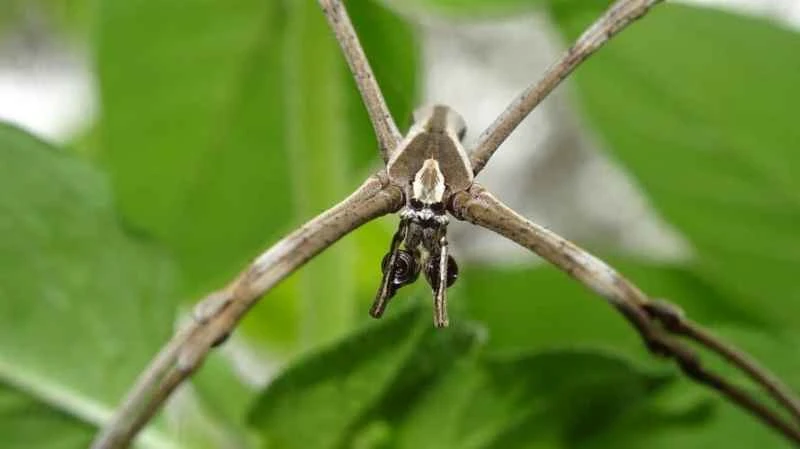
It has a slender body and long, thin legs. Its body color ranges from light yellowish-brown to chocolate brown, and it has irregular markings on its back. Its two large eyes are very conspicuous on the front of its face.
Detailed introduction
The Rufous Net-casting Spider (Asianopis subrufa ) is a well-known net-casting spider (formerly known as Deinopis subrufa ). Belonging to the family Deinopidae , it is famous for catching insects at night by throwing its web, and is one of the most representative species of the "ogre-faced spider."
Basic Information
Current scientific name: Asianopis subrufa
Common old name: Deinopis subrufa
English name: Rufous Net-casting Spider
Family: Deinopidae; Genus: Asianopis
Size: The female spider is about 25 mm long, and the male spider is about 22 mm long. The legs are slender and the leg span can reach several centimeters.
Lifespan: No precise data available, but it is estimated that they can live for 1–2 years or even longer.
Appearance and Identification Features
The reddish-brown web-spreading spider has a slender body and a posture resembling a "dead branch." Its body color ranges from light yellowish-brown and pinkish-brown to chocolate brown . Its back often has irregular patterns, which helps it to camouflage itself among branches and leaves during the day.
Its most striking feature is its enormous fore-and-middle eyes , forming two prominent "night-vision eyes" in front of its face, giving it a somewhat "strange" appearance, hence the common name "ogre-faced spider." These large eyes possess extremely high light-gathering capabilities, enabling it to track prey in near-total darkness.
Distribution range and habitat
The reddish-brown web-throwing spider is mainly distributed in eastern Australia and Tasmania , including Queensland, New South Wales, and Victoria, and has been recorded settling in places such as New Zealand.
They often appear in:
Damp forests and thickets;
Forest edges, thickets, and areas near stone walls and tree trunks;
Environments with some vegetation, such as gardens and house exteriors, on the edge of human settlements.
During the day, the reddish-brown web-spreading spider usually clings tightly to branches, leaves, or walls, its four legs held together in a thin stick, almost blending into its surroundings.
Net casting method
The reddish-brown web-casting spider is a typical example of a web-casting predator. After nightfall, it weaves a small rectangular web made of highly elastic spider silk. The web is relatively loose, similar to "wool fabric," and can effectively entangle the feet and antennae of insects.
The spider hangs upside down on a horizontal silk thread, using its forelegs and midlegs to stretch the small web into a square shape, suspending it below its body. When an insect passes by on the ground or tree trunk, it quickly pounces downwards or forwards, stretching the web to encircle its prey, then wraps it with more silk and injects venom.
Diet and ecological role
The main prey of the russet web-slinging spider is:
Ants, beetles, crickets, and other insects;
Small spiders and other arthropods.
It is nocturnal and a typical ambush predator , helping to control the populations of various insects and arthropods in forest edges and gardens, and playing an important regulatory role in the ecosystem.
Toxicity and Effects on Humans
The reddish-brown web-throwing spider possesses venom glands to paralyze its prey, but its venom and size are relatively limited compared to humans. Current data indicates that it is not considered a dangerous species to humans ; bites are extremely rare, and even when a bite occurs, symptoms are generally limited to mild, localized pain or discomfort.
Overall, it is a spider with unique behavior, high ornamental value, and extremely low threat to humans, making it more suitable as a "star species" in nature education and popular science.
References
Austin, AD and Blest, DA (1979). Biology of two species of Australian tarantulas. London Journal of Zoology 189: 145-156.
Clyne, D. (1967). Notes on the construction of the web and silk web of the silkworm spider Dinopis subrufus (Koch) (Arachnidae). Australian Zoologist 14: 189-197.
Framenau, VW, BC Baehr and P. Zborowski. 2014. The Australian Spider Guide. New Holland Press.
McKeown, KC (1963). The Australian Spider. Angus and Robertson Press.
Frequently Asked Questions
Q1: Is the reddish-brown web-spreading spider dangerous to humans?
It is generally considered to pose almost no danger to healthy people. It primarily preys on small insects and has very little opportunity for contact with humans.
Bites are rarely reported and the symptoms are usually mild.
Q2: How to identify the reddish-brown web-spreading spider?
Adults have slender bodies and long legs, and their body color ranges from light yellowish-brown to chocolate brown.
Its most distinctive feature is the two extremely large anterior median eyes on the front of its face, which it uses to "cast" small webs at night to catch prey, making it a highly representative species among web-casting spiders.
Q3: What kind of environment does it live in?
Commonly found in forests, woodland edges, and gardens in eastern Australia and Tasmania.
They are hung between tree branches or walls at night, and during the day they are attached to tree branches or leaves to disguise themselves as dead branches.
Q4: Why is it called the "Rufous" web-throwing spider?
"Subrufa" means "reddish," and many individuals are reddish-brown or pinkish-brown in color.
Hence the name Rufous Net-casting Spider.


