Basic Information
Scientific classification
- Chinese name: Red-headed mouse spider
- Scientific name: Missulena occatoria
- Classification: Arthropoda
- Family: Ratmanidae; Genus: Ratmanidae
Vital signs data
- Body length: Female spiders are about 20–24 mm or even longer, while males are about 10–15 mm long, making them relatively large among mouse spiders.
- Weight: The specific weight varies from individual to individual. Large female spiders can weigh less than a few grams, which is significantly heavier than that of male spiders.
- Lifespan: Female spiders can live in their burrows for several years, estimated at 8–10 years or even longer; male spiders, after reaching maturity, generally only live for a few months to 1–2 years.
Significant features
The spider has an enlarged cephalothorax, with males having red heads and blue abdomens, exhibiting distinct sexual dimorphism; it digs deep burrows with double "trap doors"; spiderlings can spread widely by drifting through balloons; and its venom has high potential toxicity.
Distribution and Habitat
They are found in almost all of the Australian continent, preferring open woodlands, grasslands, shrublands and riverbank slopes, and can also burrow into the edges of suburban gardens and lawns.
Appearance
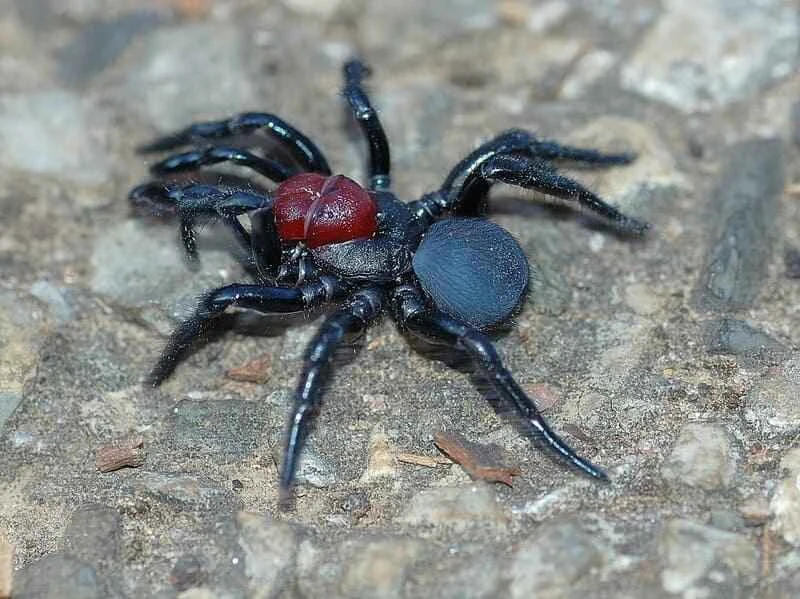
It has a short, stout body with a high-arched forequarters and large chelicerae; the male spider has a bright red head and thorax and a bluish-black abdomen, while the female spider is dark brown to black overall and is more robust.
Detailed introduction
The red-headed mouse spider ( Missulena occatoria ) is a large mouse spider widely distributed in Australia, belonging to the genus Missulena in the family Actinopodidae . The male has a bright red cephalothorax and a bluish-black abdomen, making it very conspicuous and one of the most easily recognizable mouse spider species.
Basic Information
Scientific name: Missulena occatoria
Common English name: Red-headed Mouse Spider
Taxonomic classification: Class Arachnida → Order Araneae → Suborder Mygalomorphae → Family Actinopodidae → Genus Missulena
Size: Female spiders can reach about 20–24 mm or even larger in body length, with thick, short legs; male spiders are about 10–15 mm long in body length, with relatively thinner and longer legs.
Lifespan: Female spiders can live in the burrow for several years, estimated to be 8–10 years or even longer; male spiders generally only live for a few months to 1–2 years after reaching sexual maturity.
Appearance features
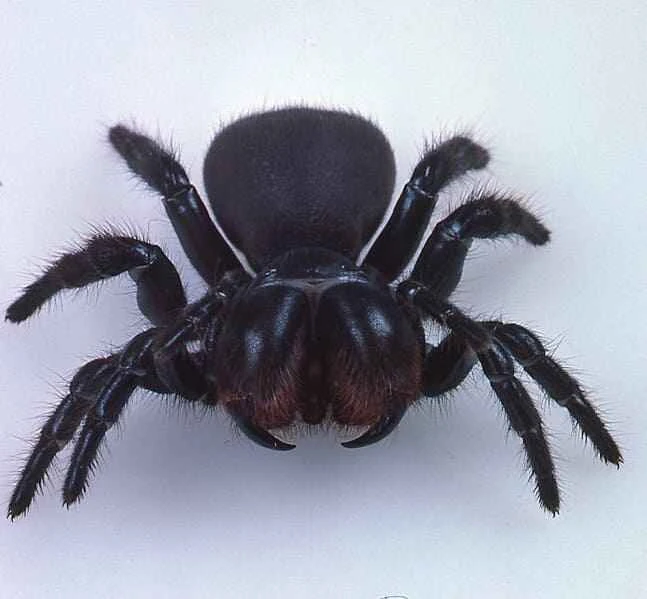
The red-headed mouse spider has a typical "mouse spider appearance" —its head and chelicerae are extremely large, its forequarters are high-arched, and its body is short and stout, making it easily mistaken for a funnel-shaped spider.
Male spider: The cephalothorax and chelicerae are bright red or brick red, while the abdomen is dark blue-black or gun-blue, creating a strong color contrast;
Female spiders: are mostly dark brown to black, with a more robust body shape, and the red color is not obvious or only slightly reddish at the base of the claws;
The enlarged anterior end of the body and the vertically opening and closing fangs are typical characteristics of the Arachnidae ("large fanged spider").
Distribution range and habitat
The red-headed mouse spider is one of the most widely distributed mouse spiders , found in almost all of the Australian continent, especially common in New South Wales, Western Australia, and South Australia, with fewer records only in the far north and Tasmania.
They adapt to a variety of habitats, ranging from open woodlands and grasslands to semi-arid scrublands and even near-desert areas . Common habitats include:
Earthen slopes and embankments of rivers, streams, and drainage ditches;
Soils along forest edges, in thickets, at the edges of farmland, and along roadsides;
Near suburban and rural gardens, lawn edges, and other human settlements.
Cave structure and living habits
Red-headed mouse spiders dig deep, straight, silk-lined mud burrows in the ground, which can be 30–55 centimeters deep. The burrow entrances often have two "trap door"-like covers or covers reinforced with mud and silk, which are convenient for camouflage and facilitate escape.
Female spiders spend most of their lives lying in ambush in or near their burrows, while male spiders leave their burrows and wander on the surface in search of females from late summer to early winter, especially after heavy rains . At this time, they are more likely to be seen or accidentally stepped on.
Diet and ecological role
The red-headed mouse spider is a typical ambush predator , primarily hunting:
Ground-dwelling insects such as beetles, cockroaches, and orthoptera;
Other spiders and arthropods;
They may occasionally attack small vertebrates such as lizards or frogs.
They occupy a high position among small predators in the ecosystem, helping to control invertebrate populations, but they themselves can also become prey for birds, small mammals, and reptiles.
Toxicity and Medical Significance
The venom of the mouse spider contains potent neurotoxins , and experiments have shown that its toxicological effects are similar to those of the Australian funnel-web spider. The venom of the red-headed mouse spider is considered to have high potential toxicity and could theoretically cause severe poisoning.
Severe localized pain and swelling;
Systemic symptoms such as sweating, nausea, vomiting, and abdominal pain;
In severe cases, muscle spasms, abnormal blood pressure, and abnormal heart rate may occur.
However, clinical studies show that the vast majority of mouse spider bites cause only mild or moderate symptoms ; severe poisoning cases are very rare, and there are no confirmed deaths. In cases of severe poisoning, veterinarians usually treat the bite with funnel-web spider antivenom , which is quite effective.
Contact with humans and protection
Because male red-headed mouse spiders are active after rain and during the breeding season, people may encounter them while walking on country roads, in garden meadows, on embankments, or along field edges. Basic protection recommendations include:
Wear thick gloves and closed shoes when gardening or tilling in areas where mouse spiders are known to be distributed.
Before moving stones, wood, and bricks, use tools to turn them over and avoid putting bare hands into holes or crevices.
If you encounter a suspected red-headed rat spider, do not try to catch or swat it with your hands. Instead, use a container with cardboard to move it away, or contact your local wildlife agency.
If you suspect you have been bitten by a mouse spider in Australia, you should follow the local funnel-web spider/mouse spider bite guidelines for first aid, including immobilizing the limbs as much as possible, getting to a hospital as soon as possible, and having a doctor assess whether antivenom is needed.
References
Brunet, B. 2008. Spider Watch: A Guide to Spiders in Australia. Reed New Holland.
Simon-Brunet, B. 1994. *Silk Webs: A Natural History of Spiders in Australia*. Reed Books.
Sutherland, SK & Nolch, G. 2000. Dangerous Animals of Australia. Hyland House.
York Main, B. 1976. *The Spider*. Australian Naturalist Library, Sydney.
Frequently Asked Questions
Q1: How dangerous are red-headed mouse spiders to humans?
Experiments have shown that its venom composition may be similar to funnel spider venom, which could theoretically cause severe poisoning.
However, statistics show that most rat spider bites only cause mild to moderate symptoms, severe poisoning is rare, and there are no confirmed cases of death to date.
Q2: How to identify the red-headed mouse spider?
Adult male spiders have a bright red cephalothorax, a bluish-black abdomen, and an enlarged head, which are very distinctive features.
The female spider is dark brown to black, with a robust body, a high-arched forequarters, and large fangs, which is also distinct from common house spiders and garden spiders.
Q3: Does it only live in Australia?
Yes, the red-headed mouse spider is a species endemic to Australia, and current records are all from the various states of the Australian continent.
Q4: What should I do if I suspect I have been bitten by a red-headed rat spider?
It should be treated with the same seriousness as a funnel-web spider bite: keep the injured person as quiet as possible and minimize their activity.
Take the spider to the hospital as soon as possible; if it is safe to do so, collect or photograph the spider for professional identification.