Basic Information
Scientific classification
- Chinese name: Great Spotted Woodpecker
- Scientific name: Dendrocopos major, Great spotted woodpecker
- Classification: Climbing birds
- Family and genus: Order Vulpetiformes, Family Woodpeckers, Genus *Woodpecker*
Vital signs data
- Body length: 22-25 cm
- Weight: 62-79g
- Lifespan: No verification data available.
Significant features
Distribution and Habitat
The Great Spotted Woodpecker is distributed in Albania, Algeria, Andorra, Armenia, Austria, Azerbaijan, Belarus, Belgium, Bosnia and Herzegovina, Bulgaria, China, Croatia, Czech Republic, Denmark, Estonia, Finland, France, Georgia (USA), Germany, Greece, Hungary, India, Islamic Republic of Iran, Italy, Japan, Kazakhstan, Democratic People's Republic of Korea, South Korea, Kyrgyzstan, Lao People's Democratic Republic, Latvia, Liechtenstein, Lithuania, Grand Duchy of Luxembourg, North Macedonia, Moldova, Mongolia, Montenegro, Morocco, Myanmar, Netherlands, Norway, Poland, Portugal, Romania, Russia, Serbia, Slovakia, Slovenia, Spain, Sweden, Switzerland, Tunisia, Turkey, Ukraine, United Kingdom, United States, and Vietnam.
Migratory birds: Faroe Islands, Gibraltar, Iceland, Ireland, USA.
The Great Spotted Woodpecker is distributed in Xinjiang, northeastern Inner Mongolia, Heilongjiang, Jilin, Liaoning, Hebei, Henan, Shandong, Jiangsu, Anhui, Shanxi, Shaanxi, Gansu, Qinghai, Sichuan, Guizhou, Yunnan, Hubei, Hunan, Jiangxi, Zhejiang, Fujian, Guangdong, Guangxi, Hong Kong, and Hainan Island in China.
It inhabits coniferous forests, mixed coniferous and broad-leaved forests, and broad-leaved forests in mountainous and plain areas, especially mixed forests and broad-leaved forests. It also appears in secondary forests at forest edges, sparse forests at farmland edges, and shrubland areas.
Appearance
The male has a brownish-white forehead, white lores, eyebrows, cheeks, and ear coverts, a black crown with a blue sheen, a bright red patch on the nape, and a narrow black band across the back of the nape. The nape and sides are white, forming a white collar. The shoulders are white, the back is glossy black, and the rump is dark brown with white tips. The wings are black with white edges, and the inner webs of the flight feathers have square or nearly square white patches. The inner median and greater wing coverts are white, forming a large, nearly circular white patch on the inner wing. The central tail feathers are dark brown, and the outer tail feathers are white with black bars. The malar stripe is broad and black, branching backward; the upper branch extends to the back of the head, and the other branch extends downward to the sides of the breast. The chin, throat, foreneck to breast, and flanks are dirty white, as is the belly, which is also dirty white with a slight pinkish tinge, and the lower belly to undertail coverts are glossy red. The female has a glossy black crown, nape, and nape with a blue sheen, and brownish-white ear coverts; otherwise, she resembles the male (Northeast Asian subspecies). The juvenile (male) has a dark red crown, with a dark brown nape, nape, back, rump, upper tail coverts, and wings, paler than the adult. The foreneck, breast, flanks, and upper belly are brownish-white, while the lower belly to the undertail coverts are pale pink. The iris is dark red, the bill is lead-black or bluish-black, and the tarsi and toes are brown.
Size measurements: Weight ♂ 63-79 g, ♀ 62.5-72 g; Body length ♂ 201-242 mm, ♀ 225-250 mm; Bill length ♂ 21-28 mm, ♀ 26-28 mm; Wing length ♂ 121-133 mm, ♀ 122-133 mm; Tail length ♂ 79-98 mm, ♀ 91-97 mm; Tarsus length ♂ 21-26 mm, ♀ 22-26 mm.
Detailed introduction
The Great Spotted Woodpecker, scientifically known as Dendrocopos major, has 14 subspecies.
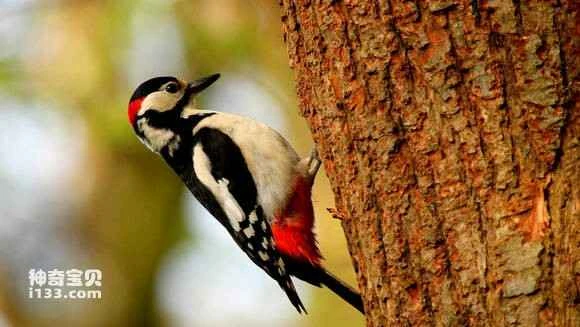
The Great Spotted Woodpecker mainly feeds on various insects and insect larvae, including beetles, bark beetles, locusts, jewel beetles, longhorn beetle larvae, ants, mosquitoes, wasps, lepidopterans, and coleopterans. It also eats snails, spiders, and other small invertebrates, and occasionally acorns, pine nuts, chokecherries, and grass seeds.
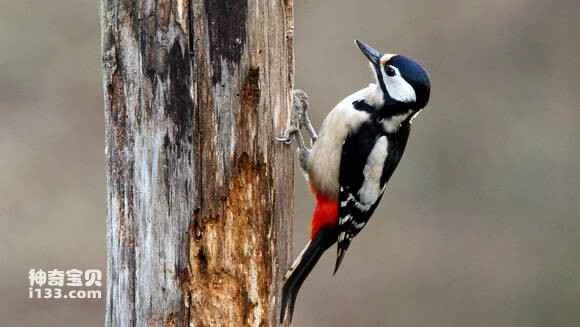
Great Spotted Woodpeckers are usually solitary or in pairs, but form loose family groups during the later breeding season. They forage mostly on tree trunks and thick branches. When foraging, they often hop upwards from the lower to middle parts of the tree. If they find insects in the bark or inside the trunk, they quickly peck at the wood to eat, using their tongues to probe into crevices in the bark or hook out pests from the holes they've pecked. If they spot a person while pecking, they will either hide behind the tree being pecked or continue climbing upwards. After searching one tree, they will fly to another, their wings opening and closing in a large wave-like motion as they fly. Sometimes they also forage among fallen logs and branches on the ground. Their call is 'jen-jen-'.
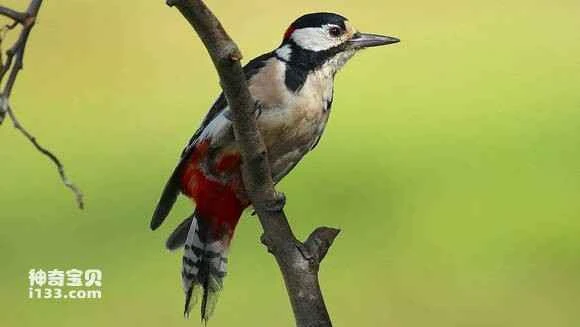
The Great Spotted Woodpecker's breeding season is from April to May. They begin mating at the end of March, during which time they frequently strike tree trunks with their beaks, producing a continuous "bang, bang, bang..." sound to attract mates. Sometimes, three birds (two males and one female) can be seen fighting for a mate, tangled together, flying up and down, calling out as they fly, until the other male is driven away. They nest in tree cavities, often in the trunks of broad-leaved trees with decayed heartwood, and sometimes in thick side branches. The nest is dug jointly by both parents. They dig a new cavity every year, discarding the old nest. Each cavity takes about 15 days to complete. The cavities are usually 4-8 meters above the ground, sometimes reaching over 10 meters or as low as 2 meters. The entrance is round, with a diameter of 4.5-4.6 cm, the inner diameter is 8.5-10 cm, and the depth is 18-28 cm. The nest contains no lining, only a few wood shavings. Each clutch contains 3-8 eggs, mostly 4-6. The eggs are white, oval, smooth, and spotless, measuring 24-27 mm × 16-21 mm. Both parents take turns incubating the eggs, with an incubation period of 13-16 days. The chicks are altricial, hatching completely naked and featherless, with a pinkish-red color. Both parents care for the chicks, and after 20-23 days of feeding, the chicks are ready to leave the nest and fly.
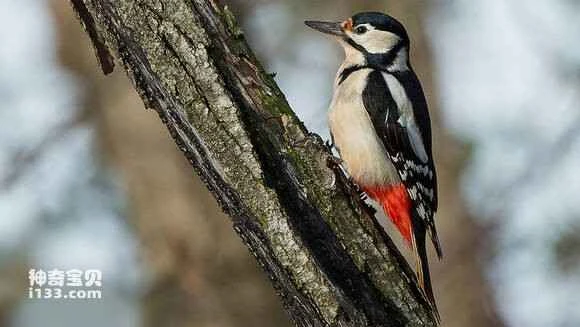
Li Guohong et al.'s investigation found that when the population density of the Great Spotted Woodpecker was approximately 0.37-0.55 individuals per hm², the average pecking rate of overwintering larvae of the mulberry longhorn beetle reached 24.71%, significantly suppressing the beetle's population density. Zhu Yuanlong et al. investigated the natural control effect of woodpeckers on the yellow-spotted longhorn beetle in poplar forests, finding that both the Black-naped Green Woodpecker and the Great Spotted Woodpecker were dominant natural enemies of the yellow-spotted longhorn beetle, effectively suppressing its population density and achieving a good control effect of "no pest infestation." Li Gang et al. investigated the control effect of the Great Spotted Woodpecker on the blue-shouldered longhorn beetle in farmland shelterbelts, finding that one woodpecker could peck at an average of 23 beetle larvae per day, with an average pecking rate of 72.3%. Reports of using the Great Spotted Woodpecker to control pests in other countries are extremely rare. Kobayashi's research revealed that the Great Spotted Woodpecker plays a significant role in suppressing the population density of the longhorn beetle when the beetle population is low.
It is listed in the "List of Terrestrial Wild Animals of Beneficial or Important Economic and Scientific Research Value under State Protection" issued by the State Forestry Administration of China on August 1, 2000.
Listed as Least Concern (LC) on the IUCN Red List of Threatened Species 2012 ver 3.1.