
Basic Information
Scientific classification
- Chinese name: White-backed Woodpecker
- Scientific name: Dendrocopos leucotos, White-backed Woodpecker
- Classification: Climbing birds
- Family and genus: Order Vulpetiformes, Family Woodpeckers, Genus *Woodpecker*
Vital signs data
- Body length: 22-27 cm
- Weight: 85-117g
- Lifespan: No verification data available.
Significant features
Distribution and Habitat
Distributed in Albania, Armenia, Austria, Azerbaijan, Belarus, Bosnia and Herzegovina, Bulgaria, China, Croatia, Czech Republic, Estonia, Finland, France, Georgia, Germany, Greece, Hungary, Italy, Japan, Kazakhstan, Democratic People's Republic of Korea, Republic of Korea, Latvia, Liechtenstein, Lithuania, Macedonia, Moldova, Mongolia, Montenegro, Norway, Poland, Romania, Serbia, Slovakia, Slovenia, Spain, Sweden, Switzerland, Turkey, and Ukraine. Migratory birds: Belgium and the Netherlands.
It has an intermittent distribution in China, but is quite common within its distribution area. The nominate subspecies is distributed in Northeast China and the far north of Xinjiang, Hebei and southeastern Inner Mongolia; the Fujian subspecies is found in the Wuyi Mountains of northwestern Fujian and the Guanshan Mountains of northern Jiangxi; the Sichuan subspecies is found in the Qinling Mountains of southern Shaanxi to central Sichuan; and the Taiwan subspecies is found in Taiwan.
It mainly inhabits deciduous and mixed forests, mountain coniferous forests, mixed coniferous and broad-leaved forests, and broad-leaved forests at altitudes of 1200-2000 meters. It is especially common in primary mixed coniferous and broad-leaved forests and broad-leaved forests. It also ventures into secondary forests and sparse forests at forest edges for activity and foraging.
Appearance
The male White-backed Woodpecker has black cere feathers mixed with brownish-white. Its forehead is brownish-white, and the crown to nape is vermilion; the lores, cheeks, and ear coverts are brownish-white. Above the eye, the foreground is black and the background is white; the cheek stripe is black, extending backward to the side of the neck. The nape to upper back is black, the lower back and rump are white, and the upper tail coverts are black. The central tail feathers are black. The shafts are glossy. The outer tail feathers are white with black horizontal bars. The shoulders are black with white tips; the lesser wing coverts are black, the flight feathers are black, with white horizontal bars and white tips on both the inner and outer sides; the chin and throat are pure white, the sides of the upper breast are black, the foreneck and breast are greyish-white with black shaft streaks; the belly and flanks are white with black shaft streaks. The lower belly and undertail coverts are vermilion. The axillary feathers and underwing coverts are white.
The female has a black crown, not red, otherwise resembles the male. The Sichuan subspecies has a buff belly in the middle; the Taiwan subspecies has a brownish belly in the middle. It differs from the Three-Toed Woodpecker in lacking a yellow forecrow and having distinct transverse bars on its wings.
The juvenile bird has a lead-grey crown with pale reddish feather tips, a greyish-white back, a brownish-white chin, throat, foreneck to upper chest, and a dirty greyish-grey tinged with black on the lower chest, abdomen, and flanks. Otherwise, it resembles the adult bird.
The iris is red, the upper beak is dark brown, the lower beak is dark gray, and the feet are dark brown.
Size measurements: Weight: ♂ 85-117 g, ♀ 86-113 g; Body length: ♂ 237-274 mm, ♀ 222-276 mm; Bill length: ♂ 30-37 mm, ♀ 30-37 mm; Wing length: ♂ 135-147 mm, ♀ 156-150 mm; Tail length: ♂ 87-109 mm, ♀ 95-116 mm; Tarsus length: ♂ 23-28 mm, ♀ 22-32 mm. (Note: ♂ male; ♀ female)
Detailed introduction
The white-backed woodpecker, scientifically known as Dendrocopos leucotos, has 10 subspecies.
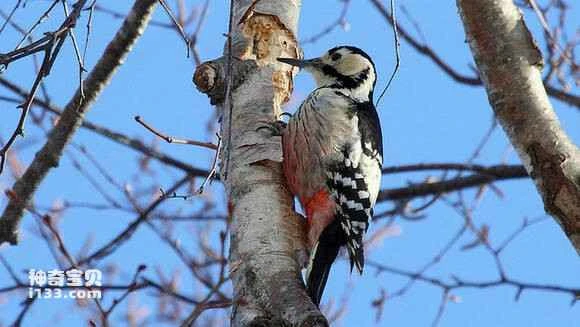
White-backed woodpeckers are usually solitary or in pairs. Family flocks of 4-5 birds are only seen shortly after the young leave the nest. They typically climb tree trunks from bottom to top in search of food, pecking incessantly at any insects found in decaying wood until all are eaten before flying from one tree to another in a wave-like flight. They sometimes also forage on fallen logs, stumps, or mounds of earth. In winter, when food is scarce, their range expands, sometimes even venturing into thickets near settlements, fences, and woodpile for food. Their call is a soft "gagai," similar to the warning call of a blackbird. They chisel forcefully for about 1.7 seconds, then suddenly accelerate, gradually decreasing in intensity at the end.
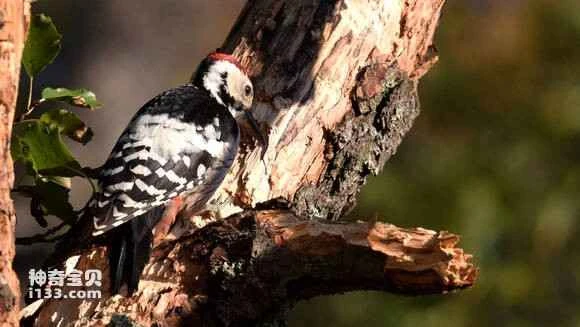
The white-backed woodpecker primarily feeds on a variety of insects, including adult and larval longhorn beetles, coleopteran insects, click beetles, ants, bark beetles, jewel beetles, aphids, pine caterpillars, and insect eggs. It also eats spiders, worms, and other small invertebrates. In autumn and winter, it also consumes some acorns, pine nuts, chokecherries, and other plant fruits and seeds.
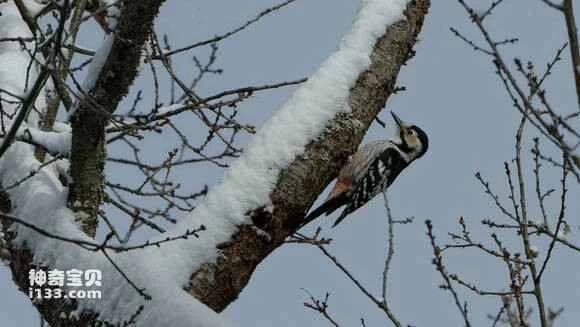
The breeding season for white-backed woodpeckers is from April to June. Pairing and courtship are observed as early as the end of March. During courtship, the male and female first fly together, chasing each other among the treetops, flitting up and down, calling out in a continuous, repetitive "gagaga-gagaga" pattern. After a period of flight and chasing, the male and female stand on thick branches, a few centimeters to several tens of centimeters apart, gazing at each other. After a while, they call "gagaga" again, exchange positions, and then stand still, gazing at each other again. This process is repeated several times, sometimes up to 10 times, before mating. During mating, the male mounts the female's back, stretches his neck forward, and their tails meet. After about 2-3 seconds, they separate, calling "gagaga" together and shaking their feathers. One to two minutes later, they chase each other again and repeat the process, mating once more. Afterward, they fly together deeper into the forest. Once paired, they usually stay together, even when foraging.
The white-backed woodpecker begins burrowing and building its nest in late April. It never reuses old nests, usually burrowing a new one every year. Sometimes, after burrowing a new nest, it discards it and starts burrowing a new one. It generally chooses broad-leaved trees with decaying heartwood that are easy to pry open. The male and female birds take turns burrowing the nest. It takes about 4-10 days to complete. The nest entrance is round, with a diameter of 5-7 cm. The inner diameter of the entrance is 10-13 cm, and the depth is 19-38 cm. The entrance is 4-15 meters above the ground. The nest is lined with wood chips and bark. Each clutch contains 3-6 eggs. The eggs are white, smooth, and spotless. They measure 26-30 × 19-22 mm, averaging 28-20.5 mm, and weigh 6.9 grams. Both parents take turns incubating the eggs. The incubation period is 16-17 days. The chicks are altricial. Both male and female parents raise the chicks together, and the chicks can leave the nest after about 23-24 days of feeding.
Listed as Least Concern (LC) on the IUCN Red List of Threatened Species 2012 ver 3.1.
It is listed in the "List of Terrestrial Wild Animals of Beneficial or Important Economic and Scientific Research Value under State Protection" issued by the State Forestry Administration of China on August 1, 2000.
Protect wild animals and ban the consumption of wild game.
Maintaining ecological balance is everyone's responsibility!


