Basic Information
Scientific classification
- Chinese name: Grey-headed Muscovy Duck
- Scientific name: South African Shelduck (Tadorna cana)
- Classification: Waterfowl
- Family and genus: Anseriformes, Anatidae, Muscovy
Vital signs data
- Body length: 61-66 cm
- Weight: 1.229-1.527kg
- Lifespan: No verification data available.
Significant features
The adult duck's tail, sides, and abdomen are predominantly orange-red, its head is bluish-grey, its underparts are more complex, and its chest is pale white.
Distribution and Habitat
It is distributed in south-central Africa, in Cape Town Province, Orange Free State, and southern Transvaal in South Africa, north to Botswana and the southern mountainous region of Damaraland in Namibia, and east to West Natal.
It inhabits various habitats including rivers, lakes, estuaries, ponds, and nearby grasslands, wastelands, swamps, beaches, farmlands, and sparse forests on plains, with a particular preference for lake areas on plains. It mainly lives in inland freshwater, but is sometimes also found on coastal beaches, in saltwater lake areas, and in open grasslands far from water bodies.
Appearance
The Grey-headed Muscovy Duck measures 61-66 cm in length and weighs 1229-1527 g. Adults have predominantly orange-red plumage on the tail, sides, and abdomen; a bluish-grey head; more complex underparts; and a pale white breast. During the breeding season, adult males have a beautiful slate-gray head and neck; yellow breast and tail; brown and orange sides and underparts; and a darker abdomen. The upperparts are mainly reddish-brown, with a lighter hue on the tail. The tail is black. The wing coverts are reddish-brown with a white underside, contrasting with the black primary flight feathers. The secondary flight feathers have a green speculum. The male's non-breeding plumage is relatively simple.
The female duck's breast is yellowish-brown, slightly darker than the male's. The head is grayish-white, with markings of varying sizes on the cheeks, sometimes limited to around the eyes, but sometimes covering almost the entire head.
The beaks, legs, and feet of both male and female adult ducks are black. Some female ducks also have pink feet.
Detailed introduction
The Grey-headed Muscovy Duck (scientific name: Tadorna cana), also known as the South African Shelduck, has no subspecies.
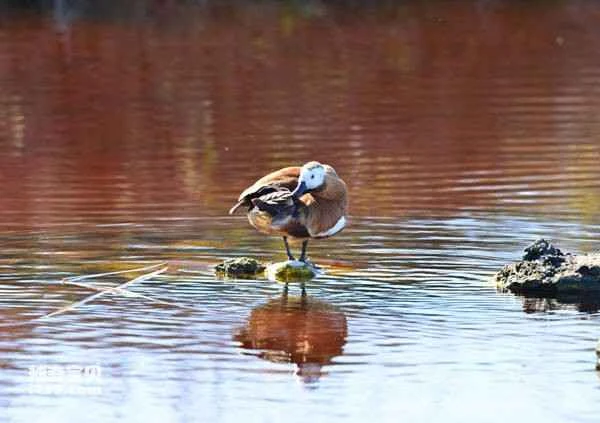
The breeding season for Grey-headed Muscovy Ducks occurs during the dry season from May to July. They typically breed in open plains, permanent lakes, shallow seas, freshwater or saltwater areas, and plateaus. Pairs are monogamous and loyal. Mating takes place in water or on land. Nests are built in natural burrows or abandoned animal burrows in open plains and grasslands, as well as in earthen burrows and rock crevices on mountains, lakes, and islands. The nest consists of a small amount of dry grass and a large amount of down feathers. The clutch size is 7-15 eggs. The female is solely responsible for the nest, while the male guards the area. The male is very territorial and will call loudly to warn of danger; sometimes, the male will even fly towards intruders and make aggressive gestures to scare them away. When the female leaves the nest, she covers the eggs with down feathers before accompanying the male to forage. After foraging, the male accompanies the female back to the nest before leaving to roost nearby and guard the area. The incubation period is about 30 days. The chicks swim with their parents in ponds and streams, immediately hiding in the grass near the bank upon seeing people. The chicks are precocial, covered in down feathers immediately after hatching and capable of swimming and diving. Some sources also indicate that the parents usually carry the chicks from the nest to the water. While swimming, the chicks often climb onto their parents' backs to play. The chicks are capable of flight after 70 days.
Listed as Least Concern (LC) on the IUCN Red List of Threatened Species 2012 ver3.1.
Protect wild animals and ban the consumption of wild game.
Maintaining ecological balance is everyone's responsibility!