Basic Information
Scientific classification
- Chinese name: *Lygodium polygillatis*
- Scientific name: Glossobalanus polybranchioporus
- Classification: Hemichordates
- Family and genus: Order Axolotidae, Family Axolotidae, Genus *Lygomorpha*
Vital signs data
- Body length: 352–613 mm
- weight:
- life:
Significant features
The multi-gillated tongue-shaped worm is an invertebrate endemic to China. It is of great significance for the study of animal systematics, evolution and biodiversity, and is a Class I protected wild animal in China.
Distribution and Habitat
This species is endemic to China. It is distributed along the coasts of the Yellow Sea and the Bohai Sea. It inhabits the intertidal zone and lives burrowing in sandy or muddy bottoms.
Appearance
Body length 352-613 mm. The snout is conical or conical. The collar has numerous longitudinal folds, with the posterior margin sloping from the dorsal to the ventral margin. There are a large number of gill slits, 130-160, hence the name. The postbranchial blind sacs and genital wings are symmetrical, without wing droops; the genital wings are purplish-brown in females and orange-yellow or orange-red in males. The hepatic region is long, with 110-130 hepatic sacs arranged in two rows.
Detailed introduction
The multi-gillated tongue-shaped worm was discovered by Chinese biologists Zhang Xi and others in 1965 and named for its prominent feature of having many gill openings.
*Glossobalanus polybranchioporus* is an animal belonging to the family Acornidae and the genus *Glossobalanus*. It measures 35-60 cm in length; its body is soft, slender, and worm-like, with a pale orange-yellow color, resembling a snake or earthworm in appearance. The body is divided into three parts: the snout, collar, and trunk. The trunk is slightly cylindrical. A distinct mouth is located at the junction of the anterior ventral surface and the snout. The collar has numerous longitudinal folds, with a dark fibrous ring at each of the anterior and posterior thirds, the area between which is lighter in color. A raised operculum forms at the posterior edge of the collar, followed by a deep orange-red ring. The trunk is further divided into four areas: gills, genital wings, liver, and tail. It is dioecious; the genital wings of sexually mature females are purplish-brown, while those of males are orange-red or orange-yellow. There are no pigmented spots on the ventral sides of the gills and genital wings.
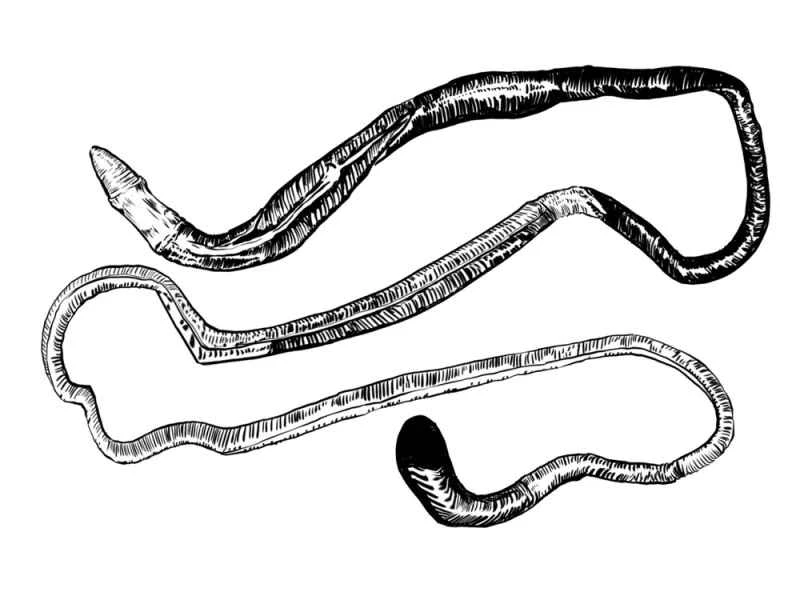
They inhabit the seabed, moving by expanding and contracting their snout and collar with water in and out of their rostrum and collar. They typically burrow in fine sand and muddy sand in the mid-tide and low-tide zones, creating irregular "U"-shaped burrows in which their entire body lies horizontally. The burrow opening is relatively wide and funnel-shaped, and the burrow depth is usually 50-200 cm. Their body walls contain a large amount of iodine, and in areas where it is densely distributed, the smell of iodine can often be detected. They feed on organic matter on the sandy bottom.