
Basic Information
Scientific classification
- Chinese name: White-bellied Muscovy Duck
- Scientific name: Tadorna radjah, Radjah Shelduck, Raja Shelduck
- Classification: Waterfowl
- Family and genus: Anseriformes, Anatidae, Muscovy
Vital signs data
- Body length: 50-60 cm
- Weight: 840-930g
- Lifespan: No verification data available.
Significant features
Its head, neck, and underparts are snow-white; it has a pale bluish-purple beak; black irises with faint dark circles around its eyes; and yellow legs.
Distribution and Habitat
Distributed across the islands of the Pacific Ocean, including Taiwan Province, the Dongsha Islands, Xisha Islands, Zhongsha Islands, and Nansha Islands of China, as well as the Philippines, Brunei, Malaysia, Singapore, Sumatra and Java of Indonesia, and Papua New Guinea. The Wallace Region refers to the area east of the traditional Wallace Line (from the eastern waters of Mindanao through the Makassar Strait to the area between Bali and Lombok) and west of Papua New Guinea, including Sulawesi, Nusa Tenggara, the Southwest Islands, the Moluccas (Maluku Islands), and East Timor of Indonesia. Australia and New Zealand, including Tasmania and its surrounding islands.
It inhabits various habitats including rivers, lakes, estuaries, coastlines, and nearby grasslands, wastelands, swamps, beaches, farmlands, and sparse forests on plains, with a particular preference for lake areas on plains. It is mainly found on coastal beaches and in saltwater lake areas.
Appearance
The White-bellied Muscovy Duck is 50-60 cm long, with males weighing 930g and females 840g. Adults have a chestnut-red upper body and wings with a dark green metallic sheen. The head, neck, and underparts are snow-white, with a pale bluish-purple beak, black irises, faint black eye rings, and yellow legs.
Detailed introduction
The white-bellied Muscovy duck (scientific name: Tadorna radjah Radjah Shelduck, Raja Shelduck) has two subspecies.
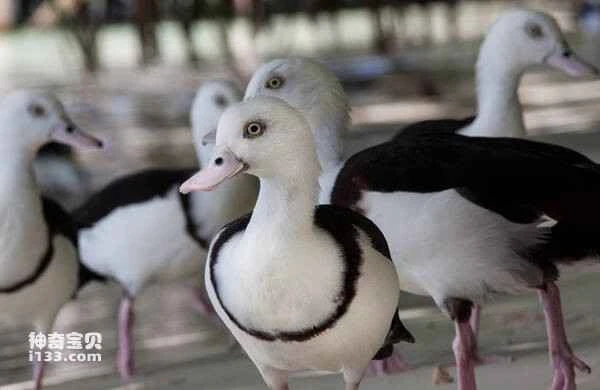
White-bellied Muscovy ducks live in pairs during the breeding season, and in family groups or small flocks outside the breeding season. They are wary and difficult for humans to approach. Their diet consists mainly of aquatic plant leaves, buds, seeds, crop seedlings, and grains, but they also eat insects, crustaceans, mollusks, shrimp, water frogs, earthworms, small frogs, and small fish. They forage mostly at dusk and dawn, sometimes during the day, especially in autumn and winter. Small flocks of several to more than 20 ducks are often seen foraging for scattered grains on farmland along riverbanks, as well as in shallow water near the water's edge and on the surface.
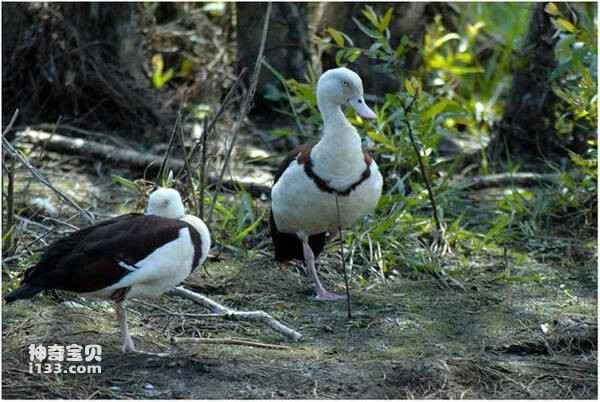
The White-bellied Muscovy Duck reaches sexual maturity at 2 years old. The breeding season is from April to June. Pairings are relatively stable. Mating takes place in water or on land. Before mating, the female stretches her neck forward, lowers her head to the ground, and makes a 'quack' sound, pacing back and forth around the male. The male then stretches his neck towards the female, takes her shoulder feathers, and mounts her back to mate. They nest in natural caves or abandoned animal burrows, graves, and earthen or rock crevices in mountains, lakes, and islands. The nest consists of a small amount of dry grass and a large amount of down feathers. The clutch size is 8-10 eggs. The female is solely responsible for the nest, while the male guards the area, calling loudly to warn of danger. Sometimes the male will even fly towards intruders and make aggressive gestures to scare them away. When the female leaves the nest, she covers the eggs with down feathers before accompanying the male to forage. After foraging, the male accompanies the female back to the nest before leaving to roost nearby as a guard. The incubation period is 27-30 days, with chicks hatching as early as the beginning of May. The hatched chicks swim with their parents in ponds and streams, immediately hiding in the grass near the bank upon seeing people. The chicks are precocial, already covered in downy feathers after hatching and capable of swimming and diving. Some sources also indicate that the parents usually carry the chicks from the nest to the water. While swimming, the chicks often climb onto their parents' backs to play. After about 50 days of chick life under their parents' guidance, the chicks acquire the ability to fly.
Listed in the International Union for Conservation of Nature (IUCN) Red List of Birds, 2009 ver 3.1.
Protect wild animals and ban the consumption of wild game.
Maintaining ecological balance is everyone's responsibility!


