Basic Information
Scientific classification
- Chinese name: Black-tailed Petrel
- Scientific names: Oceanodroma monorhis, Hydrobates monorhis, Swinhoe's Storm-petrel
- Classification: Waterfowl
- Family and genus: Procellariiformes, Petrelidae, Petrel genus
Vital signs data
- Body length: Approximately 18 centimeters
- Weight: No verification information available.
- Lifespan: No verification data available.
Significant features
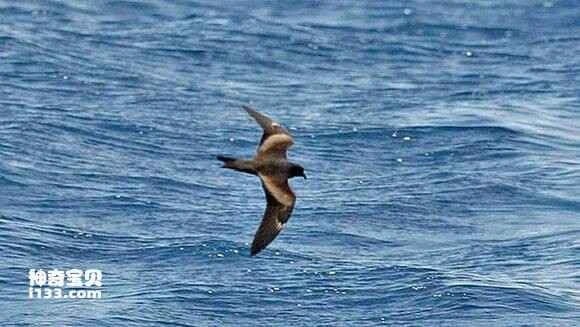
During flight, the wings, with their leading edges concave in an M-shape, closely skim the water surface, constantly changing direction and occasionally extending their legs towards the water.
Distribution and Habitat
Country of origin: China, Indonesia, Japan, North Korea, South Korea, Malaysia, Russia, Singapore, Sri Lanka, Thailand, United Arab Emirates.
Vagrant bird distribution areas: Israel, Oman, Portugal, Seychelles, Spain, United Kingdom, Yemen.
Origin unknown: Bangladesh, Cambodia, Christmas Island, India, Maldives, Myanmar, Pakistan, Philippines, Somalia, Vietnam.
In China, it is mainly distributed along the coast of Fujian, Guangdong, Taiwan, and Shandong and their nearby islands.
Small oceanic coastal birds that inhabit the coast and nearby islands and the sea during the breeding season, and mainly live at sea during the non-breeding season.
Appearance
The head and neck are dark gray, with a paler forehead and around the base of the beak. The back is dark grayish-brown, and the shoulders and upper tail coverts are also dark grayish-brown with black shafts. The outer edges of the lesser wing coverts, secondary flight feathers, and primaries are blackish-brown. The inner edges of the median coverts, greater coverts, and secondary flight feathers are pale brown with white edges. The tail feathers are black, and the underparts are dark gray, with black underwing and undertail coverts.
Brown iris, black mouth, black feet, white inner side of the inner toe and white sides of the base of the middle toe.
Size measurements: body length 182 mm, bill 13-15 mm; wings 141-165 mm, tail 70-81 mm, tarsus 23-24.5 mm.
Closely related species: The similar species, Oceanodroma Lcucorhoa, has a white rump and is larger in size, making the difference quite obvious.
Detailed introduction
The Black-tailed Petrel (scientific name: *Hydrobates monorhis*) is a small seabird. Austin (1952) merged this species with the White-rumped Petrel (*O. lcucorhoa*) into one species. However, Bretagnolle et al. (1991) and Dawson (1992) classified them as two separate species due to their differences in morphology and vocalization. Zheng Zuoxin (1994), Inskipp, Lindsey, and Duckworth (1996), and many other scholars also support classifying them as two distinct species.
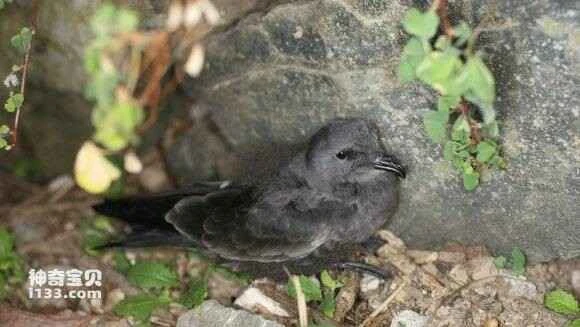
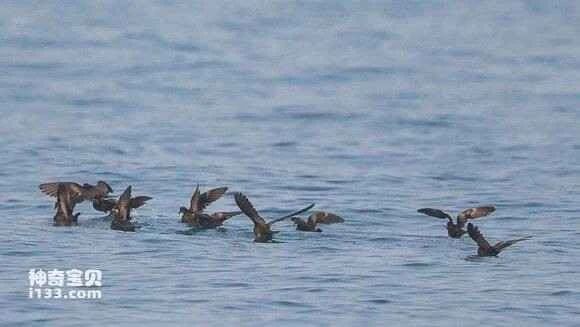
Black-tailed petrels often fly in flocks low over the sea. They sometimes flap their wings rapidly, and sometimes glide lightly over the water, resting and foraging on the surface. Occasionally, they also forage on islands. They are also fast walkers on land. Their flight characteristics are similar to terns, often leaping and swooping over the water, rarely taking light flight. Sometimes they follow ships.
The black-tailed petrel mainly feeds on various small fish, crustaceans, cephalopods, and other small marine animals. It makes a squeaking sound when flying over its breeding grounds, but is usually silent at sea.
Brooke (2004) estimated the global population of the Black-tailed Petrel to be around 100,000. Sato et al. (2010) estimated at least 130,000 pairs globally. Population statistics by country and region are as follows: Mainland China: approximately 100–10,000 breeding pairs and 50–1,000 migratory birds; Taiwan: approximately 100–100,000 breeding pairs and 50–10,000 migratory birds; South Korea: approximately 100–100,000 breeding pairs and 50–10,000 migratory birds; Japan: 100–100,000 breeding pairs and 50–10,000 migratory birds (Brazil 2009). In China, it is only found along the coasts of Shandong, Guangdong, Fujian, and Taiwan, and is rare and uncommon. The population size is projected to decline at a moderate rate over the next three generations, primarily due to the influence of invasive species.
Listed as Near Threatened (NT) on the IUCN Red List of Threatened Species, 2015 assessment.
Listed in the "List of Terrestrial Wild Animals of National Protection that are Beneficial or of Important Economic and Scientific Research Value" issued by the State Forestry Administration of China on August 1, 2000. (Note: Black-tailed Petrel, Item 11 of the Class Aves)
Protect wild animals and ban the consumption of wild game.
Maintaining ecological balance is everyone's responsibility!