Basic Information
Scientific classification
- Chinese name: Leaf-shaped web-weaving spider
- Scientific name: Phryganoporus candidus
- Classification: Arthropoda
- Family: Araneae Araneomorphae Desidae
Vital signs data
- Body length: Approximately 6–10 mm
- weight: -
- Lifespan: Approximately 1 year (estimated, depending on environment).
Significant features
Small, social spiders; they weave large, three-dimensional webs among leaves and branches; exhibit distinct subsocial behavior; nocturnal, hiding in silken tunnels during the day.
Distribution and Habitat
Native to Australia, it is widely distributed in arid and semi-arid regions of the continent, often found in open woodlands, thickets, and roadside trees, where it often builds communal nests on shrubs such as acacia.
Appearance
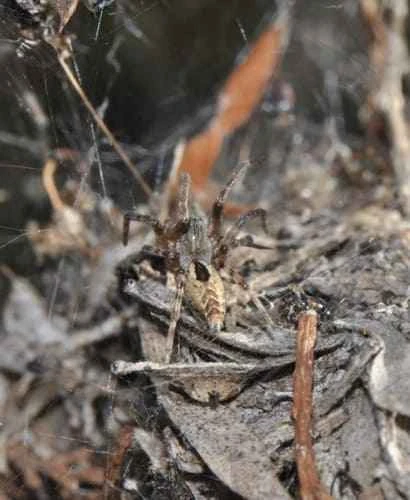
It is about 6–10 mm long, with a brown to grayish-brown body, and light and dark spots on the abdomen. The body and feet are covered with fine silvery-white down, giving it a slightly "silver" appearance.
Detailed introduction
Species Overview
The Foliage Webbing Spider, scientifically known as *Phryganoporus candidus* , is a small, social spider native to Australia. They often build large web-like nests among the branches and leaves of shrubs and trees, with hundreds of individuals living together, hunting, and raising their offspring; hence, they are also called "social web-webbing spiders."
Lifestyle Habits and Behaviors
Leaf-web spiders typically inhabit hot, dry regions, preferring open woodlands, thickets, and semi-arid environments. The female spider first builds an initial nest among branches or shrub leaves, after which the young spiders hatch and continuously expand the web, forming a "three-dimensional castle" composed of many passageways and chambers. These passageways not only trap insects for food but also provide the spider with space to escape predators.
This spider exhibits distinct "subsocial" or "social" characteristics: individuals within the same colony will share prey, collectively maintain their webs, and collectively defend against intruding predators for a certain period. In late spring and summer, subadult females will leave the nest and disperse to establish new, independent nests, while males will leave slightly later to find mates.
feeding habits
Leaf-weaving spiders feed on a variety of small arthropods, including beetles, stink bugs, bugs, moths, cockroaches, and other small spiders that wander into their webs. They are typically active at dusk and night, hiding deep within their silken tunnels during the day. After capturing prey, they quickly wrap it in silk and inject venom to paralyze it before slowly sucking its body fluids.
Relationship with plants
In some regions, leaf-web spiders form a mutually beneficial relationship with local shrubs (such as certain acacia species): the spiders build their webs among the leaves, driving away some leaf-eating insects for the plants; in return, the plants provide the spiders with stable anchor points and shade. However, in orchards or farms, large amounts of webs can sometimes cause tangled leaves and broken branches, leading farmers to consider them minor pests.
Relationship with humans and toxicity
Leaf-weaving spiders are small, secretive, and do not actively attack humans. Their venom is mainly used to subdue small insects, and there are currently no records of serious poisoning from their bites. Generally speaking, unless you deliberately damage their webs or try to catch them with your bare hands, you will almost never have direct contact with humans.
Frequently Asked Questions
Is the Foliage Webbing Spider poisonous?
They possess venom used to paralyze and kill prey, but its toxicity is very limited for humans. There are currently no cases of serious poisoning; occasional bites usually only cause mild local redness or discomfort.
Will it attack people unprovoked?
No. Leaf-web spiders are timid by nature and will usually retreat quickly into the depths of their silken tunnels when they encounter vibrations or changes in light. They will only fight back if their web is severely damaged or crushed.
Does it need to be removed from the house or garden?
If the number of webs is small, there is generally no need to remove them deliberately, as they can help prey on some pests. If large webs form on fruit trees or ornamental plants, affecting their appearance or the vigor of the tree, the webs can be gently removed with tools in the early morning or evening.
Where are they mainly distributed?
The leaf-web spider is a species endemic to Australia, widely distributed in open woodlands, scrublands and semi-arid regions of the Australian interior and coast, and commonly found in roadside thickets, farmland edges and nature reserves.