Basic Information
Scientific classification
- Chinese name: Black Rhinoceros
- Scientific name: Diceros bicornis
- Classification: Hoof Order
- Family and genus: Rhinoceros (Rhinoceros genus)
Vital signs data
- Body length: head and body length 3.0–3.75 meters; shoulder height 1.4–1.8 meters.
- Weight: 800–1,400 kg (males can reach 1,800 kg)
- Lifespan: Approximately 30–40 years in the wild
Significant features
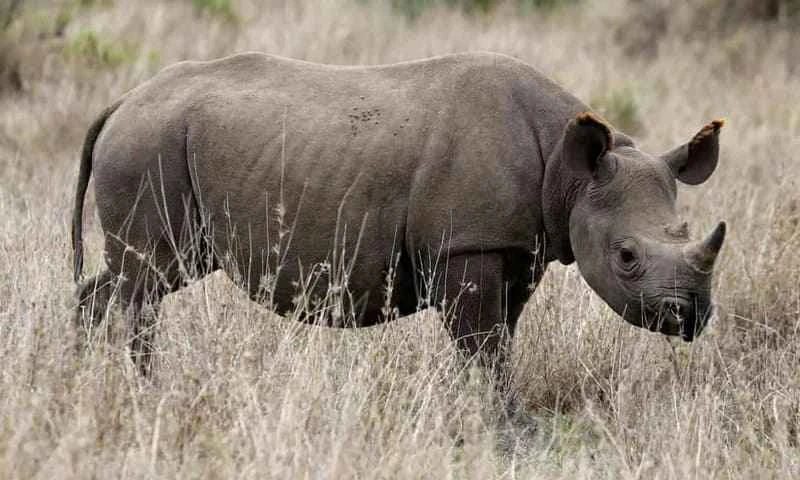
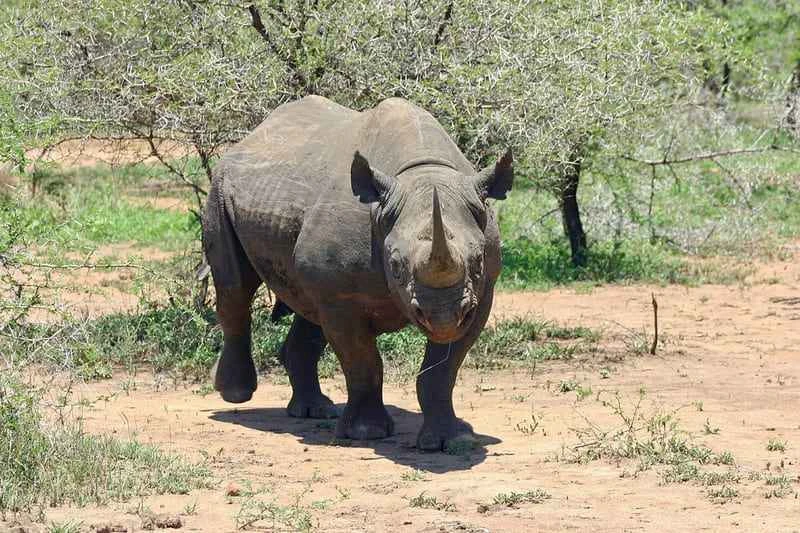
The upper lip is pointed at the front and can curl up shrub leaves; it has two horns, with the front horn usually longer; it has a keen sense of smell and hearing.
Distribution and Habitat
Arid shrublands, sparse grasslands, and acacia shrublands; often active near water sources.
Appearance
It has a robust body with thick, wrinkled skin; a pointed snout; and an anterior horn that is typically 40–60 cm long. Compared to the white rhinoceros, it has a more pointed mouth and a more arched back line.
Detailed introduction
The black rhinoceros ( Diceros bicornis ), classified as Critically Endangered (CR) by the IUCN, is primarily found in the arid scrublands and savannas of East and Southern Africa. It feeds on shrubs and leaves and faces threats from poaching and habitat fragmentation. Despite its name, the black rhinoceros is actually closer to grayish-white in color. This name is generally used to distinguish it from the white rhinoceros (Ceratotherium simum). In fact, the main difference between the two species lies not in color, but in size; the black rhinoceros is significantly smaller than the white rhinoceros.
physical characteristics
Black rhinoceroses have pointed snouts and smaller ears, while white rhinoceroses have wider lips and larger ears. Black rhinoceroses have thick skin, protecting them from sharp grass that could pierce or cut them. They have extremely poor eyesight and rely primarily on hearing and smell to detect enemies.
Habits
Black rhinos are herbivores with a wide diet, including leaves, twigs, buds, shrubs, and fruits. Studies have shown they can eat up to 220 different plant species. During the dry season, black rhinos can survive for up to five days without water. They primarily inhabit the African savanna and tropical rainforests.
Reproduction
Adult black rhinoceroses are solitary animals, only living together during mating season. Mating black rhinoceroses will stay together for 2-3 days or even several weeks.
The gestation period is approximately 15-16 months. Each birth produces one calf, with a newborn weighing approximately 35-50 kg. Weaning takes about 2 years, and the calf leaves its mother after 2-3 years. Female black rhinos reach sexual maturity at 5 years old, while males reach it at 7 years old. The average lifespan of a wild black rhino is 35-50 years.
quantity
In the 20th century, the black rhinoceros was the most numerous of all rhinoceroses. However, due to severe poaching in Zimbabwe, the black rhinoceros population declined sharply in the latter half of the 20th century, from 70,000 to 10,000-15,000 in 1981. Around 1990, the number fell below 2,500. According to data from 2003, the black rhinoceros population had recovered to approximately 3,610.
The black rhinoceros (Diceros bicornis) is currently distributed across 12 African countries, with a total estimated population of 6,421. The black rhinoceros population consists of three subspecies: approximately 2,583 individuals of the southwestern subspecies (Db bicornis), 2,450 individuals of the southern subspecies (Db minor), and 1,388 individuals of the eastern subspecies (Db michaeli). A fourth subspecies—the western black rhinoceros (Db longipes)—was declared extinct in 2011; its last known existence was in Cameroon in 2006.
Frequently Asked Questions
Q1: What is the difference between a black rhinoceros and a white rhinoceros?
Black rhinoceroses have pointed snouts and feed on shrubs; white rhinoceroses have square snouts and prefer to eat grass.
Q2: Why is it critically endangered?
Poaching of rhinoceros horns, habitat fragmentation, and small population dispersal.