Basic Information
Scientific classification
- Chinese name: White-rimmed Downy Duck
- Scientific name: Spectacled Eider (Somateria fischeri)
- Classification: Waterfowl
- Family and genus: Anseriformes, Anatidae, Eriocheir
Vital signs data
- Body length: 24-26.7 cm
- Weight: About 1.6kg
- Lifespan: No verification data available.
Significant features
Male ducks have black eye rims, while female ducks have brown eye rims.
Distribution and Habitat
Distributed in the Russian Federation and the United States. Migratory bird: Norway.
Appearance
Male Eider ducks measure 255-267 mm in length, while females measure 240-250 mm. They weigh approximately 1.6 kg. They exhibit sexual dimorphism. Unlike other Eider ducks, their facial feathers are divided into brightly colored geometric patterns, and their nostrils extend to large brown patches on the beak. The male's beak is bluish-grey, while the female's is bright orange. Both have bright yellow feet. The male has a black breast and a pale green head. The most prominent feature is the area around the eyes, which is surrounded by black feathers with white patches. The female is more subdued, with primarily black and brownish-red stripes in her plumage, and light brown patches around her round eyes.
Detailed introduction
Spectacled Eider (scientific name: Spectacled Eider) is a distinctive water duck belonging to the Anatidae family, with no subspecies.
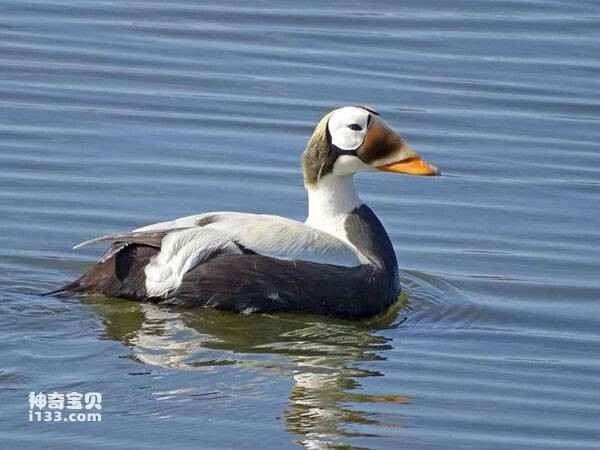
Like other eider ducks, the Eider duck is native to the far north. It breeds on frozen coastlines and feeds year-round on invertebrates such as mollusks, worms, and crustaceans. It obtains most of its food from the seabed, so it prefers to swim in shallow waters along the continental margins.

Male ducks like to make cooing sounds like pigeons or kor-er-korkorr-kor, and sometimes they groan. Females make sounds like geese or ducks. They remain silent in winter.
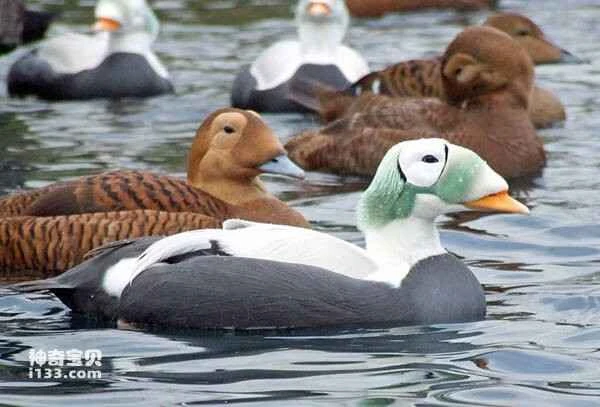
Every late summer, when the Arctic islands are surrounded by water, Eider ducks begin nesting and breeding. Nests are typically built under driftwood or a clump of seaweed for shelter from the wind. The female builds the nest base with abundant branches, leaves, grass, and seaweed, lining the inside with down. The nest is chosen in a secluded spot among rocks or vegetation. During the day, they forage at low tide, diving to depths of 10-18 meters, using their wings to paddle underwater and then flying straight out of the water. They can chew and crush the hard shells of seashells and their gizzards. A female Eider duck lays 5-9 eggs per clutch (average 5). Eggshell colors range from light olive oil, brownish olive oil, and greyish olive oil, and the eggs are 7.6 cm long. They are monogamous, with the female incubating the eggs for 21-28 days. During this time, the female rarely leaves her nesting area, focusing entirely on reproduction. After hatching, the ducklings, led by their mother, come to the seashore, where they play and dive into the water to forage for food. Typically, several families of eider ducklings will band together and live a communal life, much like a kindergarten. They begin to fly after 56 days, and by September, they are fully capable of taking flight, migrating westward to the Bering Sea and the Gulf of Alaska to overwinter.
Listed as Least Concern (LC) on the IUCN Red List of Threatened Species 2012 ver3.1.
Protect wild animals and ban the consumption of wild game.
Maintaining ecological balance is everyone's responsibility!