Basic Information
Scientific classification
- Chinese name: New Zealand diving duck
- Scientific name: Aythya novaeseelandiae, New Zealand Scaup
- Classification: Waterfowl
- Family and genus: Anseriformes, Anatidae, Duck (Duck)
Vital signs data
- Body length: Approximately 40 centimeters
- Weight: About 650g
- Lifespan: No verification data available.
Significant features
A duck that is an excellent swimmer and can dive to a depth of three meters.
Distribution and Habitat
Distributed throughout Australia and New Zealand, including Australia, New Zealand, Tasmania, and nearby islands. Scattered across New Zealand's North Island, more common along the shores of Lake Taupo and Lake Rotorua. More widely distributed in the South Island, including the western subalpine lakes.
They mainly inhabit open areas such as lakes, waters formed by hydroelectric power plants, ponds, and marshes rich in aquatic plants.
Appearance
The New Zealand Pochard is one of the smallest ducks, measuring about 40 cm in length and weighing 650 grams. It is quite distinctive; the male is blackish-purple with a greenish sheen on its head and body. Its wings are edged with white. Its eyes are bright yellow. The female has brownish-gray eyes. During the breeding season, white spots appear on its feathers and the tip of its bill. The New Zealand Pochard is the only true diving duck, capable of remaining underwater for up to 20 seconds. Its "proportionally large webbed feet" are more advantageous for underwater movement than other ducks, making it a very good swimmer and capable of diving to depths of up to three meters, but it is clumsy on land.
Detailed introduction
The New Zealand Scaup (scientific name: Aythya novaeseelandiae) is the smallest of the ducks.
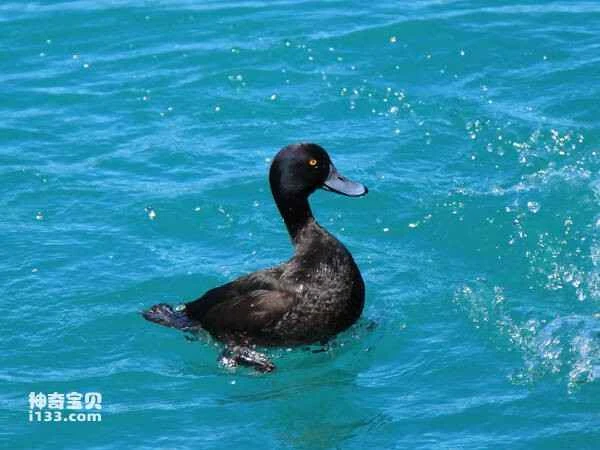
The New Zealand Pochard is an omnivorous duck, feeding on the bulbs, leaves, buds, shoots, and seeds of various aquatic plants. It also consumes animal matter such as crustaceans, mollusks, aquatic insects and their larvae, worms, frogs, and small fish. It typically forages in shallow, lush vegetation near the water's edge. A clean and diving duck, it can dive to depths of 2-3 meters. Its primary foraging method is diving, generally in shallow water, but sometimes it will dip its head or tail into the water near the edge to feed.
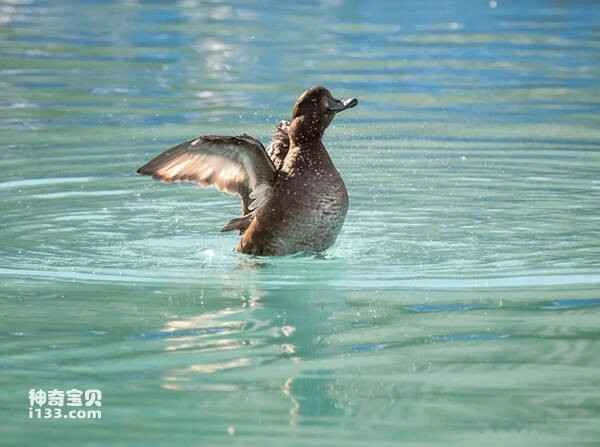
The New Zealand Pochard nests on the shore near water, with the nest and the incubating female completely covered and hidden by vegetation. The nest is lined with grass. Each nest contains 5 to 8 eggs, and the breeding season is from October to January. The female incubates the eggs alone for nearly 30 days.
BirdLife International estimated that the New Zealand Pochard population was between 5,000 and 10,000 by 2008.
Listed as Least Concern (LC) in the IUCN Red List of Threatened Species 2016 ver 3.1.
Protect wild animals and ban the consumption of wild game.
Maintaining ecological balance is everyone's responsibility!