Basic Information
Scientific classification
- Chinese name: Falkland Islands diving duck
- Scientific name: Madagascar Pochard, Aythya innotata
- Classification: Waterfowl
- Family and genus: Anseriformes, Anatidae, Duck (Duck)
Vital signs data
- Body length: 45-56 cm
- Weight: No verification information available.
- Lifespan: No verification data available.
Significant features
The male is entirely chestnut-black with a metallic sheen, while the female is pure brown.
Distribution and Habitat
The Madagascar pochard is found in the Madagascar archipelago and nearby islands. It is generally found in the northern and central highlands of Madagascar, mainly in Lake Alaotra and nearby lakes.
Appearance
The Madagascar pochard measures 45-56 cm in length and has a wingspan of 63-72 cm. The male is entirely dark chestnut-brown with reddish-brown wings and a white belly. The undertail coverts are white, while the wings extend with white stripes. The bill, legs, and feet are grey, and there is a distinct white ring around the eye. Outside the breeding season, the male's plumage becomes dull and lacks luster, with indistinct dark markings. The female is more brownish than the male and lacks the white eye ring. Ducklings resemble the female but are a lighter brown and lack the chestnut color.
Detailed introduction
The Madagascar Pochard (scientific name: Aythya innotata) is an animal belonging to the genus Aythya in the family Anatidae of the order Anseriformes.
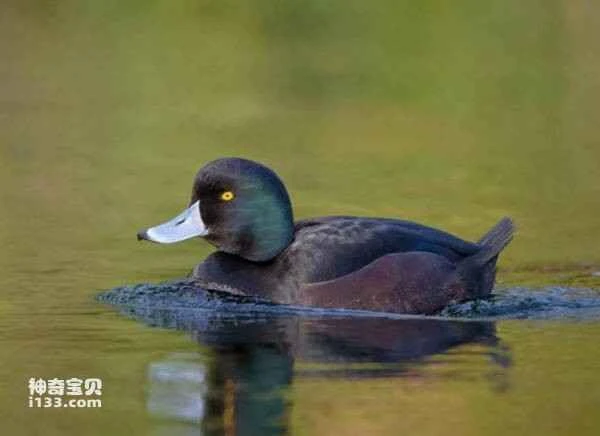
The Malayan Pochard typically inhabits freshwater lakes, marshes, open waters, and areas with dense vegetation around the islands. It is omnivorous, feeding on aquatic invertebrates and plant seeds in shallow waters. It often forages in shallow, lush vegetation near the water's edge. Foraging activity is mainly at dawn and dusk; during the day, it rests on the shore or floats on open water to sleep. It primarily forages by diving, usually in shallow water, sometimes dipping its head or tail into the water near the edge to feed.
The Malayan Pochard duck is usually found alone or in pairs, rarely forming flocks. Males have a strong territorial instinct, typically choosing nesting sites in lakeside vegetation. Nests are built from October to January, with 6 to 8 eggs laid per nest, and an incubation period of approximately 26 to 28 days. Ducklings have dark brown upper bodies and yellow underparts.

Lake Alautra, declared a Ramsar Wetland of international significance in 2003, has been the subject of ongoing efforts to protect and restore wildlife habitat, benefiting local threatened and endangered species. Enhanced conservation measures include education and awareness programs, participation in local community environmental monitoring, and continued searches for the remaining Máradus pochards. A reserve mechanism has been established, and hunting in the area is prohibited.
A survey conducted in July 2009 revealed that there were fewer than 20 adult Falkland's Pochards left on the island, including only 6 females. A team of experts launched a rescue mission, raising the ducks in captivity during the breeding season starting in 2009. The eggs have hatched successfully, and it is hoped that this will mark the start of a long-term artificial breeding and conservation program that will not only save the Falkland's Pochard from extinction but also help restore the wetlands in the area, protecting the interests of both wildlife and the people.
Listed as Critically Endangered (CR) in the IUCN Red List of Threatened Species 2016 ver 3.1.
Protect wild animals and ban the consumption of wild game.
Maintaining ecological balance is everyone's responsibility!