Basic Information
Scientific classification
- Chinese name: Shovel-billed Kingfisher
- Scientific name: Shovel-billed Kingfisher, Spoon-billed Kingfisher, Clytoceyx rex, Shovel-billed Kingfisher
- Classification: Climbing birds
- Classification and genus: Order Coraciiformes, Family Kingfisher, Genus Kingfisher
Vital signs data
- Body length: 31-34 cm
- Weight: 245-325g
- Lifespan: No verification data available.
Significant features
It is the only representative species of the kingfisher family in New Guinea.
Distribution and Habitat
It is distributed in the New Guinea Peninsula and Milne Bay, the eastern part of some Indonesian islands, Finistel and Owen Stanley Mountains.
They inhabit lowland rainforests and mountains up to 2400 meters in altitude. They are more widely distributed in hilly areas and plains. They live along waterways surrounded by forest valleys and ravines, and also in gardens where people live.
Appearance
The Shovel-billed Kingfisher is 31-34 cm in length, with females weighing 245-310 grams and males 247-325 grams. The male's head is decorated with many different colors: a dark brown crown, an orange collar with reddish tinges, orange nostrils, orange eyes, a white throat, and contrasting orange sides of the neck. The back is black, while the shoulder blades and wings are very dark brown. The tail is bright sky blue, contrasting sharply with the dark blue-brown underside. The underside of the wings, chest, wings, lower abdomen, and tail form a unified orange hue. The beak is very robust and powerful, with a dark brown jaw. The iris is dark brown, and the legs are yellowish-brown.
The female is similar to the male, except that her tail is reddish-brown. Juveniles closely resemble females, but their plumage is darker. The feathers on the neck and chest have dark brown borders.
The beak is thick, straight, long, and strong, with a rounded ridge; the nasal groove is indistinct; the wingtips are long, with the first primary flight feather slightly shorter and the third and fourth longest; the tail is short and rounded; the body plumage is bright and glossy, often with blue or green hues. The head is large, the neck short, the wings short and rounded, and the tail mostly short as well; the beak is large and pointed with a blunt culmen; the legs are very short, the toes slender and weak, the fourth toe mostly fused with the third, and only fused with the second toe at the base. The preen gland is covered with (unidentified feathers). Coracoid bones are present on both sides, and there are four notches on the posterior margin of the sternum; the manubrium of the sternum is simply formed by external spines.
Detailed introduction
The shovel-billed kingfisher, scientifically known as *Clytoceyx rex*, has two subspecies.
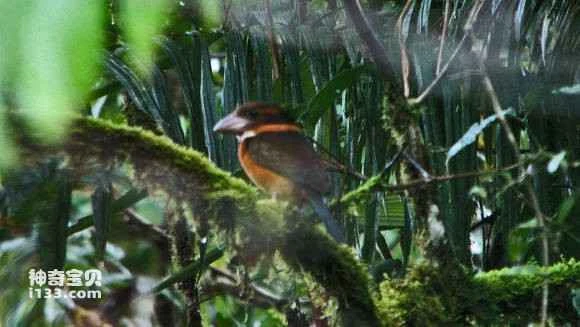
The Shovel-billed Kingfisher is a resident bird. It is usually solitary, generally perching on tree stumps and rocks along riverbanks, and sometimes on the low branches of small trees near the river. It often stares motionlessly at the water's surface for long periods, and upon spotting fish or shrimp, it immediately plunges into the water with extreme speed and ferocity to catch them with its beak. Sometimes it also hovers in the air, flapping its wings and looking down at the water's surface; upon spotting prey, it immediately dives in and quickly captures it. It usually carries its prey back to its roost, beats it on branches or rocks until the fish dies, and then swallows it whole. Sometimes it also flies low and straight along the water's surface at a very high speed, often calling as it flies. Its main diet consists of large earthworms, insects and their larvae, snails, and small lizards; there are also records of it preying on small snakes.
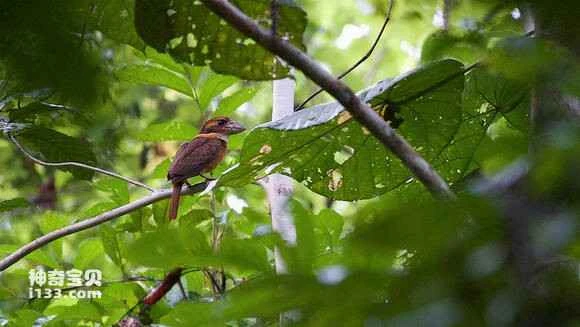
The shovel-billed kingfisher typically nests in tall trees, about 25 to 30 meters above the ground. It uses its beak to dig a very short burrow in the tree trunk, which it reuses for several years. They breed in October, laying two eggs at a time. The female raises the chicks, and after each feeding, she excretes with her tail pointing out of the nest.
Listed as Least Concern (LC) on the IUCN Red List of Threatened Species 2013 ver 3.1.
Protect wild animals and ban the consumption of wild game.
Maintaining ecological balance is everyone's responsibility!