
Basic Information
Scientific classification
- Chinese name: Sura Blue-eared Kingfisher
- Scientific name: Sulawesi Blue-eared Kingfisher, Cittura cyanotis, Sulawesi Blue-eared Kingfisher, Celebes flatbilled kingfishe
- Classification: Climbing birds
- Classification and genus: Order Coraciiformes, Family Kingfisher, Genus Kingfisher
Vital signs data
- Body length: Approximately 22 centimeters
- Weight: No verification information available.
- Lifespan: No verification data available.
Significant features
Very good at fishing
Distribution and Habitat
The Sulawesi Blue-eared Kingfisher is found only in the northern, eastern, and central parts of Sulawesi, in primary and secondary forests, regenerated forests, and at altitudes from sea level to 1000 meters. A subspecies (Cittura cyanotis sanghirensis) is found on the neighboring islands of San and Talau.
Appearance
The Sura Blue-eared Kingfisher is 22 cm in length. It has an olive-brown upperparts, a chestnut-colored tail, and a powerful red beak. Its eyebrows, throat, and chest are lilac-antelope skin-colored. It has wings that combine deep blue and black. A long white stripe runs across its shoulders. The lower chest displays a pale reddish-white. There are slight differences between males and females: the male's eyes have a deep blue quality, and the forewings are the same color. In the female, these same areas are black. Juveniles resemble adults, but more of their plumage and beak are dark greyish-brown.
The beak is thick, straight, long, and strong, with a rounded ridge; the nasal groove is indistinct; the wingtips are long, with the first primary flight feather being slightly shorter, and the third and fourth being the longest; the tail is short and rounded; the head is large, the neck is short, the wings are short and rounded, and the tail is also mostly short; the beak is large and pointed, with a blunt apex; the legs are very short, the toes are thin and weak, and the fourth toe is mostly fused with the third toe, and with the second toe...
The toes are joined only at the base. The preen gland is covered with feathers. There are coracoid bones on both sides, and there are four notches on the posterior border of the sternum. The manubrium of the sternum is simply formed by external spines.
Detailed introduction
The Sulawesi Blue-eared Kingfisher, scientifically known as *Cittura cyanotis*, also called *Sulawesi Blue-eared Kingfisher* or *Celebes flatbilled kingfishe*, has three subspecies.

The Sura Blue-eared Kingfisher is very timid and rarely seen. They quietly conceal themselves among adjacent branches and trunks, and at the base of vegetation, crouching low and remaining almost motionless for extended periods while prey comes ashore. Once they spot their target, they swoop down to capture it. Solitary by nature, they usually perch alone on branches or rocks near water, waiting to hunt. Their diet consists mainly of small fish, supplemented by crustaceans, various aquatic insects and their larvae, as well as small frogs and a small amount of aquatic plants. Kingfishers maintain excellent vision even when submerged, as their eyes can quickly adjust to the visual contrast caused by light underwater. Therefore, they are highly skilled at fishing.
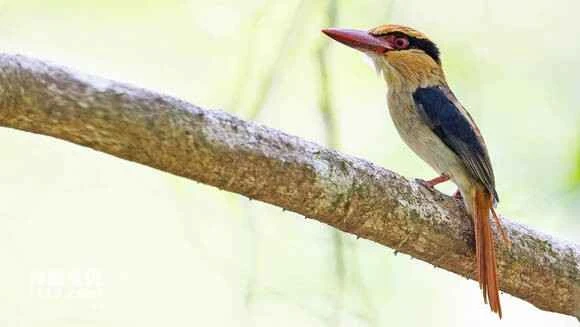
The call of the Sura Blue Kingfisher is like a cry. It consists of a series of three to four syllables that are quite shrill. It can be compared to the call of an eagle or a cuckoo, and is five or six times louder.

The nesting range, territorial extent, and behavior of the Sulawesi blue kingfisher are almost entirely unknown. However, like all other kingfishers that mainly inhabit Sulawesi (green-backed kingfisher and red kingfisher), it digs its nests on the dikes or roosts in trees.

Listed as Near Threatened on the IUCN Red List.

Protect wild animals and ban the consumption of wild game.
Maintaining ecological balance is everyone's responsibility!


