Basic Information
Scientific classification
- Chinese name: Australian hard-tailed duck
- Scientific name: Oxyura australis, Blue-billed Duck
- Classification: Waterfowl
- Family: Anseriformes, Anatidae, Hard-tailed duck
Vital signs data
- Body length: 35-44 cm
- Weight: 810-850g
- Lifespan: Approximately 16 years
Significant features
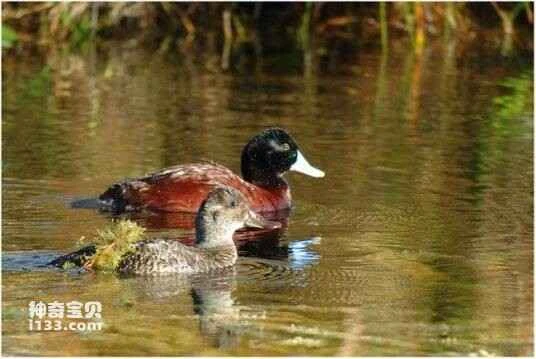
The male duck has a large, compact, and bright pale blue bill. Most of its body is covered in dark chestnut feathers, with a dark orange head and upper neck, a brown belly, and a white central area.
Distribution and Habitat
It is found in Australia and New Zealand, including Tasmania and its nearby islands.
They inhabit open, deep and freshwater lakes, dams, inland rivers, ponds, and swamps, and are almost entirely aquatic, rarely seen on land.
Appearance
The Australian Blue-billed Duck measures 35-44 cm in length with a wingspan of 60 cm. Males weigh 850 grams, and females weigh 810 grams. They have a lifespan of 16 years. They have pale reddish plumage and a black head. The male has a large, compact, bright pale blue bill, and most of its body is dark chestnut plumage, with a dark orange head and upper neck, a brown belly with a white central area. The tail feathers are stiffly erect and usually level with the water's surface. The female has darker plumage than the male, with each feather having a brown bill with narrow light brown stripes. The upper tail is black, and there are black spots on the chin and throat.
The male duck has a glossy black head and neck, and a deep chestnut color on its back and wings. Outside the breeding season, the smooth black head has grey spots, and the body changes from chestnut to dark grey. Some males retain their breeding plumage throughout the year. The female's plumage remains unchanged year-round. The head is dark brown, and the back and wings are covered in black feathers with light brown tips, giving them a mottled appearance.
Detailed introduction
The Blue-billed Duck (scientific name: Oxyura australis) has no subspecies.
The Australian Hardtail Duck breeds in quiet, densely vegetated areas, nesting in marshes on the water's edge, in bushes, or in grass, building sturdy floating nests made of reeds. The nests are typically lined with dried cattail leaves. They are polygynous, and the breeding season is from May to July. Each clutch contains 6-10 eggs. The incubation period is 25 days.
Listed as Near Threatened (NT) on the IUCN Red List of Threatened Species 2012 ver3.1.
Protect wild animals and ban the consumption of wild game.
Maintaining ecological balance is everyone's responsibility!