
Basic Information
Scientific classification
- Chinese name: Brown Hardtailed Duck
- Scientific name: Oxyura jamaicensis, Ruddy Duck
- Classification: Waterfowl
- Family: Anseriformes, Anatidae, Hard-tailed duck
Vital signs data
- Body length: 36-40 cm
- Weight: 560-590g
- Lifespan: No verification data available.
Significant features
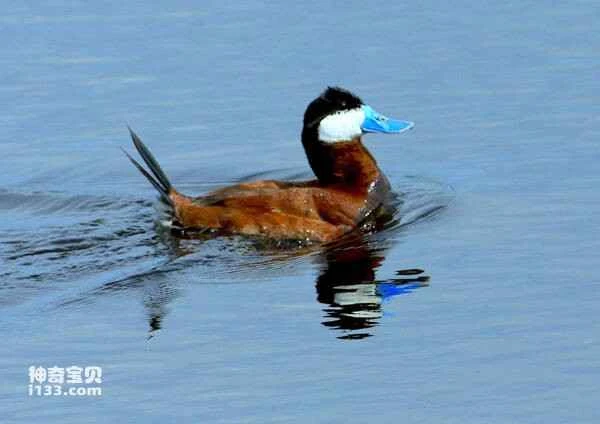
The male duck has a black cap extending from its eyes to the back of its neck, white cheeks year-round, bright reddish-brown feathers in summer, a white underparts, and a blue beak.
Distribution and Habitat
Distributed in Anguilla, Antigua and Barbuda, the Bahamas, Barbados, Bermuda, Bonaire, Saint Eustachians and Saba, Canada, the Cayman Islands, Cuba, Curaçao, the Dominican Republic, the Dominican Republic, El Salvador, Guatemala, Haiti, Honduras, Jamaica, Martinique, Mexico, Montserrat, Nicaragua, Puerto Rico, Saint Kitts and Nevis, Saint Lucia, Saint Vincent and the Grenadines, Saint Martin (Dutch part), Turks and Caicos Islands, and the Virgin Islands.
Imported from: Austria, Belgium, Denmark, France, Germany, Iceland, Ireland, Morocco, Netherlands, Norway, Portugal, Spain, Sweden, Switzerland, and the United Kingdom.
Migratory birds: Algeria, Finland, Grenada, Guadeloupe, Hungary, Israel, Italy, Saint Pierre and Miquelon, Slovenia, Tunisia, Turkey.
They breed in Canada and the northern United States during the summer. During the breeding season, they primarily inhabit freshwater lakes in open plains, particularly shallow lakes and ponds near larger lakes, especially those with riparian and emergent vegetation. They occasionally venture into saltwater lakes. In winter, they migrate to the southern United States to escape the cold. They prefer to inhabit large, open lakes, shallow bays, and saltwater swamps.
Appearance
The female Brown Hardtailed Duck has a dark brown head from the forehead and above the eyes to the nape, with brown feather tips. A white stripe runs from the base of the bill to the nape below the eye, with another black stripe below it. The cheeks, throat, and foreneck are buff-white with dark spots; the lower neck and most of the underparts are brown with dark subterminal spots. The central abdomen and undertail coverts are buff-white with dark spots. The lower back, rump, and uppertail coverts are greyish-brown with dark horizontal bars; the wings and tail resemble the male's. The female's winter plumage is darker and less brown, with whiter sides of the head and more prominent dark spots on the cheeks.
Juveniles and females have similar winter plumage, but the cheek patches on the head are more prominent, the sides of the head are whiter, the upper body is darker, and the underparts are more buff.
The male's iris is yellow or orange-yellow, while the female's is pale yellow. The male's bill is bright blue with an enlarged base; the female's bill is dark gray with a smaller enlarged base than the male's. The male's tarsi and toes are gray, with black or red webbed feet. The female's tarsi and toes are dark gray.
Size measurements: Weight 589 grams, body length 36-41 cm, wingspan 53-61 cm.
Detailed introduction
The Ruddy Duck (scientific name: Oxyura jamaicensis) has three subspecies.

The swimming, diving, and flying postures of the Brown Hardtailed Duck are more like those of a grebe compared to other ducks. It generally does not stay on land and rarely flies. It can sleep in rough seas. It lives in flocks mixed with other ducks and is adept at swimming and diving. When swimming, it often raises its tail high. When taking off from the water, it often skims the surface for a considerable distance before leaving it.
Listed as Least Concern (LC) on the IUCN Red List of Threatened Species 2012 ver3.1.
Protect wild animals and ban the consumption of wild game.
Maintaining ecological balance is everyone's responsibility!


