Basic Information
Scientific classification
- Chinese name: African hard-tailed duck
- Scientific name: Oxyura maccoa, Maccoa Duck
- Classification: Waterfowl
- Family: Anseriformes, Anatidae, Hard-tailed duck
Vital signs data
- Body length: 48-51 cm
- Weight: 450-820g
- Lifespan: No verification data available.
Significant features
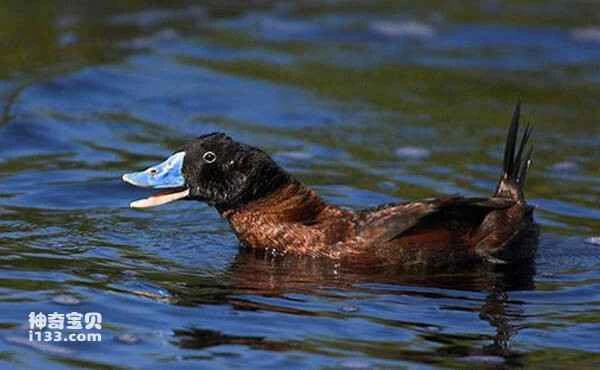
The male duck has a black head, brown eyes, a blue beak, a black throat, a chestnut-colored back, and grey legs.
Distribution and Habitat
It is distributed in Botswana, Eritrea, Democratic Republic of Congo, Ethiopia, Kenya, Lesotho, Namibia, Rwanda, South Africa, Sudan, United Republic of Tanzania, Uganda, Zimbabwe, Angola, Burundi, Malawi, and Swaziland.
They inhabit wetlands, riverside areas, lakes, ponds, swamps, and other similar locations.
Appearance
The African hard-tailed duck measures 48-51 cm in length and weighs 450-820 g. Males and females have different plumage. The male has a black head, brown eyes, a blue bill, a black throat, a chestnut back, and grey legs. The female has a greyish-brown body, a dark grey bill, a dark brown comb, and stripes on the back of the neck and cheeks. The legs are typically of uniform length.
Detailed introduction
The African hard-tailed duck (scientific name: Oxyura maccoa), also known as the Maccoa Duck, is a very typical gregarious duck belonging to the Anatidae family.
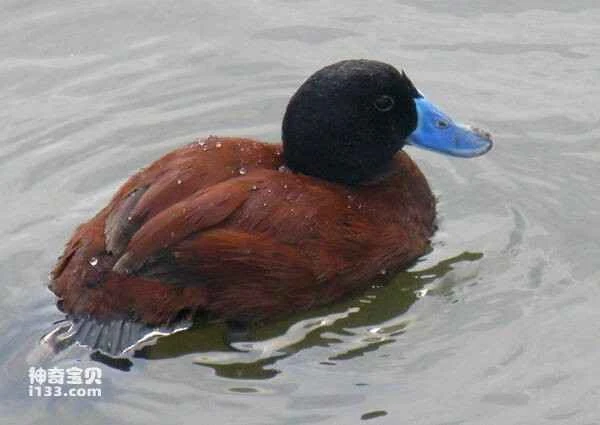
The African hard-tailed duck lives in flocks mixed with other duck species and is an excellent swimmer and diver. It is extremely wary of humans and will take flight at the slightest disturbance. While swimming, it typically stays submerged for only 3-5 minutes. When swimming, it often raises its tail high. When taking off from the water, it often skims the surface for a considerable distance before leaving it. It generally does not live on land and rarely flies. It rarely makes calls. It feeds on aquatic plants, but also eats insects, fish, frogs, crustaceans, mollusks, and worms.
African hard-tailed ducks typically have more than one breeding mate, and the breeding season is from May to July. They nest in floating nests among shrubs or grasses near water. Each clutch contains 4-8 blue eggs. The incubation period is 25 days.
Listed as Near Threatened (NT) in the IUCN Red List of Threatened Species, 2009 ver 3.1.
Protect wild animals and ban the consumption of wild game.
Maintaining ecological balance is everyone's responsibility!