Basic Information
Scientific classification
- Chinese name: Green-bellied Hummingbird
- Scientific name: Lepidopyga lilliae, Sapphire-bellied Hummingbird
- Classification: Climbing birds
- Family and genus: Apodiformes, Hummingbird family, Blue-bellied Hummingbird
Vital signs data
- Body length: No verification information available.
- Weight: No verification information available.
- Lifespan: No verification data available.
Significant features
Distribution and Habitat
Distributed in South America (including Colombia, Venezuela, Guyana, Suriname, Ecuador, Peru, Bolivia, Paraguay, Brazil, Chile, Argentina, Uruguay, and the Falkland Islands).
The blue-bellied hummingbird is an arboreal animal, mostly living in trees. Therefore, most of its nests are built on branches, in caves in the mountains, or in tree cavities. A small number of blue-bellied hummingbirds will also choose to build their nests on leaves. To secure the nest, they will use spider silk to wrap it around the branch, connecting the branch to the nest, thus making it stable.
Appearance
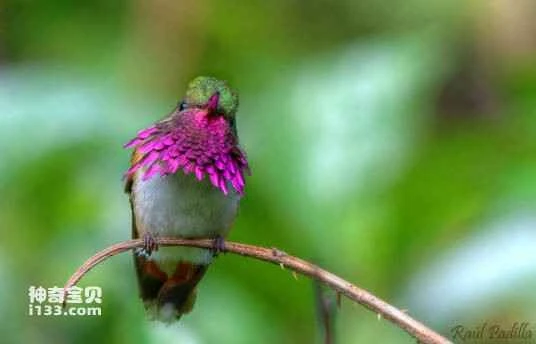
The Blue-bellied Hummingbird is one of the most beautiful types of hummingbirds, almost the epitome of beauty. Its feathers are incredibly colorful and glossy, appearing to glow in the sunlight. The head is covered in fine, hair-like feathers that shimmer with a bright metallic sheen, while the neck is adorned with feathers of various colors. Even the feathers on its legs are remarkably fine, neatly arranged, and shimmering.
Detailed introduction
The Sapphire-bellied Hummingbird, scientifically known as *Lepidopyga lilliae*, has unknown habits.
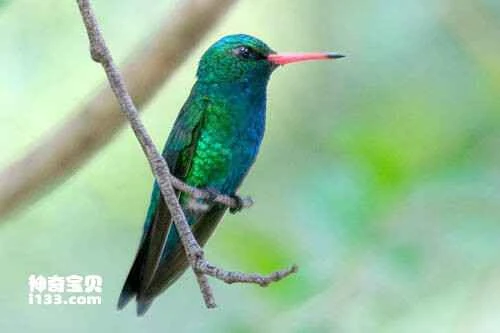
Green-bellied hummingbirds primarily feed on fruit. Due to their small size, few small spiders or insects can be defeated by them. Therefore, they tend to collect the carcasses of small insects rather than actively attacking them.
The nests of the blue-bellied hummingbird are mostly slender, small, cup-shaped structures that hang from horizontal branches; some nest in caves, while others are woven nests, suspended from rock surfaces or large leaves (such as palm or tree fern leaves) by spider silk.
South America has already developed an awareness of protecting the blue-bellied hummingbird. In order to prevent the blue-bellied hummingbird's habitat from shrinking further, the people of South America have decisively adopted a policy of returning farmland to forest, hoping to increase the reproduction of the blue-bellied hummingbird by protecting its habitat.
Conservation status: Endangered (EN). Listed in the Endangered Species List.
Protect wild animals and ban the consumption of wild game.
Maintaining ecological balance is everyone's responsibility!