Basic Information
Scientific classification
- Chinese name: Horned Duck
- Scientific name: Anhima cornuta, Horned Screamer
- Classification: Waterfowl
- Family and genus: Anseriformes, Anatidae, Diaper genus
Vital signs data
- Body length: 84-99 cm
- Weight: 3-3.15kg
- Lifespan: Approximately 15 years
Significant features
It gets its name from the sharp cry it makes when flying or walking.
Distribution and Habitat
It is distributed in Bolivia, Brazil, Colombia, Ecuador, French Guiana, Guyana, Paraguay, Peru, Suriname, Venezuela, and the Bolivarian Republic.
Possibly extinct: Trinidad and Tobago.
They inhabit the tops of bushes near ponds. They are frequently found in rainforests, swamps, and grasslands near rivers. These birds are endemic to South America. Their distribution is extensive, extending from Colombia to the Andes Mountains in northern Argentina. This species is primarily found at low altitudes, although it can reach altitudes of up to 1000 meters in the Cauca Valley of Colombia.
Appearance
The Horned Duck is the largest species in the Anatidae family, measuring 84-99 cm in length, with a wingspan of 170 cm, a weight of 3000-3150 grams, and a lifespan of 15 years. It swims much like a goose. It has a short, slightly curved bill, powerful legs, and concave claws. The Horned Duck appears very large, with its head relatively small compared to its body. Long, black feathers form a flowing horn-like shape on its head. Its plumage is predominantly blackish-green, with white spots on its head and neck. Large, silvery-white spots cover its broad shoulders, especially visible in flight. The underparts, abdomen, and legs are pure white, with the legs leading in green. Juveniles have duller plumage than adults, and the leading horn-like feathers are shorter.
The internal structure of the call duck resembles that of the Anseriformes, but its appearance is quite different from other Anseriformes birds. Its beak is like a chicken's beak, its toes are slightly webbed, and its wings have pointed spurs.
Detailed introduction
Horned Screamer (scientific name: Anhima cornuta) has no subspecies.
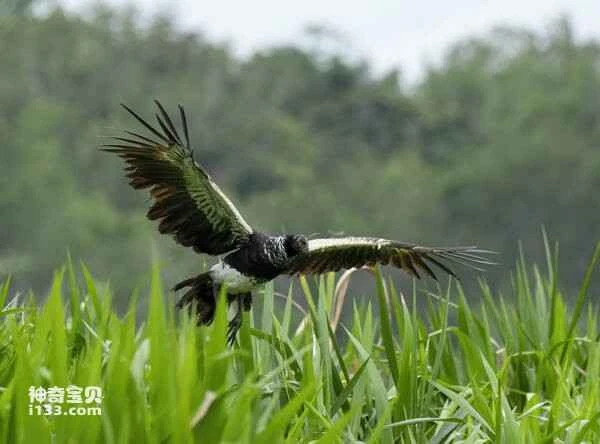
In dangerous situations, the horned duck can quickly fly to the top of a tall tree where it lives. They are resident birds, making only short flights. Primarily herbivorous, they eat leaves, stems, flowers, and plants, generally focusing on the softest parts of the roots. They also consume insects and eat grass in the same way as geese. The horned duck is a noisy bird; its calls can be heard from 3 kilometers away. Its call is transcribed as: "quuk-quoo, quuk-quoo, Yoik, Yoik." It has a guttural quality.
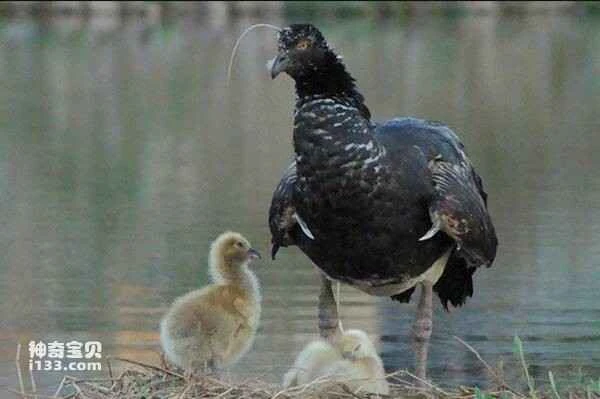
The Horned Duck can breed year-round, primarily in spring and summer. In the southernmost part of South America, its egg-laying season is from November to December. During the breeding season, they fiercely defend their territory, building nests from plant material and debris. They nest in shallow water and/or in grassy areas along the water's edge. Each clutch contains 3 to 5 brown eggs, which are incubated by both parents for approximately 40 to 47 days. The chicks hatch with yellowish-grey down, and their plumage fully develops in 8 to 10 weeks, but they become completely independent after about a month.
Listed as Least Concern (LC) on the IUCN Red List of Threatened Species 2012 ver 3.1.
Protect wild animals and ban the consumption of wild game.
Maintaining ecological balance is everyone's responsibility!