
Basic Information
Scientific classification
- Chinese name: Moluccan Three-Toed Kingfisher
- Scientific name: Variable Kingfisher (Ceyx lepidus)
- Classification: Climbing birds
- Genus and species: Order Coraciiformes, Family Kingfisher, Genus *Tripterygium*
Vital signs data
- Body length: Approximately 14 centimeters
- Weight: 11-24g
- Lifespan: No verification data available.
Significant features
Distribution and Habitat
The Moluccan Three-Toed Kingfisher is distributed across the Pacific islands (including Taiwan, the Dongsha Islands, Xisha Islands, Zhongsha Islands, Nansha Islands, as well as the Philippines, Brunei, Malaysia, Singapore, Sumatra and Java in Indonesia, and Papua New Guinea), east of the Wallace Line (the area east of the traditional Wallace Line (from the eastern waters of Mindanao through the Makassar Strait to Bali and Lombok) and west of Papua New Guinea, including Sulawesi, Nusa Tenggara, the Southwest Islands, the Moluccas (Maluku Islands), and East Timor in Indonesia).
They live in tropical rainforests, monsoon secondary forests, and the middle and lower reaches of rivers, far from densely vegetated areas. This does not prevent them from swimming in forest streams. They are distributed from sea level to altitudes of 1300 meters.
Appearance
The Moluccan Three-Toed Kingfisher is 14 cm long, with males weighing 11-21g and females weighing 13-24g. They are similar in appearance. Adults have an orange head with black spots. The forehead, crown, cheeks, and back of the neck are blue with a black sheen, and each feather is bright blue. There is a bright white triangular area on the neck. The cape, shoulders, and wings are bluish-black, and there is a bright blue cap on the head. The back and tail are bright blue. The chin and throat are white or slightly yellow, and the entire underside and wing spreads are bright orange. The orange-yellow breast has small dark blue spots. The beak is red, and the iris is dark brown. The legs are yellow-orange with only 3 toes. The blue of the juveniles is slightly lighter and darker. The base of the beak is orange. [1]
The tail is shorter than the beak; the wings are pointed and long; the plumage is not black and white. The beak is thick, straight, long and strong, with a rounded ridge; the nasal groove is not prominent; the wingtips are long, with the first primary flight feather being slightly shorter and the third and fourth feathers being the longest; the tail is short and rounded; the body plumage is bright and glossy, often with blue or green.
Detailed introduction
The Moluccan three-toed kingfisher, scientifically known as *Ceyx lepidus*, also called the Variable Kingfisher or Moluccan dwarf kingfisher, has 14 subspecies.

The Moluccan Three-Toed Kingfisher is solitary and timid by nature. Its wings beat rapidly and gracefully when hunting, but its hunting skills are relatively low. It enjoys playing in the water and bathes several times a day, diving into the water to soak its feathers. It is a small kingfisher with very vibrant colors. It is entirely carnivorous, primarily feeding on insects, such as dragonflies and other insects.
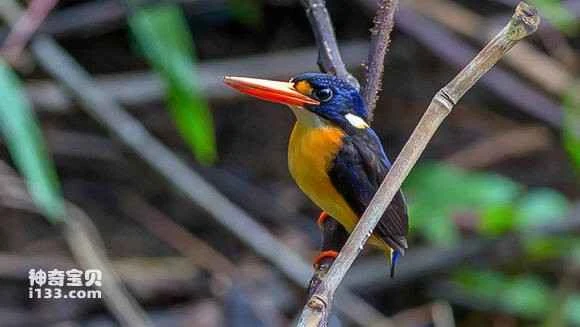
The breeding season for the Moluccan Three-toed Kingfisher varies by region: it lays eggs in New Guinea in November, and around September in New Britain and Bougainville. They nest in earthen cliffs or river embankments, digging tunnel-like burrows with their beaks, which are generally unlined. The female lays two eggs directly on the ground in the nest. Some also burrow into tree trunks to nest.
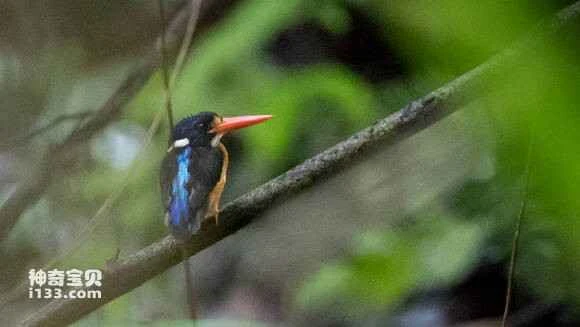
Listed in the IUCN Red List of Birds, ver 3.1: 2008.
Protect wild animals and ban the consumption of wild game.
Maintaining ecological balance is everyone's responsibility!


