Basic Information
Scientific classification
- Chinese name: Grey-faced Round-tailed Shepherd
- Scientific name: Pterodroma gouldi, Grey-faced Petrel
- Classification: Waterfowl
- Family and genus: Procellariiformes, Procellariiidae, *Rhynchus*
Vital signs data
- Body length: 38-40 cm
- Weight: 385-680g
- Lifespan: No verification data available.
Significant features
It is a relatively large seabird with dark plumage, long, pointed wings, and a wedge-shaped tail.
Distribution and Habitat
It is distributed in Australia, New Zealand, and Norfolk Island. It breeds in many communities around the northern part of New Zealand's North Island. Outside of the breeding season, it is scattered in the subtropical southwestern Pacific Ocean, mainly between 25 and 50 degrees south latitude, but some birds may also stray into the Antarctic region.
This marine species is highly pelagic, with a wide but sparse distribution at sea. They are one of the few burrowing seabirds still surviving on the New Zealand mainland. Small colonies are scattered around the coast of the upper North Island, mainly on coastal headlands and peninsulas. Breeding typically occurs below 400 meters in elevation. Nests are primarily in burrows under tall forest canopies, but can also be found in grassy or shrubbery areas, especially near cliffs above sea level. Sandy or loose soil is preferred, with little rock or tree roots.
Appearance
The Grey-faced Round-tailed Shearling is 38-40 cm long, weighs 385-680 g, and has a wingspan of 97-100 cm. It is a relatively large seabird with dark plumage, long, pointed wings, and a wedge-shaped tail. At sea, they soar swiftly and gracefully with their long, narrow wings. The species has long, narrow wings and a long, pointed tail. The entire body is a uniform dark brownish-black, but occasionally with lighter brown worn feathers. The base of the beak and throat are grey or pale yellow. It has a stout, short, powerful, black, sharp, hooked beak, 33-40 mm long. The eyes and legs are black.
Detailed introduction
The Grey-faced Petrel (scientific name: *Pterodroma gouldi*) has no subspecies. Prior to 1993, the Grey-faced Petrel (*P. gouldi del Hoyo and Collar* 2014) and the Giant-winged Petrel (*Pterodroma macroptera*) were classified as two separate subspecies under the name *Pterodroma macroptera*. In 2014, they were separated into two distinct species.
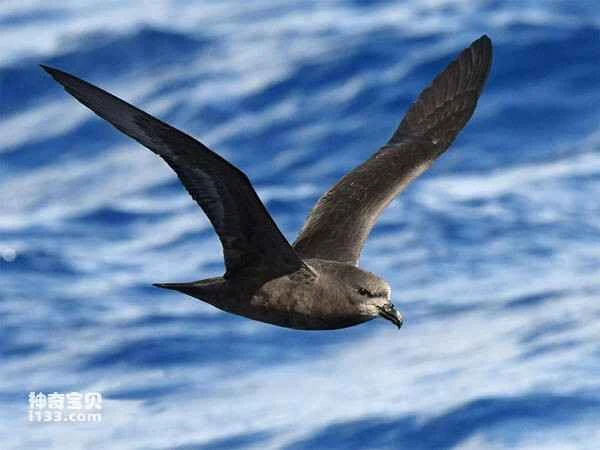
During the breeding season, the Grey-faced Roundtail Shearling primarily forages in the Tasman Sea or the waters east of New Zealand, near the edge of the continental shelf, or in deeper waters, ranging from thousands of kilometers. During summer molting, they are widely distributed across the Tasman Sea to the Australian coast, with some reaching the Coral Sea.
The Grey-faced Roundtail is nocturnal while at breeding grounds. Unlike other species of the same genus on the southern islands, they are very active in their colonies at night, calling and searching for burrows, as well as moving and sleeping on the shore. On damp nights, shore activity is more pronounced, but they return on windy nights under bright moonlight. A spectacular aerial courtship chase is a characteristic of this species, and breeding grounds can be very noisy during April-May and August. At sea, they fly rapidly to the edge of the continental shelf before beginning to forage. They can travel great distances in search of food, and have been recorded flying to the east coast of Australia while their mates are incubating eggs. After breeding, the Grey-faced Roundtail disperses primarily to the warmer waters of the Northern Tasman Sea or the southern and eastern waters of Australia.
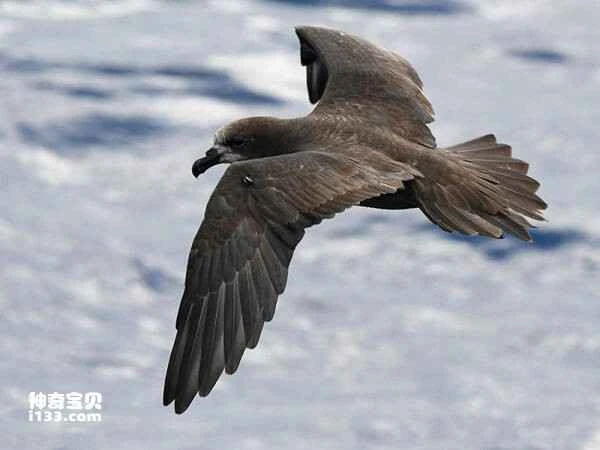
The Grey-faced Round-tailed Shearling has a wide diet, most commonly feeding on squid, but also eating crustaceans and fish. It hunts at night, but often anchors at sea during the day and may prey on other animals. It catches smaller squid alive at the surface, but larger squid are likely eaten when dead animals float to the surface. Studies of the species' diving ability indicate that they primarily forage at depths of 5 meters below the surface, but occasionally dive to depths of up to 20 meters. The nocturnal nature of its prey may be due to the prevalence of bioluminescence, suggesting this is a method of prey location for the bird. It occasionally appears after cetaceans and mixes with other shearlings. Its primary flight calls are high-pitched whistles (whi-her, wik-wik) or low moans (oor-wik). These identical calls are frequently heard on the ground or in burrows.
The Grey-faced Roundtail breeds in northern New Zealand, on islands, and some mainland headlands. These birds begin breeding in the dead of winter, but many chicks don't fully emerge until mid-summer. Some Maori tribes still exercise their right to hunt on the islands, harvesting Grey-faced Roundtail chicks between mid-November and mid-December each year. As predators on many breeding islands are eliminated, the Grey-faced Roundtail will regain its abundance.
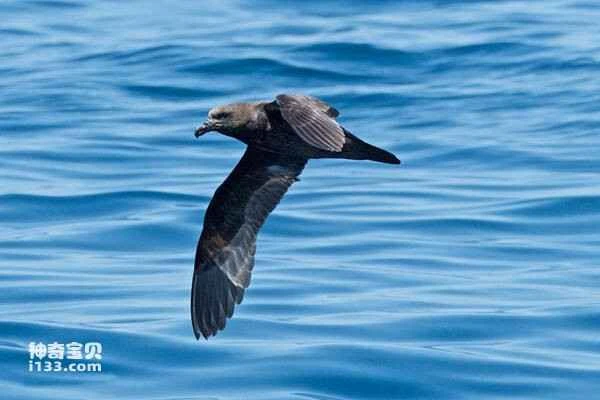
The breeding season for the Grey-faced Round-tailed Shearling is roughly from early March to January of the following year. They nest in loose colonies on ridges, slopes, or flat ground on ocean islands, using burrows that can be about 1.5 meters long. A single white egg, measuring 68 x 48 mm, is laid between mid-June and late July. The neatly arranged nest cells are located at the end of a long burrow dug into the soil or vegetation. The egg hatches in August or September, with an incubation period of about 55 days. The chicks develop feathers during the winter, from November to January of the following year, at approximately 118 days old. This species breeds once a year; very few pairs skip the breeding season. Both parents share incubation and chick care. The young birds' plumage is fully developed by late December. Immature chicks begin to return to the colony at age 3 and can breed as early as age 4, but most delay breeding until 8-10 years old.
Invasive mammalian predators are the primary threat to the Grey-faced Roundtail. Cats, Polynesian rats, brown rats, house mice, stoats, and pigs are all thought to cause population decline by raiding nests and reducing reproductive success; cats also prey on adult birds. Eradication efforts have been undertaken to reduce the numbers of cats and Polynesian rats. Removal of each species from breeding islands has resulted in an increase in the Grey-faced Roundtail population (Greene et al., 2015). Cats remain on one breeding island and are distributed across the continent outside the fenced area, while Polynesian rats remain in certain areas of their range. Brown rats and house mice remain on nine and fourteen breeding islands, respectively. The species is still legally fished on some offshore islands in the Bay of Plenty and the Hauraki Gulf; however, efforts have been made to ensure that current harvests are sustainable (Greene et al., 2015).
Listed as Least Concern (LC) in the IUCN Red List of Threatened Species 2018 ver3.1.
Protect wild animals and ban the consumption of wild game.
Maintaining ecological balance is everyone's responsibility!