
Basic Information
Scientific classification
- Chinese name: Hook-billed Round-tailed Shepherd
- Scientific name: Black-backed White-bellied Burrower, Tahitian Petrel, *Pterodroma rostrata*, Tahiti Petrel
- Classification: Waterfowl
- Family and genus: Procellariiformes, Procellariiidae, *Rhynchus*
Vital signs data
- Body length: 38-40 cm
- Weight: 410-520g
- Lifespan: No verification data available.
Significant features
The upper body is dark brown, the lower body from the chin and throat to the front of the neck is grayish-black, and the area below the chest is white.
Distribution and Habitat
Origin: American Samoa, Australia, Fiji, French Polynesia, Guam, Federated States of Micronesia, New Caledonia.
Regional extinction: Vanuatu.
Migratory birds: Mexico, New Zealand, Solomon Islands.
Sources uncertain: Chile, Colombia, Cook Islands, Costa Rica, Ecuador, El Salvador, French Southern Territories, Guatemala, Indonesia, Japan, Kiribati, Marshall Islands, Nauru, Nicaragua, Niue, Norfolk Island, Northern Mariana Islands, Palau, Panama, Papua New Guinea, Peru, Philippines, Pitcairn, Samoa, Tokelau, Tonga, Tuvalu, Outer Islands of the United States, Wallis and Futuna Islands.
The Hook-billed Round-tailed Shearling is a typical marine bird, inhabiting temperate oceans. During the breeding season, it inhabits the coast and coastal islands and the surrounding waters, while outside the breeding season, it lives entirely at sea.
Appearance
The Hook-billed Round-tailed Shearling is a medium-sized seabird, measuring 38-40 cm in length, with a wingspan of 84 cm and a weight of 410-520 grams. It has a relatively short bill, with the upper mandible curved into a hook at the tip. The nasal tube is short, located at the base of the bill's midline. The wings are pointed and long. It has a rounded tail. The forehead, crown, nape, and tail are blackish-brown. The chin, throat, and foreneck are blackish-grey, while the rest of the underparts are white. The underwing margins are blackish-brown, and the underwing coverts are blackish-brown with greyish-white tips, forming a pale line under the black wings. The bill is black, and the tarsi are flesh-colored.
Compared to similar species, the round-tailed shelduck, its upper body plumage is paler, appearing mouse-grey, while its underparts are entirely white. It lacks black on its chin, throat, and foreneck, and its underwings are white with fine, oblique black spots.
Detailed introduction
The Hook-billed Round-tailed Shearling (scientific name: Pterodroma rostrata), also known as the Tahiti Petrel, is a medium-sized seabird belonging to the family Procellariidae in the order Procellariiformes. It has three subspecies.
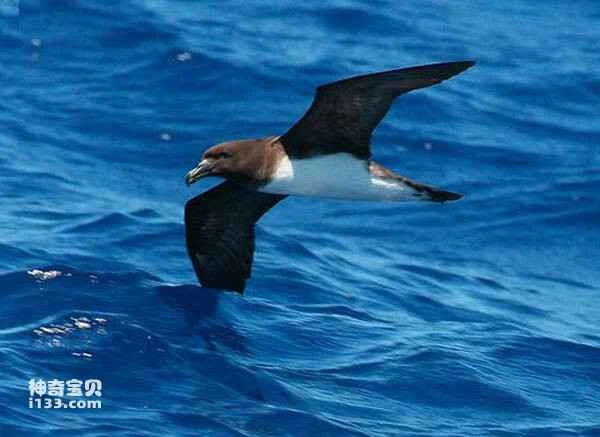
Hook-billed round-tailed shelducks typically live in flocks over the ocean, active at night except during the breeding season. They are excellent fliers, capable of both flapping their wings and gliding for extended periods over the ocean. They can also perform sharp descents from the air. Flying and soaring over the sea, they rarely follow ships and are therefore less easily spotted. Their diet consists mainly of small fish, shrimp, and zooplankton. They are resident birds and generally do not migrate. They are usually silent at sea.
Hook-billed Round-tailed Shearlings nest solitarily or loosely in their breeding grounds, where they are strictly nocturnal. Breeding is believed to occur year-round, but peaks may occur depending on location. They place a single egg in a cave or rock crevic, with an incubation period of approximately 55 days, and chicks reach maturity in about 110-120 days. In some areas, Hook-billed Round-tailed Shearlings face competition for nesting space from Drifttail Shearlings.
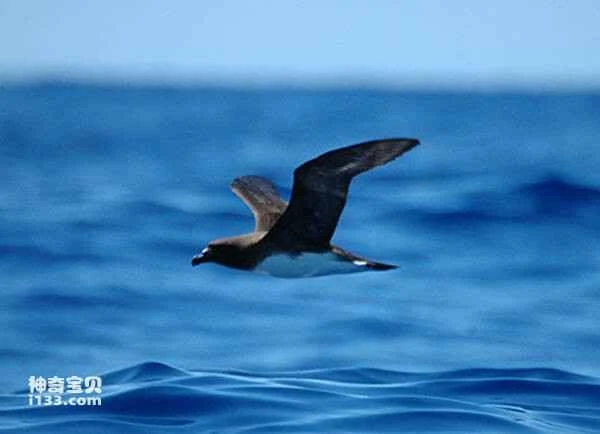
In the Marquesas and Society Islands, the Hook-billed Round-tailed Shearling is an observed but unquantified species. It may coexist with black rats for decades but does not pose a significant threat to the species (2003). Young birds are attracted to nighttime lights, primarily in the urban areas around Papeete in Tahiti and in New Caledonia around Nouméa, in rural areas and active mining sites. Power lines in the mountains of French Polynesia also have an impact. On Grand Terre, black rats may pose a threat to the remaining breeding grounds (although rats have been eradicated from all the islands in the southern lagoon). Wild cats are most likely to affect the population living on Grand Terre, as they prey on adults (adult mortality has a stronger statistical impact on chick numbers than on chick mortality), and the Hook-billed Round-tailed Shearling was found in 1–8% of cat droppings (n = 4166), with surveys conducted at 5 of 9 sites. Dogs and, in particular, pigs, are known to dig adults or chicks from burrows. Deer may also pose a threat to breeding grounds and chicks. The newly discovered sites in New Caledonia are all in areas threatened by nickel mining (2008). The contaminated soil is deep enough to affect the nesting and breeding grounds of the hook-billed roundtail warbler and may also lead to fierce competition for burrows (2006). Locals use the bird's white feathers as bait for fish (1984).
In New Caledonia, a plan to reduce the impact of mining on the Koniambo region was proposed to the KNS Mining Association in 2006. On the same island, the Shanghai Cooperation Organisation (SCO) has initiated a campaign to collect and release birds disoriented by light. In June 2007, a marine cross-section from Nouméa to Chesterfield was established; repeated surveys along this line will be used to monitor long-term species trends. New Caledonia is conducting population censuses and bird population monitoring.
Listed as Near Threatened (NT) in the IUCN Red List of Threatened Species 2016 ver 3.1.
Protect wild animals and ban the consumption of wild game.
Maintaining ecological balance is everyone's responsibility!


